[](https://github.com/J3vb/OwnCord/actions/workflows/ci.yml)
[](https://github.com/J3vb/OwnCord/releases/latest)



[](LICENSE)
# OwnCord
A self-hosted chat app I build for me and my friends — text channels, voice and video, and a server you actually own.
> **Alpha, and a hobby project.**
> This is something I build for fun and run for a small group of friends. It isn't a product, it comes with no support commitment, and it isn't production-ready. Expect rough edges, rapid changes, and the occasional breaking change.
>
> Don't use it for anything sensitive.
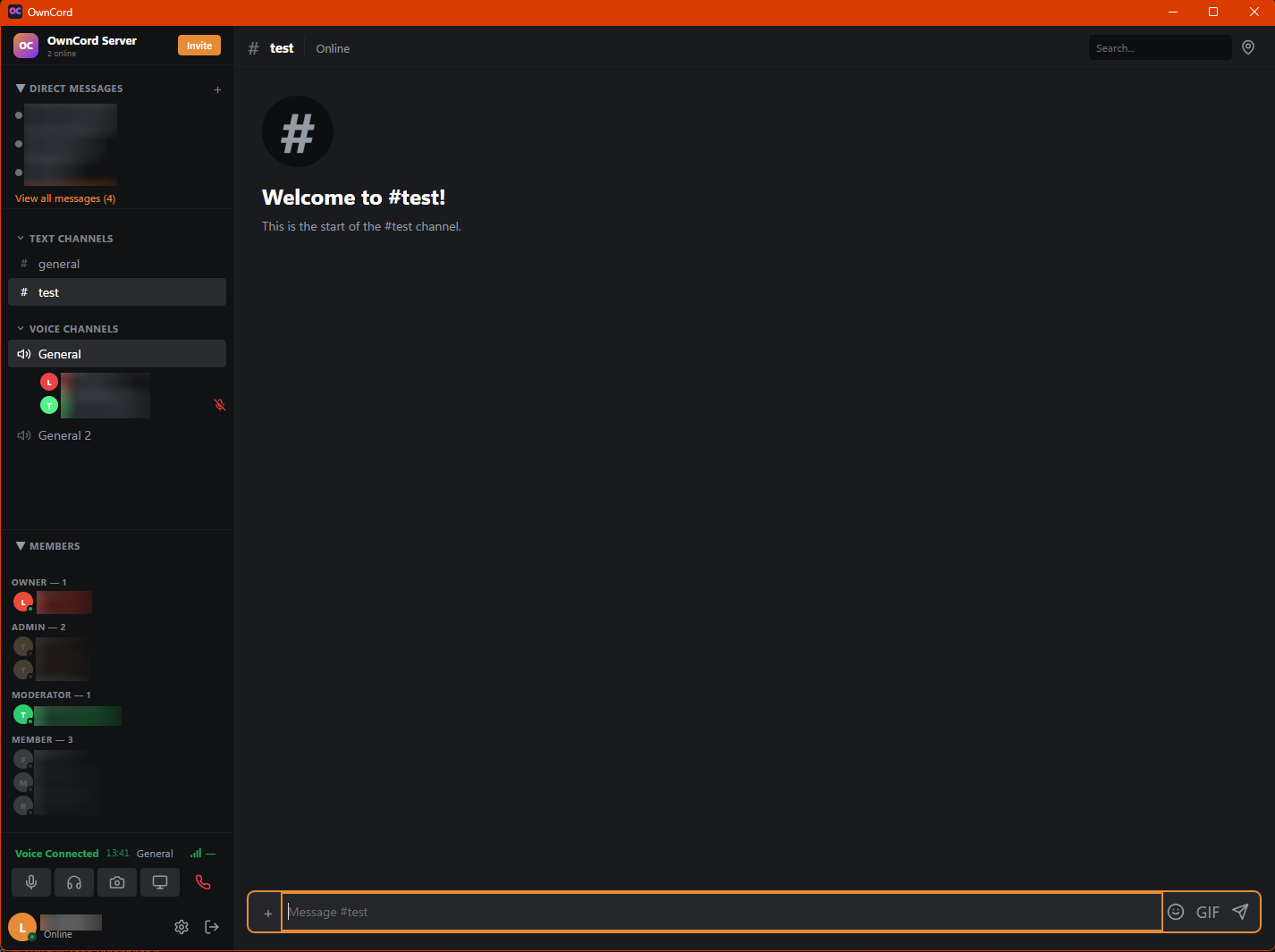
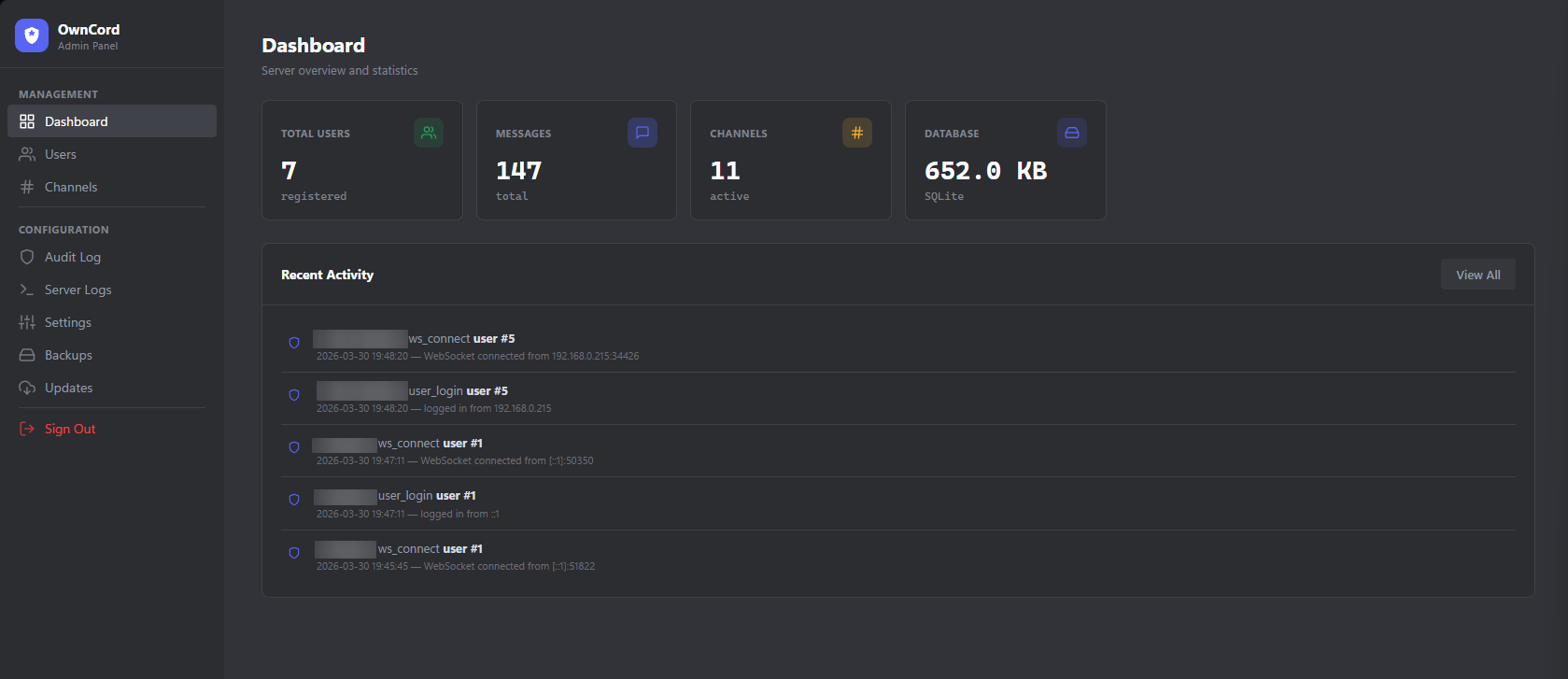
It's a Go server plus a Tauri desktop client: real-time messaging, voice/video via LiveKit, file sharing, and a web admin panel.
Run the server on a spare box or a VPS, hand your friends an invite code, and that's the whole thing.
## How it's built
Most of the implementation is generated with AI tooling, with quality held up by automated checks — CI, tests, linting — and by me and my friends actually using it.
That keeps iteration fast, and it also means behaviour can change quickly between releases.
## What works right now
| Area | Status |
| ------------------ | ------------------------------------------------------------------------------------------------------------------------------- |
| Core chat flow | Working in alpha |
| Voice/video | Working in alpha |
| Admin panel | Working in alpha |
| Security hardening | Ongoing review passes; findings and their statuses are tracked in the dated audits in [docs/](docs/) (see the Docs Index below) |
## Platform Support (Current Releases)
| Component | Windows x64 | Linux x64 | Linux ARM64 |
| -------------- | -------------------- | --------------------------- | -------------------- |
| Server binary | Yes | Yes | Not yet |
| Desktop client | Yes (NSIS installer) | Yes (AppImage, .deb) | Yes (AppImage, .deb) |
| Docker server | N/A | Build from source (compose) | Not yet |
## Start Here
- New user quick path: [docs/quick-start.md](docs/quick-start.md)
- Linux Docker deployment: [docs/deployment.md](docs/deployment.md)
- Remote access without router config: [docs/tailscale.md](docs/tailscale.md)
- Manual router/network setup: [docs/port-forwarding.md](docs/port-forwarding.md)
## Quick Start
### Option A: Prebuilt binaries
1. Download assets from [Releases](https://github.com/J3vb/OwnCord/releases) (binaries, checksums, signatures, and a full source snapshot per release).
2. Run the server binary:
- Windows: `chatserver.exe`
- Linux: `./chatserver`
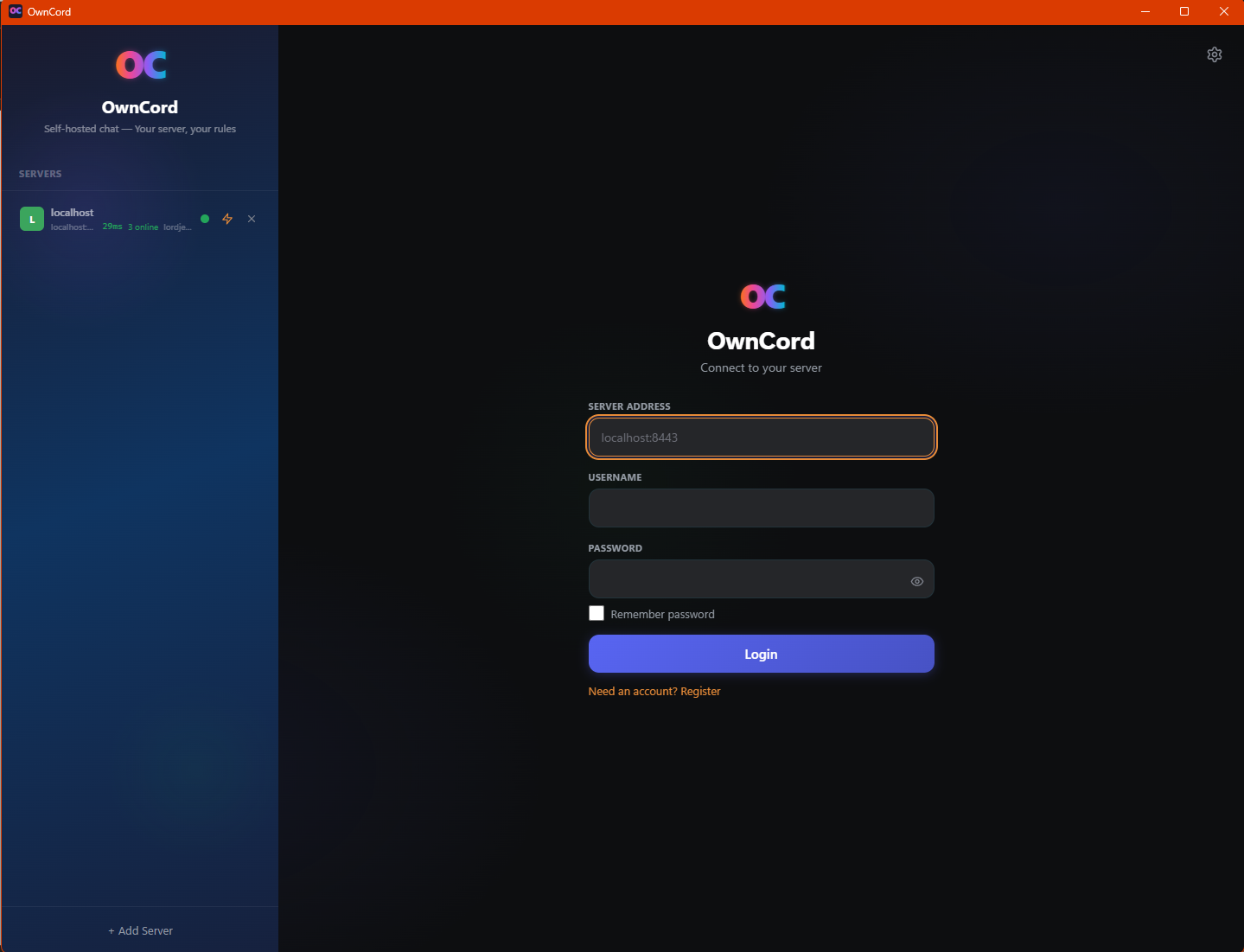
3. Open `https://localhost:8443/admin` and complete the setup wizard — it creates your Owner account and configures the server for you (settings are saved to `config.yaml` automatically).
4. Generate invite codes in the admin panel and share them with friends.
### Option B: Docker (Linux server)
```bash
cd Server
cp .env.example .env
cp livekit.yaml.example livekit.yaml
# Edit both files before starting
docker compose up -d
```
See the full setup guide in [docs/deployment.md](docs/deployment.md).
The client uses TOFU (Trust On First Use) for self-signed certificates: it prompts once, then pins the certificate for future connections.
## What OwnCord Already Has
- Real-time channels and direct messages over WebSocket
- Voice/video channels via LiveKit — the LiveKit server binary is downloaded and managed for you
- Invite-only registration and role-based permissions
- Web admin panel with logs, backups, and update tooling
- File uploads and inline media rendering
- TOTP 2FA support and API rate limiting
- Desktop client auto-update with signature verification
- WASM plugin system (slash commands; sandboxed, default-disabled — enable via
`plugins.enabled` and build with `-tags wazero`)
- GIF picker — off by default; each server supplies its own
[Klipy](https://partner.klipy.com) key via `gif.api_key`
([setup](docs/server-configuration.md#gif-picker-gif))
See deeper feature and architecture docs in [docs/architecture/](docs/architecture/README.md) and [docs/protocol.md](docs/protocol.md).
## Architecture
Two main components:
- Go server (REST API, WebSocket hub, SQLite, admin panel)
- Tauri v2 desktop client (Rust backend + TypeScript frontend)
```text
+---------------------+ +---------------------+
| OwnCord Client | | OwnCord Server |
| (Tauri v2) | | (Go) |
| | | |
| +---------------+ | WSS | +---------------+ |
| | Chat UI |--+------->| | WebSocket Hub| |
| +---------------+ | | +---------------+ |
| +---------------+ | HTTPS | +---------------+ |
| | REST Client |--+------->| | REST API | |
| +---------------+ | | +---------------+ |
| +---------------+ | LiveKit | +---------------+ |
| | Voice/Video |--+------->| | LiveKit SFU | |
| +---------------+ | | +---------------+ |
+---------------------+ | +---------------+ |
| | SQLite DB | |
| +---------------+ |
+---------------------+
```
## Build and Test
### Prerequisites
- Go 1.26+
- Node.js 24+ (see `Client/.nvmrc`)
- Rust stable (client builds)
### Build from source
```bash
# Server (Windows)
cd Server
go build -o chatserver.exe -ldflags "-s -w -X main.version=1.2.0-alpha.4" .
# Server (Linux)
cd Server
CGO_ENABLED=0 go build -o chatserver -ldflags "-s -w -X main.version=1.2.0-alpha.4" .
# Client
cd Client
npm install
npm run tauri build
```
### Core verification commands
Everything CI gates on, from the repository root:
```bash
npm run check # server + client + Rust
npm run check:server # or one stack at a time
node scripts/run.mjs --list # exactly what each task runs, and where
```
Or run the stacks directly — the facade is a convenience, not the only path,
and **server work needs no Node at all**:
```bash
# Server
cd Server
go test ./...
# Client
cd Client
npm run typecheck
npm run lint
npm test
```
For the full command set, use [docs/contributing.md](docs/contributing.md).
## Configuration
On first run, the server generates `config.yaml` and a local `data/` directory:
```text
data/
├── chatserver.db
├── certs/
├── uploads/
└── backups/
```
Key options include TLS mode, upload limits, LiveKit settings, and admin CIDR restrictions.
See [docs/server-configuration.md](docs/server-configuration.md).
## Security and Vulnerability Reporting
- For vulnerabilities, use GitHub Security Advisories (private disclosure flow).
- Do not open public issues for security bugs.
- Read full policy and hardening notes in [docs/security.md](docs/security.md).
## Update Signing Notes (Maintainers)
Client and server update signing keys are intentionally separate.
Required Actions secrets for release signing:
- `TAURI_SIGNING_PRIVATE_KEY`
- `TAURI_SIGNING_PRIVATE_KEY_PASSWORD`
- `SERVER_UPDATE_SIGNING_PRIVATE_KEY`
- `SERVER_UPDATE_SIGNING_PRIVATE_KEY_PASSWORD`
When rotating the server updater key, update [Server/updater/server_update_public_key.txt](Server/updater/server_update_public_key.txt) and use staged rollover for live fleets.
## Docs Index
**[docs/README.md](docs/README.md) is the complete index** — every document in
`docs/`, grouped by whether it is guidance, a reference contract, a dated audit,
or a plan. The most-used entries:
- [docs/quick-start.md](docs/quick-start.md) — get a server running
- [docs/deployment.md](docs/deployment.md) — production deployment
- [docs/contributing.md](docs/contributing.md) — setup, branch model, how to run the checks CI runs
- [docs/security.md](docs/security.md) — reporting a vulnerability
- [docs/architecture/](docs/architecture/README.md) — system blueprints (diagrams + flows)
- [docs/architecture/ux/](docs/architecture/ux/README.md) — client UX specification (target-state flows, per-view states, event→reaction maps)
- [docs/api.md](docs/api.md), [docs/protocol.md](docs/protocol.md), [docs/schema.md](docs/schema.md), [docs/server-configuration.md](docs/server-configuration.md) — reference contracts
- [docs/plans/README.md](docs/plans/README.md) — plan index; records each plan's state and is the authority over a plan's own header
Audits are dated snapshots and are not maintained after the fact — read them as
history. [docs/README.md](docs/README.md#audits--dated-not-maintained) lists all
nine, newest first.
## Contributing
1. Create a branch from `dev` (the active development branch).
2. Keep changes focused and tested.
3. Open a PR targeting `dev` — `dev` is merged to `main` for releases.
See [docs/contributing.md](docs/contributing.md) for the full process.
## Getting Help and Reporting Problems
Nothing here is a support promise — see the note at the top — but there is a
right place for each kind of message:
| Kind | Where |
| ------------------------------- | -------------------------------------------------------------------------------------------- |
| A reproducible bug | [Issues](https://github.com/J3vb/OwnCord/issues/new/choose) |
| A question about setup or usage | [Discussions → Q&A](https://github.com/J3vb/OwnCord/discussions/categories/q-a) |
| An idea or feature suggestion | [Discussions → Ideas](https://github.com/J3vb/OwnCord/discussions/categories/ideas) |
| A security vulnerability | [Private advisory](https://github.com/J3vb/OwnCord/security/advisories/new) — never an issue |
## License
AGPL-3.0