The toolbar's controls each carried their own ad-hoc .filter chain, and the
text box was a name-only sub-search blind to everything the app knows about
a file. Filtering now goes through one model and one pure pass
(fileFilters.ts): text, origin, types, category — a new facet extends the
model instead of adding another chain. The text filter reaches through
classification too: typing "user guide" or "finance" finds the files so
tagged, via a per-vocabulary index on the grouping seam (core, without
classification, matches names alone). Category filter state moves into
FilesPageContext beside its siblings, so the whole filter lives in one home.
The category dropdown also shows each family's own icon in its sidebar
accent, in the list and on the selected value.
The origin and category badges tinted into transparency, and they sit on
top of thumbnails — whatever the page happened to render underneath bled
through and made them illegible. The tints now mix into the surface colour
instead, so every badge carries a solid, theme-aware backer.
The card wears only the family icon(s) — the same identity as the sidebar
group and the files-page filter — with the labels named on hover rather than
each drawing its own icon. Label icons stand in only when no visible family
claims the labels (a hidden category), so a tagged file is never entirely
unmarked.
The badge showed only label-level icons, while the sidebar speaks in
categories — so a card tagged manual + user-guide gave no visual cue that
it lives under Operations. The file's categories (the families its labels
roll up into) now lead the badge, each wearing its family icon in the same
cycled accent as its sidebar group, with the labels' icons following. The
hover names the group first and the specifics after: 'Operations — Manual,
User guide'.
The categories existed everywhere except anywhere you could act on them: the
sidebar groups by them and cards wear their labels, but the files page had
no way to see "just the Finance documents". The toolbar now carries a
category filter beside the source and type filters, offering the same
visible families in the same order the sidebar groups by, and keeping the
files whose labels fall under the chosen family.
The options come through the grouping seam (useCategoryFilterOptions): core,
which has no classification, offers none and the dropdown never renders.
The category tag invented its own look — a generic tag glyph and the raw
label slug as text — when the classification vocabulary already gives every
label an icon and the sidebar already gives every category an accent colour.
The badge now wears exactly those: each label's own icon, tinted with the
accent its category cycles to in the sidebar (hidden-category labels wear
the Other group's neutral grey), no text, and the translated display names
on hover. Up to three icons show; a "+n" covers the rest.
The lookup lives on the grouping seam (useLabelBadges): core, which has no
classification, renders nothing; the proprietary override resolves icons
from the vocabulary and accents from the same visible-category order the
sidebar colours by, so a card's badge and its sidebar group read as one
colour.
A classified file's categories were invisible until you opened the details
panel or noticed which sidebar group it sat in. File cards and rows now
carry a category tag beside the origin badge — a tag glyph, the first
label, "+n" for the rest, every label on hover. Unclassified files show
nothing: absence of the tag is the "no category" state.
Disk-listed files get the same tag without ingesting anything: the lazy
thumbnail pass already holds the file's bytes, so it harvests the embedded
classification labels in the same read and caches them beside the
thumbnail. The Outputs section of a processing folder thereby shows what
each result was classified as, straight off the disk.
Opening a file from a mounted folder paid twice for work the listing had
already done. The listing's thumbnail cache and the workbench's hydration
pipeline live in different key spaces (path vs file id), so the same first
page was rasterised again on open; and the labels a processed file carries
in its own metadata were ignored, leaving it in "Other" until the sidebar's
idle backfill got around to re-reading the whole PDF minutes later.
The open path — and only the open path; ordinary uploads are untouched —
now hands the listing's cached thumbnail through a new precomputedThumbnails
add option. Hydration still parses the document (page count, rotations,
dimensions are still needed) but adopts the supplied image instead of
rendering: both variants when page one carries no rotation (the common
case, zero renders), just the display variant otherwise. And the labels are
read out of the bytes already in hand and stamped on the stub at add time,
so the file lands in its category instantly and the idle backfill skips it.
A mount with processing attached no longer opens onto a flat listing of its
originals — with the results landing in a separate directory the folder
looked untouched, and the one place named after the source showed exactly
the files that carry no categories. It now presents as a master folder of
three fixed sections: Inputs (the originals, read straight off the watched
directory, never changed), Outputs (the processed results, read off
whatever directory the record delivers to — today a subfolder, later
wherever an output picker points), and Processing (the runs executing right
now, polled live with each document's name and step cursor).
The sections are pure presentation: no stored folder backs them, the master
IS the existing mount record, and navigation rides a `section` URL query
the pathname sync already strips on any real folder change. The breadcrumb
grows a trailing section crumb, with the master's own crumb clearing the
section. Counts on the three cards come from the two directory listings and
the live runs poll.
PolicyRunView now carries the input document's display name (the trailing
segment of a path-shaped file identity) — a client showing live runs needs
something to call them before any output exists — and the processing-folder
hook exposes the record's output directory and an active-runs listing
through the same core/proprietary seam as the rest of its API.
sweepConcurrency's default rises to 6: the classification pipeline is
API-bound (one fast-model call per document, ~half a second), so it scales
nearly linearly with concurrency and 2 was the bottleneck — a 100-file sweep
drops from ~90s to ~30s while completions keep arriving steadily. The knob
stays for installs whose pipeline really is a heavyweight local engine.
The runs listing takes an optional policyId filter and delivery passes it:
following one sweep polls the endpoint every second, and the unfiltered
response re-serialized every other policy's runs each time, growing with
history. The client-side filter stays as a guard for backends that ignore
the parameter.
Delivery no longer selects what it opens: a selection isn't meaningful
across a folderful of results, and re-selecting on every batch re-rendered
the whole growing file list once a second for the length of the sweep.
A sweep fans out one run per file and dispatched all of them at once onto the
unbounded virtual-thread executor. Every run then converges on the pipeline's
slowest tool — on a desktop install, the local AI engine, which serves a
couple of requests at a time — so the whole folder sat "in progress" with
nothing visibly finishing until the end, then completed in clumps. Same total
time as pacing, with the worst possible feel.
Each sweep now carries an admission gate (policies.sweepConcurrency, default
2, 0 = unbounded): every run is still registered and reported to the caller
immediately, but only that many execute at once — parked runs sit honestly
pending on their virtual threads and start as slots free. Completions arrive
as a steady drip from the first file onward, which is also what feeds the
sweep-result delivery opening files into the workbench one after another.
The disk listing also orders a sweep smallest-file-first, so the first result
appears within seconds of approving rather than after the largest document in
the folder.
"Process files in this folder…" on a mounted folder was fire-and-forget: the
backend swept, results landed in the on-disk output subfolder, and the app
showed nothing — a finished job and an unchanged screen. The Downloads offer
already solved this (poll the sweep's runs, open each run's results as it
settles); that machinery now lives in one shared delivery module the wizard
renders progress from, and the folder menu's enable and sweep actions use for
every mounted folder. Storage-backed folders stay as they are — their results
replace files in place, already visible where the user is looking.
The sweep endpoint's client now returns the backend's outcome (run ids,
already-processed count), which is what tells delivery how many runs to wait
for instead of polling for runs that were never going to start.
Ledger integrity — track-mode settle now takes the content hash through the
same claim-gate guard the consume path uses: a file replaced mid-run settles
null instead of recording the replacement's bytes under the old gate (which
made the new content read as already-processed forever), and a file deleted
mid-run no longer throws out of the completion callback. The storage sweep
likewise survives one unreadable blob by skipping that file unclaimed rather
than aborting the whole folder on the hash supplier's exception.
Compose atomicity — the controller held the pair's "neither exists
half-configured" promise only for creates. A create against a place that
already has a processing folder now adopts the existing pair (same policy,
same ledger — so re-approving the Downloads offer sweeps only what is new
instead of composing a duplicate with an empty ledger that re-processes
everything), and a failed update validation restores the prior source instead
of leaving it mutated under an unchanged policy.
Folder placement — replaceFile itself now re-anchors the row's folder as a
fresh by-id reference before saving: the entity is often detached (runs
deliver on worker threads) and merging its dead folder proxy dropped the FK,
silently moving the file to the file-manager root. That retires the storage
sink's read-check-repair compensation (which raced concurrent moves) and
fixes the ordinary web update path, which had the same bug and no patch.
Portal isolation — a disk-backed processing folder's source shares its type
with real folder-watch sources, so the Sources overview now hides pair
sources by policy reference rather than type alone; they no longer surface as
zero-reference orphans an admin could pause out from under the editor.
Downloads offer — the local-folder mount only happens where this build can
actually read the directory, so a plain browser no longer bookmarks the
SERVER's Downloads path as a forever-empty folder; and the success copy now
matches the one-shot behaviour instead of promising a standing watch the
approve flow deliberately stands down.
Virtual folder engine — a scan's own deliveries bump the IndexedDB revision
the effect keys on; the re-fire now queues a follow-up pass instead of
cancelling the scan in flight, which stranded every file after the first
delivery until an unrelated write happened along.
Locales — en-GB restored to main (en-US is the only hand-edited locale) and
en-US re-sorted.
A disk-backed run's outputs live on the filesystem: FolderOutputSink hands
back a synthetic fileId (nothing serves it) with the output's absolute path
in fileName, so downloading them from the storage endpoint 404s and the
Downloads offer finished having opened nothing. fetchRunOutputFile now
recognises a path-shaped name and reads the file straight off the disk via
the local-folder read seam — which only a build that can see the filesystem
provides, and on desktop the server writing the output IS this machine. Web
builds keep the storage-id path for storage-backed runs and skip disk
outputs with a clear error instead of a misleading 404.
A virtual folder's files live only in this browser's IndexedDB, where no
server-side watcher can reach them — so their processing engine runs in the
client. The folder's pipeline config lives on its own record
(FolderRecord.processing, written via virtualFolderStorage.setProcessing),
and a headless loop under PolicyAutoRunController plays the watcher: it
scans enabled virtual folders on every IndexedDB revision, uploads each
unprocessed file through an ad-hoc pipeline run (the same engine stored
policies use), and delivers the output back as a new version of the input.
The child stub inherits the input's folderId, so results stay in the folder;
classification labels are read off the output PDF and stamped on the stub so
the sidebar groups it immediately. Each (folder, file) pair dispatches once,
through the shared dispatched-marker store, with derivedFromTool as the
durable guard against the loop eating its own outputs.
The engine splits on the AI toggle exactly as org-wide Classification does:
with the engine on, files run server-side through the pipeline; with it off,
the browser-side classifier covers them — virtual processing folders now
count toward its enabledFolderIds scope.
The folder menus offer processing on every kind. A virtual folder's engine is
continuous (arrivals process on their own), so its menu carries only stop —
an explicit "process now" would have nothing to do.
A processing folder is now an ordinary folder with a pipeline attached,
whatever its kind. The files page previously showed disk-backed processing
records as a synthesized "mounted" entry — a row with no folder behind it, no
menu, no way to remove it. That entry kind is gone; a directory-backed record
now attaches to the real mounted folder whose directory it watches, matched by
path, while server folders keep matching by storage folderId.
useProcessingFolders speaks folder records instead of bare ids: stateFor,
enable, disable, and sweep all take the FolderRecord and resolve the record
kind-appropriately. Id-only callers (the client-side classification loop) get
enabledFolderIds and anyEnabled instead of the raw map. Virtual folders
deliberately resolve to no state yet: their files live in the browser, so
their engine is client-driven and lands separately.
Mounted folders get the processing actions in their kebab (their other edit
items stay hidden — the directory owns name and lifetime), factored into one
ProcessingMenuItems shared by card and row. Removing a mount also deletes the
processing record watching its directory, which otherwise would keep running
against a folder the app no longer shows.
The Downloads offer now mounts the directory as a real local folder alongside
composing the processing record, so its results have a folder the user can
open, style, and remove like any other.
Virtual membership seam — the invariant "a local file has no folderId" was
relaxed on the way into a virtual folder but never on the way out, nor taught
to the server sync. Moving a local file to the root now clears its browser-
side membership (previously the move silently did nothing and the file was
stuck), and the reconcile keeps a stub's folderId when it points at a virtual
folder — the server has never heard of that folder, so its null is not an
opinion about the membership and must not eject the file on save-to-server.
Mount flows — the disk-listing effect's bail-out branch also stands the
loading flag down, so leaving a mount mid-listing no longer strands the
skeleton over every folder; the effect depends on the stable error setter
rather than the whole folder context, whose identity changes on every
mutation including this effect's own error reporting; and landing in a fresh
mount goes through the URL, which owns folder selection — setting state
directly raced the pathname→state effect and bounced the user back to root.
Appearance — the virtual branch forwards only the fields the picker sent;
always sending both meant the store's spread persisted an undefined over
whichever field the user did not touch.
Creation gating — the empty-state CTA and the sidebar rail say their kind out
loud (on this device) at the root instead of falling through to the context's
server-preferring default, which guaranteed a 401 for guests; inside a server
folder the New-folder button carries the server-side blockers again, since
the subfolder inherits kind server and would otherwise fail at submit; and
the rail's blanket reachability disable is kind-aware, so desktop's rail
action works at all.
IndexedDB — the runtime missing-store self-heal is gone. It left databases
permanently ahead of the configured version, where a future oldVersion-gated
migration silently never fires. The cure for two schemas shipped under v10 is
the honest one: v11 declares the full schema, and the ordinary upgrade path
completes any v10 profile.
Tree sidebar — mounted folders offer "Remove (files stay on disk)" like the
grid does, instead of a greyed Delete whose tooltip claimed removal was
impossible on the one surface still showing the folder.
Thumbnails — a disk file's bytes are only read when its extension names a
type the generator can render, and the thumbnail cache is bounded by bytes
rather than entry count, since an image thumbnail's size tracks its source.
Locales — en-GB is restored to main (en-US is the only hand-edited locale;
the rest are translated separately) and en-US re-sorted so the pre-commit
gate passes.
"Ask your admin to turn it on" told a desktop user to go ask an admin who
doesn't exist about a feature the install deliberately lacks. The caption now
just says what's true; what to do about it is the reader's business.
The split treated "on this device" as the main act and the other two
destinations as an afterthought behind a chevron — but the three are peers,
so every click now shows all of them. One button, chevron affordance built
in, three actions each with its caption.
The dialog-as-chooser read like a settings page: three radios with paragraph
descriptions under a title ("New folder") that one of the options — adding an
existing folder — made a lie of, and a body that rearranged itself when the
disk option swapped the name input for a picker.
The choice now lives where choices belong, on the button. Plain click does
the common thing (a folder on this device); the chevron offers each action
under its true name with its minimal flow. "Add folder from this computer"
goes straight to the native picker — no dialog, no typing, the directory's
name is the folder's name, and landing inside the fresh mount is the
confirmation. The server item, when unavailable, says why in its own caption.
The name dialog goes back to being a name dialog: one input, one job, a
title that's true. The kind is chosen before it opens and rides the dialog
state; a subfolder never asks, it inherits.
"On this device" is the distinction that matters, not which corner of it —
once something is in Stirling, browser-store versus mounted directory is an
implementation detail. So the separate On-disk badge is retired: virtual
folders, mounted folders, and disk-listed files all wear the same Local mark,
with tooltips still saying which flavour when someone cares.
The New-folder chooser now names what the user is doing rather than where an
implementation lives: "Add an existing folder" (point Stirling at one already
on this computer), "Create a folder on this device", "Create a folder on the
server". And a disabled server option explains itself in its own description
text instead of a hover-only tooltip — the reason is the one thing the user
needs, and hover-only text hides it (and never appears on touch).
The badge has carried a tooltip all along, but the card's origin overlay sets
pointer-events: none so the card's own clicks and drags pass through — which
also meant the badge could never receive a hover, so the tooltip never
opened. The overlay stays transparent; the badge inside catches pointer
events again. List rows were unaffected, their badges sit inline.
Adding the disk origin cloned the local case wholesale — same Computer icon,
same grey — and in compact mode the icon IS the badge, so a browser-only
folder and a mounted directory wore identical marks. Disk now gets its own
glyph and tint; the Computer icon stays meaning "this browser".
A folder row now answers "where does this live?" the way a file row already
did: server folders wear the Cloud badge, virtual folders the Local one, and
mounted folders On disk — same component, same corner of the card, same slot
beside the name in the list. The badge grew a tooltip override because its
default hover text describes files, and a folder wearing the identical mark
deserves wording about itself.
The filesystem hands back bytes and a name, never a MIME type — but
everything downstream branches on File.type: the thumbnail generator's PDF
path, the workbench's format handling. An untyped File silently took every
"unknown format" branch, so no disk-listed file could ever render a
thumbnail (and the failure was then cached as final). The type is now
recovered from the extension.
Same generator and the same two-at-a-time concurrency gate as stored files,
so a mounted folder's rows fill in progressively alongside everything else
instead of stampeding the disk — each render reads the file's full bytes,
which is also why results are cached by path + mtime + size (an unchanged
file never renders twice, an edited one does) with a bounded FIFO. A failed
or oversized render caches its emptiness too, so the same row doesn't retry
on every mount; the extension icon simply stays.
Disk-listed files now render as ordinary file cards and rows — same classes,
same layout, size · date meta, an extension fallback thumb — wearing an
"On disk" origin badge where stored files wear Local or Cloud, and their menu
action is named "Add to workspace" like everywhere else. The first cut used
its own second-class markup, which is exactly what it looked like.
The list view's sort headers now apply inside a mounted folder, and New
folder disables there with the reason ("this folder mirrors a directory on
disk — create subfolders in your file explorer") instead of offering a
dialog whose submit could only ever fail.
Opening a local folder now shows what the directory actually contains,
read fresh on every look — the directory is the source of truth, and
nothing is copied or ingested to produce the listing. The desktop build
reads it over the Tauri filesystem plugin (read-dir and stat join the
already-granted read-file permission); core reports the capability
absent, since a browser cannot see paths at all.
A listed file carries no stub and no storage row, so it offers none of
the stored-file actions — no select, move, rename, or delete. Its one
affordance is Open, which loads the bytes into the workbench: the only
moment anything leaves the disk, and only because the user asked to
work on it. Listing is capped at the 500 freshest files so a bulging
Downloads directory cannot drown the page; name search filters the
listing like anywhere else.
Once a database's version matches the config, onupgradeneeded never fires
again — so a store added to the config under an already-opened version number
is missing forever, and every transaction naming it throws "object store was
not found" with no way out short of deleting the database. Chiefly a
dev-profile hazard (a browser that opened the schema mid-change), but the
failure is permanent wherever it happens.
On open, any configured store found absent now forces a one-version bump,
which replays the declarative store creation — that only adds what's missing
and touches no data. A database left ahead of the config this way rejects the
next ordinary open with VersionError; that error now recovers by reopening at
the database's own version. The probe happens only on that error, so the
normal path costs no extra open, which the connection-dedupe contract pins.
The chooser now always lists the three places a folder can live — a real
folder on this computer, this browser, the server — and an option this
install can't provide renders greyed with the reason as its tooltip, the
treatment the New folder button itself used to get. Showing the capability
disabled beats hiding it: the user learns it exists and what would unlock it.
Picking "a folder on this computer" swaps the name input for a directory
picker: the desktop build shadows the picker module with the Tauri dialog,
which can hand back a real path; a browser deliberately cannot reveal one
(the File System Access API deals in handles, not locations), so core
reports the capability absent and the option explains it needs the desktop
app. The mounted folder takes its directory's name, mounting twice hands
back the existing record, and mounts are flat — a directory's subdirectories
are the filesystem's business, not a hierarchy for the record to model.
Removing a mount removes the record and nothing else, so it skips the delete
dialog — its "what about the files?" question would be a scary lie — and the
row's menu says so: "Remove (files stay on disk)". With server-storage and
sign-in concerns now carried per-option, the New folder button itself only
stays disabled on tabs that don't show folders at all.
Creating at the root is the one place a folder's kind is genuinely a choice —
a subfolder inherits its parent's — so that is the one place the dialog asks:
on the server (synced to the account) or in this browser (this device only,
works offline). The chooser only appears when both are real options; when
server storage is off, unreachable, or the session is anonymous, the folder
can only be virtual and the dialog stays a plain name prompt.
The dialog itself stays dumb: it renders whatever kinds it is offered and
reports the pick with the name. Deciding what is offerable stays with the
view, next to the same signals that drive the New folder disabled reasons.
A folder row's menu now matches what its kind can actually do. Server folders
keep the reachability gating; virtual folders never disable on it, being
browser-owned; a local folder hides rename, appearance, and delete outright —
its name, look, and lifetime belong to its directory on disk, and a disabled
item with an "offline" excuse would be the wrong explanation. The list view
names the kind (Browser folder / Local folder) where it showed "Folder".
"New folder" stays live on installs without server storage: creation there
makes a virtual folder, which is what lets a desktop user organise at all —
previously the control was disabled with advice to ask an admin for a server
feature the install deliberately lacks.
A cross-kind folder drop reads as a friendly message rather than a thrown
error, matching how the cycle guard already reports.
The context now loads both systems of record — the server cache and the
browser-owned virtual store — into one list, and a server pull replaces only
the server rows: a pull says nothing about folders the server has never heard
of. Every mutation looks up the folder's kind and routes accordingly; virtual
mutations never touch the network, which is what makes them work offline and
on installs with no server storage.
A subtree is one kind throughout. A child is created as its parent's kind, and
a folder moves to the root or under a parent of its own kind, never across —
each kind has its own system of record, and a mixed chain would mean an
ancestry no single store can vouch for. At the root, creation defaults to
server when the install has server-backed storage and virtual otherwise, so
organising files never requires an account.
File membership follows the same ownership line: local files can move into a
virtual folder as a pure IndexedDB write — no upload, no server call — while
server files stay out of them, since their folder membership belongs to the
server and the next sync would silently snap them back. Moves into a local
folder are refused outright: its contents are whatever the directory on disk
contains, and putting a file there is a filesystem write, not a membership
change.
Local folders reject rename, recolour, move, and delete for now — their
records live with whichever feature mounts them, and nothing does yet.
Three independent features share the folder shape, and the model now says
which one a record is. `server` is a folder in app storage, synced down and
cached; `virtual` is an organisation-only folder owned by this browser's
IndexedDB, which is what lets folders exist offline and on installs with no
login or storage; `local` is a real directory on the machine, mounted
read-through with the filesystem as the source of truth. A record with no
kind reads as `server`, since every row that predates kinds is one.
Virtual folders get their own store and system of record. They cannot live in
the server folder cache — that store is wiped and rewritten from the server's
response on every sync, so a virtual row there would silently vanish — and
both write paths now refuse non-server rows loudly for the same reason. With
no server to be authoritative, the store enforces the hierarchy invariants
itself: no reparenting into a folder's own subtree, chain depth capped to
match the server's, and subtree deletes that report every removed id so the
caller can unlink the files that referenced them.
desktop:jlink:jar hardcoded DISABLE_ADDITIONAL_FEATURES=true, so `task
desktop:dev` could only ever bundle the core backend — even though the release
matrix already ships a with-login variant that includes the proprietary
module. The flag is now a variable defaulting to core, overridable by env.
The task also records which variant it built and rebuilds when that changes:
its status check only tested that a JAR existed, so switching variant silently
reused the other one — the same staleness trap jlink:verify catches for the
bundled JRE.
The offer asked the server about Downloads exactly once, on mount. On a
desktop install the window and the bundled backend start together and the UI
always wins that race, so the one attempt failed, the catch swallowed it, and
the offer never appeared. It now retries for a bounded while and stops early
on a definite answer — only "backend not up yet" resolves itself.
The offer is also no longer gated on whether policies are available. A
processing folder is its own surface: it runs on the policy engine, but the
builds where the portal's Policies rail makes sense are not the builds where
a Downloads folder exists — the desktop flag reads "confirmed SaaS", which
hid the offer precisely where it works. The wizard gates itself by asking the
server instead.
A desktop install has no login and no file storage, and the route demanded
both: every endpoint required an authenticated principal, and a disk folder's
results were delivered into app storage. So the surface 401'd on exactly the
install it is most useful on.
The caller is now optional, mirroring PolicyAccessGuard's model — login
disabled means a null owner and the local operator owns everything. A
disk-backed folder writes its results to a "Stirling Processed" subdirectory
of the directory it watches: outside the source's non-recursive scan, recorded
in the ledger, and the user's own files are never written over. The
subdirectory name is fixed for now and expected to become a per-folder option.
The view also reports the directory a folder WATCHES, read from its source —
reading it off the output made a disk folder advertise its own results
subdirectory as its address, and grouped storage folders by the wrong id.
Review Flow PR 2 of 5. Editor tool failures now reach the same durable
queue as failures from folders, buckets and webhooks.
## What's added
**A report endpoint** — `POST /api/v1/file-run-events/reports`, open to
any authenticated user. Takes four fields: `operation`, `errorCode`,
`fileIds`, `detail`. No team, no actor, no filename: the first two come
from the session, the third is never a field. Refused with 400 above 200
file ids, and nothing is written when refused.
**Automatic reporting from every tool** — wired into `useToolOperation`,
so no per-tool work is needed. Client-side refusals (an unsupported
format that never reaches the server) are reported too. User
cancellations are not.
**Error codes parsed from Blob bodies as well as JSON** — a
download-typed tool call fails with a Blob, so `errorCodeOf` handles
both shapes.
**Source attribution for unattended runs** — `sourceId` is threaded from
`PolicyRunner` through `PolicyRun` to the recorded row and out to the
wire, so a folder, bucket or webhook failure names what fed it.
Previously it had none.
**Deleting a file closes its failures** — `FileContext.removeFiles`
notifies `POST /removed-files`, which transitions those incidents to
`FILE_REMOVED`. Terminal, so they leave every reviewer's queue. The rows
stay for audit.
**The queue can be emptied** — reads now default to open statuses only;
ask for a status explicitly to see closed rows.
## Behaviour changes
- **Editor failures dedup per person.** `RecordFailure.scopeRef()`
includes the actor for TOOL-origin rows, so two people hitting the same
failure on the same file are two incidents rather than one. Processor
rows are unaffected and their dedup key is byte-identical to before.
- **`UNKNOWN` offers only Dismiss.** Acknowledge is no longer offered on
it.
- **Background reports no longer raise a toast.** Both calls pass
`suppressErrorToast`, so a failed report is silent as intended;
previously a core build showed the user a "Not Found" toast on every
tool failure.
## What is stored
File ids only, never names. The request type has no filename field, and
a `fileNames` value handed to the client reporter is accepted and
ignored.
One caveat to review deliberately: the free-text `detail` is stored
**verbatim**. `RecordFailure` truncates it at 2000 characters and
nothing else; the redaction that used to strip name-shaped text was
reverted in `024899f3f6` because it made an unclassified failure
impossible to act on. A backend message that embeds a filename
(LibreOffice conversion errors, IO errors) will therefore persist that
text and show it to a team leader.
## How to test
Needs a proprietary or SaaS build with login enabled. `task dev:all`
gives you one.
1. **Report a failure from a tool.** Open a PDF, run **Remove Password**
on it with a wrong password. Nothing visible changes for you: reporting
is silent by design.
2. **See it recorded.** Go to `/processor/documents` and scroll to
**Failures** (dev builds only). A row appears titled "Password-protected
document", with `Hit by <your user>`. Press **Show raw JSON** to see
exactly what was stored.
3. **Confirm no filename is stored as data.** In that JSON, `fileId` is
an opaque uuid and there is no name field. Note the `detail` string may
contain a filename if the backend put one in its message, per the caveat
above.
4. **Confirm the request is capped.** In DevTools, POST to
`/api/v1/file-run-events/reports` with 201 entries in `fileIds`. It
returns 400 naming the limit, and no rows are added.
5. **Deleting a file clears its failure.** Back in the editor, delete
the file you just failed on. Refresh the failures list: its row is gone
from the default view. Filter by `FILE_REMOVED` to see it still exists.
6. **Two people, two incidents.** Have a colleague fail the same tool on
their own copy of the same file. Two rows, not one occurrence count.
## Migration
`source_id` is a new column and `FILE_REMOVED` a new status value. Both
are already in the SaaS migration ([Stirling-PDF-SaaS
#322](https://github.com/Stirling-Tools/Stirling-PDF-SaaS/pull/322));
self-hosted picks them up from `ddl-auto`.
# Description of Changes
This fixes the a11y violations that are currently failing in the
nightlies in dark mode. Now that we're down to 0 baseline, we can
require the a11y tests to pass in PRs before they merge, so I've changed
that, and I've also made it so that the nightly will report failures in
both light and dark mode instead of just light mode if that fails.
<img width="2560" height="838" alt="image"
src="https://github.com/user-attachments/assets/b0322182-f6ff-4dea-9a1c-5a6c9c9c5439"
/>
Five unrelated snags in the processor (portal) UI, plus fixes they
turned up. No backend changes.
`84 files changed, +892 / −3364`
## Fat CTA buttons
- New `fat` prop on the SUI `Button`: 2.75rem tall, 1.25rem side
padding, 0.75rem corners, semibold. Composes with all four
variants/accents.
- Applied to the page-header CTA on Sources, Documents, Pipelines, Users
(both), Usage, Integrations, Infrastructure — 8 buttons, all in line
with a page title. Nothing else.
- `LandingActions` migrated onto the prop; `.landing-btn-primary` /
`.landing-btn-secondary` and their four `!important`s deleted. The
editor landing CTAs come down 4px with everything else.
- Infrastructure's header CTA is now primary; its "Create key" dropped
to secondary so they stop competing.
<!--IMG:buttons-->
## Documents empty state
- "Connect a source" opened the Sources *page*; it now opens the
`SourceModal` connect flow in place, no route change.
- No extra cache wiring: `SourceModal` already invalidates the sources
query.
<!--IMG:documents-->
## Infrastructure tabs
- Only API Keys and Audit Logs hit real endpoints. Deployments,
Security, Models and Storage read mock-only `/v1/infrastructure/*` that
no backend serves.
- Those four are now disabled: native `disabled`, out of the keyboard
tab order, `aria-disabled`, with the view refusing non-enabled keys as a
second guard.
- Real tabs moved leftmost; API Keys is the default; `?tab=` deep links
validated against the enabled set (the home flow's audit link still
works).
- Deleted: 4 tab components, their fetch fns and ~25 dead types, MSW
handlers, fixtures (908 → 253 lines), dead CSS, unused formatters, 240
lines of `en-US` strings. Most of the −3364.
- Page subtitle no longer advertises the disabled tabs.
<!--IMG:infrastructure-->
## Surface consolidation
- New `Surface` primitive (`sui-surface`): fill, hairline, radius, no
shadow. Kept separate from `sui-nav-surface` so nav chrome can diverge
later.
- `Card` composes it and no longer draws its own shadow — this changes
editor Card usages too, by design.
- SUI primitives that are surfaces adopt it: `MetricCard`,
`MetricStrip`, `NodeCard`, `Table`, `Collapsible`, `CodeBlock`.
- The portal gets its own `.portal-surface` with the same three
declarations, applied to 19 elements. A `sui-` class belongs to the
component that emits it, so feature markup doesn't wear one.
- `raised` variant = one subtle shadow for a surface in front of another
surface (the flow diagram's tiles). Same fill as its parent, so nesting
never shifts a region's colour. Dark has its own value.
- Floating chrome (modals, drawers, dropdowns, assistant, sidebar) keeps
its elevation; sunken wells stay sunken.
<!--IMG:surfaces-->
## Sources list
- Centred "No sources connected yet" empty state removed — it duplicated
the header CTA and pushed the table down the page. The header's "Connect
source" is the single way in.
## Drive-by fixes
- The connect flow rendered unstyled outside the Sources view:
`.portal-conn-picker__*` / `.portal-sources__connection-*` lived in
`views/Sources.css`, which none of the five components rendering them
imported. Moved to `components/sources/connections.css`.
- Three inert custom properties (`--surface-input`, `--color-border-2`,
`--text-default`) are defined nowhere in the codebase —
`.portal-conn-picker__card` had no fill at all as a result.
- Dead CSS removed from `Sources.css` (grep-verified unused): old
expanded-row panel + its keyframes, type-card block.
## Testing
- `task frontend:check` — typecheck, lint (oxlint + 4 theme-lint passes
+ stylelint), format, 238 files / 2063 tests.
- `frontend:typecheck:all` across all 9 tsconfigs.
- `frontend:storybook:a11y:changed` — 119 stories, light and dark, zero
violations, no regressions vs baseline.
- New tests: `Infrastructure.test.tsx` (tab order, default, disabled
behaviour, deep-link filtering) and a Documents test that the
empty-state CTA opens the modal without navigating.
- Merged `origin/main` (#7438 replaced `PipelineHeader` with the new
Create/Edit headers); full suite green at 240 files / 2072 tests after
the merge.
# Description of Changes
## Harden GitHub Actions secret handling
Moves secrets behind deployment environments, removes the GitHub App
token from
workflows that only comment and label, and moves PR preview images to
GHCR so the
preview path needs no registry credential.
Builds on #6005 by @dagecko — that commit is preserved with original
authorship,
rebased onto current main.
### Extract secrets from `run:` blocks (@dagecko, #6005 rebased)
- Secrets referenced in shell bodies moved to step-level `env:` so
values never
reach a rendered command line
- Two `workflow_dispatch` inputs moved out of shell interpolation
(`multiOSReleases`, `push-docker-base`)
- Dropped the hunks main has since solved — `setup-uv`, `reviewdog`,
`build-push-action` and `github-script` are all pinned newer on main now
- Fixed a bug in the original: `PR-Demo-cleanup.yml` uses a **quoted**
`<< 'ENDSSH'`
heredoc, so rewriting `${{ secrets.DOCKER_HUB_USERNAME }}` to
`${DOCKER_HUB_USERNAME}`
would have sent the literal string to the VPS and expanded to empty,
silently
orphaning preview images behind `|| true`
### Gate secret-bearing jobs behind environments
- `environment:` added to 15 jobs across 10 workflows, mapping to
`release-signing`,
`docker-publish`, `package-publish`, `pr-preview` and `bot-identity`
- Environment branch/tag policies are enforced by GitHub before the job
starts, so
editing the workflow file cannot bypass them
- Four jobs deliberately **not** gated — `tauri-build`,
`frontend-backend-licenses-update`,
`swagger` and `push-docker-base` would fail their own triggers under the
current
policies and need restructuring first
- Removed the `testMain` trigger from `push-docker` — the branch doesn't
exist and
isn't in the environment's policy
### Publish PR previews to GHCR instead of Docker Hub
- Preview images now go to `ghcr.io/stirling-tools/stirling-pdf-test`,
authenticated
with `GITHUB_TOKEN` rather than `DOCKER_HUB_API`
- Docker Hub personal access tokens cannot be scoped to a single
repository, so the
preview path was holding the same credential that publishes `s-pdf` and
`stirling-pdf`
- `DOCKER_HUB_API` no longer appears in any PR-reachable workflow
- Login now precedes every `docker manifest inspect` —
`deploy-on-v2-commit` had them
reversed, which only worked because the Docker Hub repo was public
### Use `GITHUB_TOKEN` for comment and label workflows
- Seven workflows no longer mint a GitHub App token; only
`sync_files_v2`,
`sync-portal-docs` and `frontend-backend-licenses-update` still do, so
unattended
auto-merge is unaffected
- `permissions:` blocks derived per job from the API calls each actually
makes —
these were previously inert, since an App installation token ignores
them, and one
job had no block at all
- Comment-threading matchers updated to `github-actions[bot]` so
workflows still edit
their own previous comment instead of posting duplicates
- Removed the App token from the `refs/pull/N/merge` checkout in
`PR-Demo-Comment-with-react` and set `persist-credentials: false` — it
was written
into `.git/config` of an untrusted tree that the same job then builds
- Fixed a script injection in `check_toml.yml`: a fork-controlled branch
name was
interpolated into `actions/github-script` JS source, with validation
running after
the injected code had already executed. Values now come from
`process.env` and are
validated before use.
---
## Checklist
### General
- [ ] I have read the [Contribution
Guidelines](https://github.com/Stirling-Tools/Stirling-PDF/blob/main/CONTRIBUTING.md)
- [ ] I have read the [Stirling-PDF Developer
Guide](https://github.com/Stirling-Tools/Stirling-PDF/blob/main/DeveloperGuide.md)
(if applicable)
- [ ] I have read the [How to add new languages to
Stirling-PDF](https://github.com/Stirling-Tools/Stirling-PDF/blob/main/devGuide/HowToAddNewLanguage.md)
(if applicable)
- [ ] I have performed a self-review of my own code
- [ ] My changes generate no new warnings
### Documentation
- [ ] I have updated relevant docs on [Stirling-PDF's doc
repo](https://github.com/Stirling-Tools/Stirling-Tools.github.io/blob/main/docs/)
(if functionality has heavily changed)
- [ ] I have read the section [Add New Translation
Tags](https://github.com/Stirling-Tools/Stirling-PDF/blob/main/devGuide/HowToAddNewLanguage.md#add-new-translation-tags)
(for new translation tags only)
### Translations (if applicable)
- [ ] I ran
[`scripts/counter_translation.py`](https://github.com/Stirling-Tools/Stirling-PDF/blob/main/docs/counter_translation.md)
### UI Changes (if applicable)
- [ ] Screenshots or videos demonstrating the UI changes are attached
(e.g., as comments or direct attachments in the PR)
### Testing (if applicable)
- [ ] I have run `task check` to verify linters, typechecks, and tests
pass
- [ ] I have tested my changes locally. Refer to the [Testing
Guide](https://github.com/Stirling-Tools/Stirling-PDF/blob/main/DeveloperGuide.md#7-testing)
for more details.
---------
Co-authored-by: dagecko <cnyhuis@vigilantnow.com>
The offer is a way of getting files into the workspace, so it belongs with
"Open from computer" and "My Files" rather than in the tool panel, where it sat
above a list of PDF tools it has nothing to do with.
It enters through a slot, following the getting-started checklist's pattern:
core renders nothing, since it has no policy engine to run a folder, and the
proprietary build shadows the file with the real offer. That keeps the policy
components out of the core bundle rather than importing them and gating on a
flag at the call site.
Hidden on the collapsed rail — the offer is a sentence, and there is nothing
sensible to reduce it to at icon size.
Main reshaped the policy model underneath this branch:
- A policy's trigger moved onto each input. `Policy` now takes a list of
`PipelineInput` (source + its own optional trigger) in place of a single
trigger and a list of source ids, so the compose route builds one input
carrying the folder-watch trigger for a disk folder and none for a
storage-backed one.
- A run delivers to every destination rather than one. The engine's delivery
loop is main's; the inputs still travel with each delivery, which is what
lets the storage sink anchor ownership and placement on the file the run
came from.
- `ResolvedInput` carries the file's identity. The storage-folder source now
builds its inputs through `forFile` like the disk source does.
- `PolicyValidator` gained an asset store and a tool-chain validator.
The folder-input source keeps track mode, which main had not seen: a processed
file in a tracked directory is recorded and left where the user put it, rather
than consumed.
Processing happened server-side, so a finished sweep left the user looking at
an unchanged screen. Each run's results are now pulled down and opened as
active files the moment that run completes, rather than at the end of the
batch — a slow or stuck straggler would otherwise hold back everything that had
already succeeded, and a timeout threw the lot away.
Results download from the storage endpoint, not the job one. ResultFile.fileId
carries a job-file UUID for an ad-hoc run but a stored file's own id for a
storage-backed one; the two share a field name and not an id space, and the job
endpoint rejects the latter outright.
The offer is a one-shot: it stands the folder down once the sweep is done
rather than leaving a standing watch, and says so.
A disk-backed processing folder wrote its results to a "Stirling Processed"
subdirectory of the watched directory, so the output of a run was a file on the
user's filesystem and nothing the app could open. Results now land in app
storage as ordinary Stirling files, in a storage folder named after the watched
directory and created with the pair.
The storage sink previously refused any run whose input was not itself a stored
file, having nothing to anchor ownership to. A disk-fed run has no such input,
so it now takes its owner from the folder the results are placed in, and a
policy delivering there must name one. In-place replacement is skipped for
those runs: there is no stored row to replace.
The watched directory still holds only the user's own files and is never
written to.
# Description of Changes
This PR refactors our JPA entity classes to replace Lombok's `@Data` and
auto-generated `@EqualsAndHashCode` annotations with explicit Lombok
annotations and custom, JPA-compliant `equals()` and `hashCode()`
implementations.
### Rationale
Lombok's default `@Data` and `@EqualsAndHashCode` annotations are not
recommended for JPA entities. They often lead to:
- Severe performance issues (e.g., loading lazy collections when
evaluating `hashCode` or `toString`).
- Identity mismatches or collection bugs (e.g., when database-generated
IDs transition from `null` to assigned, breaking the entity's lookup in
a `Set` or `Map`).
This change ensures all JPA entities use safe Hibernate proxy checking
and use only the entity's database identifier for equality and hash code
calculations.
<!--
Please provide a summary of the changes, including:
- What was changed
- Why the change was made
- Any challenges encountered
Closes #(issue_number)
-->
---
## Checklist
### General
- [X] I have read the [Contribution
Guidelines](https://github.com/Stirling-Tools/Stirling-PDF/blob/main/CONTRIBUTING.md)
- [X] I have read the [Stirling-PDF Developer
Guide](https://github.com/Stirling-Tools/Stirling-PDF/blob/main/DeveloperGuide.md)
(if applicable)
- [ ] I have read the [How to add new languages to
Stirling-PDF](https://github.com/Stirling-Tools/Stirling-PDF/blob/main/devGuide/HowToAddNewLanguage.md)
(if applicable)
- [X] I have performed a self-review of my own code
- [X] My changes generate no new warnings
### Documentation
- [ ] I have updated relevant docs on [Stirling-PDF's doc
repo](https://github.com/Stirling-Tools/Stirling-Tools.github.io/blob/main/docs/)
(if functionality has heavily changed)
- [ ] I have read the section [Add New Translation
Tags](https://github.com/Stirling-Tools/Stirling-PDF/blob/main/devGuide/HowToAddNewLanguage.md#add-new-translation-tags)
(for new translation tags only)
### Translations (if applicable)
- [ ] I ran
[`scripts/counter_translation.py`](https://github.com/Stirling-Tools/Stirling-PDF/blob/main/docs/counter_translation.md)
### UI Changes (if applicable)
- [ ] Screenshots or videos demonstrating the UI changes are attached
(e.g., as comments or direct attachments in the PR)
### Testing (if applicable)
- [X] I have run `task check` to verify linters, typechecks, and tests
pass
- [X] I have tested my changes locally. Refer to the [Testing
Guide](https://github.com/Stirling-Tools/Stirling-PDF/blob/main/DeveloperGuide.md#7-testing)
for more details.
---------
Co-authored-by: Anthony Stirling <77850077+Frooodle@users.noreply.github.com>
# Description of Changes
Follow-up to #7314, which fixed the IndexedDB blob rejection itself.
This one fixes the remaining WebKit engine gaps, fixes the ways that
class of failure surfaced to the user, and adds the cross-browser signal
that would have caught them on the PR instead of six weeks later.
## Why this exists
Two total WebKit outages sat on `main` for weeks:
1. pdf.js reads its text stream with `for await (… of readableStream)`,
and WebKit has no `ReadableStream[Symbol.asyncIterator]`. **All** pdf.js
text extraction threw `TypeError: undefined is not a function` —
Compare, read-aloud and the PDF text editor were dead on Safari.
2. IndexedDB in WebKit rejects Blob/File values with `UnknownError:
Error preparing Blob/File data to be stored in object store`, so nothing
persisted and every reload came back empty.
Neither was caught, because the existing specs never did the work. The
Compare specs filled both slots and asserted the button was enabled;
none of them clicked it. The persistence specs asserted a *filename*
reappeared after a reload, which only needs the metadata record, not the
bytes.
Every failure here **looked like success** — empty panes, blank
thumbnails, a `src` that was set but empty. That shapes the tests more
than the fixes.
## WebKit engine gaps
- **`ReadableStream[Symbol.asyncIterator]`**, installed at the entry
point before any PDF work starts. The lock discipline is the subtle
part: releasing is idempotent, is *not* done after a successful read,
and *is* done in the read's error steps — `for await` never calls
`return()` when `next()` rejects, so nothing else would ever unlock an
errored stream.
- **`requestIdleCallback`**, installed once instead of guarded at each
call site. This one wasn't broken, it was mistimed: the local fallbacks
fired at 200ms and 1000ms, landing the pdfium WASM compile on top of the
app's first renders. The shim honours the caller's full timeout, so
`{timeout: 2000}` means 2000ms.
- **`convertToBlob()` does not fail on a format it can't encode.** Per
spec it silently serialises to PNG, so asking for WebP and getting PNG
back looks like success. Canvas output now probes what the engine really
produced (once per realm) and uses the best lossy format it honours. PNG
of a rendered page is several times the size of the equivalent WebP or
JPEG, held as object URLs for every page on screen, on the engine with
the tightest renderer memory budget.
## WebKit storage failures
These read as generic transaction hygiene. They aren't — a refused blob
write **aborts its transaction**, which is the mechanism that turned a
WebKit rejection into a hang.
- **Blob refusal is remembered from any write**, not just the initial
`add`. WebKit reports it when it can't write the blob's *backing file*,
which is per-operation — an engine that accepted the add can still
refuse the rewrite, and every read-modify-write rewrites the record with
its body attached.
- **Aborted transactions no longer hang.** Read-modify-write moves to a
single `updateRecord` helper that owns its transaction, guards it once,
and resolves on **commit** rather than on the put's `onsuccess`. The
previous shape — two promises over one shared transaction, with an
`await` between the get and the put — put the abort guard on the read,
leaving the write with no handler at all. `persistVersionedOutputs`
awaits that, and `.catch` can't rescue a promise that never settles, so
tool outputs could silently stop persisting.
- **Stored blobs are no longer re-wrapped on read.** Since #7175 the
record holds the `File` itself; wrapping it in `new Blob([record.data])`
can cost WebKit the backing handle, giving you an object that looks
valid and reads as empty.
- **The file sidebar reaches a resting state** when the library can't be
read, instead of spinning forever on a rejection nobody observes. It
carries on with the in-memory workbench files: an unreadable library
should cost the user their history, not the file they're working on.
- **Thumbnail failures are logged.** Three `catch {}` blocks returned
`""`, and an empty thumbnail is indistinguishable from "this file has no
preview" — which is how outage #1 hid as a cosmetic nicety.
## CI
`main` now runs the whole stubbed suite once per engine (#7304), so the
new `@engine-capability` specs get chromium, firefox and webkit for
free. They assert the primitives actually work — a **counted**
comparison, a raster thumbnail data URL with real payload, and a page
rendered from a file restored by a reload — rather than that the UI
rendered. Deliberately small: anything added there is paid for three
times per PR, so add depth, not breadth. Run them alone with `task
e2e:cross-browser -- --grep @engine-capability`.
The cross-browser projects now share the stubbed project's viewport. At
the device presets' default 1280x720 a layout difference would fail
these specs on Firefox/WebKit only, which reads as an engine outage.
`vite.config.ts` gains a `worker.plugins` entry so `@app/*` resolves
inside worker bundles. Worker bundles are a separate Rollup pass and
don't inherit `plugins`, so the alias worked in the app and failed in a
worker — previously worked around with a relative import plus a lint
exemption, which silently bypasses the layer cascade.
## Verification
- `task frontend:check` green: typecheck, oxlint, theme lint, stylelint,
prettier, 215 test files / 1841 tests.
- The `@engine-capability` suite passes on Chromium and WebKit locally.
- **Negative control:** with the `ReadableStream` shim removed, the
WebKit comparison spec fails at the Deletions/Additions assertion — the
exact reported Safari symptom. Restored, and it passes. Both the fix and
the test that guards it are load-bearing.
- The worker alias change verified both ways: the build inlines the
encoding probe into the worker chunk, and removing `worker.plugins`
fails with `Rollup failed to resolve import
"@app/utils/canvasImageEncoding"`.
- The abort regression test aborts the transaction mid-write and asserts
`markFileAsProcessed` settles. Before the fix it never settles and the
test times out.
## Split out of this PR
Two things in earlier revisions of this branch were engine-agnostic —
found via the same symptom, not the same cause — and now have their own
PRs:
- **#7416** — blocked IndexedDB upgrades hanging the file library
(multi-tab lifecycle, the concurrent-open race, `onversionchange`).
- **#7417** — the thumbnail TTL rewriting the whole library on every
listing.
`FileSidebar`'s try/catch appears in both this PR and #7416,
identically: a WebKit rejection and a blocked-open rejection both have
to stop stranding the spinner. Whichever merges second is a no-op for
that file.
## Known gaps
- The blob-refused **rewrite** recovery in `updateRecord` isn't
unit-tested. `fake-indexeddb` never returns Blob values from a read, so
the branch that converts to a copy can't be reached there. Noted in the
test file.
- For the same reason, `fileFromRecord`'s "hand the stored File back
untouched" path is only covered on a real engine, by the reload spec.
- Nothing asserts that `src/index.tsx` imports the shims. The unit suite
installs the same module via `setupTests.ts` (jsdom has the same gaps
WebKit does), so a future regression where the entry point drops the
import would still be green under vitest.
- `FileSidebar`'s resting-state fix loses its E2E coverage until #7416
lands — forcing WebKit's blob refusal from a spec isn't practical, which
is why that spec blocks the database instead.
---
## Checklist
### General
- [x] I have read the [Contribution
Guidelines](https://github.com/Stirling-Tools/Stirling-PDF/blob/main/CONTRIBUTING.md)
- [x] I have read the [Stirling-PDF Developer
Guide](https://github.com/Stirling-Tools/Stirling-PDF/blob/main/DeveloperGuide.md)
(if applicable)
- [x] My changes generate no new warnings
### Documentation
- [x] I have updated relevant docs on [Stirling-PDF's doc
repo](https://github.com/Stirling-Tools/Stirling-Tools.github.io/blob/main/docs/)
(if functionality has heavily changed)
## Description of Changes
- Add `/app/saas` and `/buildSrc` to Dependabot's Gradle update
directories.
- Include `buildSrc/**` in every Gradle `actions/cache` key.
- Ensure changes to shared Gradle build logic invalidate the dependency
cache.
This keeps dependency updates and CI caching aligned with the
repository's current Gradle build structure.
---
## Checklist
### General
- [ ] I have read the [Contribution
Guidelines](https://github.com/Stirling-Tools/Stirling-PDF/blob/main/CONTRIBUTING.md)
- [ ] I have read the [Stirling-PDF Developer
Guide](https://github.com/Stirling-Tools/Stirling-PDF/blob/main/DeveloperGuide.md)
(if applicable)
- [ ] I have performed a self-review of my own code
- [ ] My changes generate no new warnings
### Documentation
- [ ] I have updated relevant docs on [Stirling-PDF's doc
repo](https://github.com/Stirling-Tools/Stirling-Tools.github.io/blob/main/docs/)
(if functionality has heavily changed)
### Testing
- [ ] I have run `task check` to verify linters, typechecks, and tests
pass
- [ ] I have tested my changes locally.
One search bar for the whole app, in both the Editor and the Processor.
**Cmd/Ctrl+K** from anywhere.
- **Editor** — your files, tools, settings, and everything in the
Processor: its pages plus live users, policies, pipelines, sources, and
full-text developer docs.
- **Processor** — the same bar over its own data (users, policies,
pipelines, sources, docs) plus tools and settings. Files stay
editor-only; pages stay out (the sidebar covers them).
- **Filter chips** (and typed prefixes like `policy: invoice`) narrow to
one lane; each group shows a few results with **Show more** to expand.
- **Access-gated**: users only see lanes and settings sections they can
actually open — no Processor chips, results, or entity fetches without
portal access, no admin settings for non-admins, no account-bound
sections for anonymous SaaS sessions. Asserted by unit tests and a
stubbed Playwright suite.
- Selecting a result takes you straight there, across apps when needed —
results group under collapsible sections.
Replaces the separate search boxes that previously lived in the file
sidebar, the tool panel header, the settings modal, and the docs page.
### Editor
<img
src="https://gist.githubusercontent.com/reecebrowne/5879e797c5ab6abc027a7bfd5cd4de17/raw/editor-search.png?v=2"
width="800" alt="Editor super search" />
### Processor
<img
src="https://gist.githubusercontent.com/reecebrowne/5879e797c5ab6abc027a7bfd5cd4de17/raw/portal-search.png?v=2"
width="800" alt="Processor super search" />
---------
Co-authored-by: EthanHealy01 <ethan.healy.21@gmail.com>
# Description of Changes
Refactors automatic text redaction to use JPDFium-based redaction/text
removal instead of PDFBox
Changes:
* The `RedactController` now uses the JPDFium native redaction engine
(`PdfRedactor.redact`) as the primary method for PDF redaction, with
automatic fallback to the manual redaction service if JPDFium fails or
throws an exception. This improves reliability and leverages more robust
native features when available.
* Regex patterns provided by the user are now validated before redaction
begins, ensuring invalid patterns are rejected early with clear error
messages.
* The code now trims and filters out empty or excessively long redaction
terms, preventing unnecessary processing and potential errors.
<!--
Please provide a summary of the changes, including:
- What was changed
- Why the change was made
- Any challenges encountered
Closes #(issue_number)
-->
---
## Checklist
### General
- [x] I have read the [Contribution
Guidelines](https://github.com/Stirling-Tools/Stirling-PDF/blob/main/CONTRIBUTING.md)
- [x] I have read the [Stirling-PDF Developer
Guide](https://github.com/Stirling-Tools/Stirling-PDF/blob/main/DeveloperGuide.md)
(if applicable)
- [ ] I have read the [How to add new languages to
Stirling-PDF](https://github.com/Stirling-Tools/Stirling-PDF/blob/main/devGuide/HowToAddNewLanguage.md)
(if applicable)
- [x] I have performed a self-review of my own code
- [x] My changes generate no new warnings
### Documentation
- [ ] I have updated relevant docs on [Stirling-PDF's doc
repo](https://github.com/Stirling-Tools/Stirling-Tools.github.io/blob/main/docs/)
(if functionality has heavily changed)
- [ ] I have read the section [Add New Translation
Tags](https://github.com/Stirling-Tools/Stirling-PDF/blob/main/devGuide/HowToAddNewLanguage.md#add-new-translation-tags)
(for new translation tags only)
### Translations (if applicable)
- [ ] I ran
[`scripts/counter_translation.py`](https://github.com/Stirling-Tools/Stirling-PDF/blob/main/docs/counter_translation.md)
### UI Changes (if applicable)
- [ ] Screenshots or videos demonstrating the UI changes are attached
(e.g., as comments or direct attachments in the PR)
### Testing (if applicable)
- [x] I have run `task check` to verify linters, typechecks, and tests
pass
- [x] I have tested my changes locally. Refer to the [Testing
Guide](https://github.com/Stirling-Tools/Stirling-PDF/blob/main/DeveloperGuide.md#7-testing)
for more details.
Bumps the gradle group with 1 update in the /docker/backend directory:
gradle.
Bumps the gradle group with 1 update in the /docker/embedded directory:
gradle.
Updates `gradle` from `934a520` to `e8aeffb`
Updates `gradle` from `934a520` to `e8aeffb`
Dependabot will resolve any conflicts with this PR as long as you don't
alter it yourself. You can also trigger a rebase manually by commenting
`@dependabot rebase`.
[//]: # (dependabot-automerge-start)
[//]: # (dependabot-automerge-end)
---
<details>
<summary>Dependabot commands and options</summary>
<br />
You can trigger Dependabot actions by commenting on this PR:
- `@dependabot rebase` will rebase this PR
- `@dependabot recreate` will recreate this PR, overwriting any edits
that have been made to it
- `@dependabot show <dependency name> ignore conditions` will show all
of the ignore conditions of the specified dependency
- `@dependabot ignore <dependency name> major version` will close this
group update PR and stop Dependabot creating any more for the specific
dependency's major version (unless you unignore this specific
dependency's major version or upgrade to it yourself)
- `@dependabot ignore <dependency name> minor version` will close this
group update PR and stop Dependabot creating any more for the specific
dependency's minor version (unless you unignore this specific
dependency's minor version or upgrade to it yourself)
- `@dependabot ignore <dependency name>` will close this group update PR
and stop Dependabot creating any more for the specific dependency
(unless you unignore this specific dependency or upgrade to it yourself)
- `@dependabot unignore <dependency name>` will remove all of the ignore
conditions of the specified dependency
- `@dependabot unignore <dependency name> <ignore condition>` will
remove the ignore condition of the specified dependency and ignore
conditions
</details>
Signed-off-by: dependabot[bot] <support@github.com>
Co-authored-by: dependabot[bot] <49699333+dependabot[bot]@users.noreply.github.com>
Bumps the ubuntu group with 1 update in the /docker/base directory:
ubuntu.
Bumps the ubuntu group with 1 update in the /docker/unoserver directory:
ubuntu.
Updates `ubuntu` from `4fbb8e6` to `561618e`
Updates `ubuntu` from `4fbb8e6` to `561618e`
Signed-off-by: dependabot[bot] <support@github.com>
Co-authored-by: dependabot[bot] <49699333+dependabot[bot]@users.noreply.github.com>
## Summary
- add sample/example file prompts to the bug report and feature request
issue forms
- remind reporters to remove sensitive information before attaching
files
Closes#4480
## Checks
- `git diff --check`
- parsed both updated issue template YAML files with PyYAML and verified
the `sample-files` field is present
Co-authored-by: Anthony Stirling <77850077+Frooodle@users.noreply.github.com>
…:runtime
The Windows branch of jlink:runtime clears the read-only attribute jlink
leaves on the bundled JRE, so Tauri can overwrite the staged copies. It
never worked.
Task does not hand the command to cmd.exe; it runs it through its own
POSIX shell, which expands `$_` and `$false` as shell variables. Neither
is set, so both became empty and PowerShell was asked to run
ForEach-Object { .IsReadOnly = }
which errors on every file. Verified against a directory of read-only
files: the double-quoted form leaves 3 of 3 still read-only and exits
non-zero, the single-quoted form clears all 3 and exits 0.
Single quotes stop the expansion. Also add -File: without it
Get-ChildItem yields directories too, and DirectoryInfo has no
IsReadOnly property, so those iterations would fail even once the
variables survive.
The POSIX branch above is unaffected - chmod needs no variables.
# Description of Changes
<!--
Please provide a summary of the changes, including:
- What was changed
- Why the change was made
- Any challenges encountered
Closes #(issue_number)
-->
---
## Checklist
### General
- [ ] I have read the [Contribution
Guidelines](https://github.com/Stirling-Tools/Stirling-PDF/blob/main/CONTRIBUTING.md)
- [ ] I have read the [Stirling-PDF Developer
Guide](https://github.com/Stirling-Tools/Stirling-PDF/blob/main/DeveloperGuide.md)
(if applicable)
- [ ] I have read the [How to add new languages to
Stirling-PDF](https://github.com/Stirling-Tools/Stirling-PDF/blob/main/devGuide/HowToAddNewLanguage.md)
(if applicable)
- [ ] I have performed a self-review of my own code
- [ ] My changes generate no new warnings
### Documentation
- [ ] I have updated relevant docs on [Stirling-PDF's doc
repo](https://github.com/Stirling-Tools/Stirling-Tools.github.io/blob/main/docs/)
(if functionality has heavily changed)
- [ ] I have read the section [Add New Translation
Tags](https://github.com/Stirling-Tools/Stirling-PDF/blob/main/devGuide/HowToAddNewLanguage.md#add-new-translation-tags)
(for new translation tags only)
### Translations (if applicable)
- [ ] I ran
[`scripts/counter_translation.py`](https://github.com/Stirling-Tools/Stirling-PDF/blob/main/docs/counter_translation.md)
### UI Changes (if applicable)
- [ ] Screenshots or videos demonstrating the UI changes are attached
(e.g., as comments or direct attachments in the PR)
### Testing (if applicable)
- [ ] I have run `task check` to verify linters, typechecks, and tests
pass
- [ ] I have tested my changes locally. Refer to the [Testing
Guide](https://github.com/Stirling-Tools/Stirling-PDF/blob/main/DeveloperGuide.md#7-testing)
for more details.
Co-authored-by: Claude Opus 5 (1M context) <noreply@anthropic.com>
# Description of Changes
Remove the hard-coded five-minute client-side timeout from Automate
operations.
- Remove `AUTOMATION_CONSTANTS.OPERATION_TIMEOUT`.
- Let normal Automate requests use the API client's default no-timeout
behavior, matching regular tool execution.
- Preserve an explicitly supplied `AutomationProcessingOptions.timeout`
without applying a finite default.
- Add regression coverage verifying that Automate does not send a
client-side timeout by default.
Large PDF operations such as compression can legitimately take more than
five minutes. Previously, Axios aborted the frontend request after
300,000 ms even when the server and reverse proxy allowed the operation
to continue. The backend could continue processing while the frontend
discarded the result.
No significant implementation challenges were encountered.
Closes#7081
## Testing
The following frontend checks passed:
- Proprietary frontend TypeScript typecheck
- ESLint with zero warnings
- Circular dependency check
- Theme colour lint
- Prettier formatting check
- Focused `automationExecutor.test.ts` regression test
- Complete Vitest suite: 165 test files and 1,354 tests passed
---
## Checklist
### General
- [x] I have read the [Contribution
Guidelines](https://github.com/Stirling-Tools/Stirling-PDF/blob/main/CONTRIBUTING.md)
- [x] I have read the [Stirling-PDF Developer
Guide](https://github.com/Stirling-Tools/Stirling-PDF/blob/main/DeveloperGuide.md)
(if applicable)
- [ ] I have read the [How to add new languages to
Stirling-PDF](https://github.com/Stirling-Tools/Stirling-PDF/blob/main/devGuide/HowToAddNewLanguage.md)
(not applicable)
- [x] I have performed a self-review of my own code
- [x] My changes generate no new warnings
### Documentation
- [ ] I have updated relevant docs on [Stirling-PDF's doc
repo](https://github.com/Stirling-Tools/Stirling-Tools.github.io/blob/main/docs/)
(not applicable; no user-facing configuration changed)
- [ ] I have read the section [Add New Translation
Tags](https://github.com/Stirling-Tools/Stirling-PDF/blob/main/devGuide/HowToAddNewLanguage.md#add-new-translation-tags)
(not applicable)
### Translations (if applicable)
- [ ] I ran
[`scripts/counter_translation.py`](https://github.com/Stirling-Tools/Stirling-PDF/blob/main/docs/counter_translation.md)
(not applicable)
### UI Changes (if applicable)
- [ ] Screenshots or videos demonstrating the UI changes are attached
(not applicable; no visual changes)
### Testing (if applicable)
- [ ] I have run `task check` to verify linters, typechecks, and tests
pass
- [ ] I have tested my changes locally. Refer to the [Testing
Guide](https://github.com/Stirling-Tools/Stirling-PDF/blob/main/DeveloperGuide.md#7-testing)
for more details.
Co-authored-by: Reece Browne <74901996+reecebrowne@users.noreply.github.com>
# Description of Changes
This PR introduces a broad modernization of the codebase by adopting
newer Java language features and improving code readability and
maintainability.
## What was changed
- Replaced traditional `switch` statements with modern switch
expressions (`case ->`) across multiple classes.
- Replaced usages of `List#get(0)` and `List#get(size - 1)` with
`getFirst()` and `getLast()` respectively.
- Simplified conditional logic using pattern matching (e.g.,
`instanceof` and switch pattern matching).
- Refactored various utility and controller classes to reduce
boilerplate and improve clarity.
- Removed unused or redundant code (e.g., `parseClientFileIds` method in
`MergeController`).
- Improved type safety (e.g., using `Class::isInstance` instead of
`instanceof` checks in streams).
- Cleaned up Spring annotations by removing unnecessary `@Autowired`
where constructor injection is already used.
- Added a new test (`UIDataControllerTest`) to ensure correct handling
of identical JSON configs with different filenames.
- Minor formatting and style fixes (e.g., Spotless formatting
adjustment).
## Why the change was made
- To align the codebase with modern Java standards (Java 17+ features).
- To improve readability and maintainability by reducing verbosity.
- To eliminate common indexing patterns that are more error-prone.
- To standardize coding style across the project.
- To improve test coverage for edge cases discovered during refactoring.
---
## Checklist
### General
- [ ] I have read the [Contribution
Guidelines](https://github.com/Stirling-Tools/Stirling-PDF/blob/main/CONTRIBUTING.md)
- [ ] I have read the [Stirling-PDF Developer
Guide](https://github.com/Stirling-Tools/Stirling-PDF/blob/main/DeveloperGuide.md)
(if applicable)
- [ ] I have read the [How to add new languages to
Stirling-PDF](https://github.com/Stirling-Tools/Stirling-PDF/blob/main/devGuide/HowToAddNewLanguage.md)
(if applicable)
- [ ] I have performed a self-review of my own code
- [ ] My changes generate no new warnings
### Documentation
- [ ] I have updated relevant docs on [Stirling-PDF's doc
repo](https://github.com/Stirling-Tools/Stirling-Tools.github.io/blob/main/docs/)
(if functionality has heavily changed)
- [ ] I have read the section [Add New Translation
Tags](https://github.com/Stirling-Tools/Stirling-PDF/blob/main/devGuide/HowToAddNewLanguage.md#add-new-translation-tags)
(for new translation tags only)
### Translations (if applicable)
- [ ] I ran
[`scripts/counter_translation.py`](https://github.com/Stirling-Tools/Stirling-PDF/blob/main/docs/counter_translation.md)
### UI Changes (if applicable)
- [ ] Screenshots or videos demonstrating the UI changes are attached
(e.g., as comments or direct attachments in the PR)
### Testing (if applicable)
- [ ] I have run `task check` to verify linters, typechecks, and tests
pass
- [ ] I have tested my changes locally. Refer to the [Testing
Guide](https://github.com/Stirling-Tools/Stirling-PDF/blob/main/DeveloperGuide.md#7-testing)
for more details.
---------
Signed-off-by: Ludy87 <Ludy87@users.noreply.github.com>
Bumps [dompurify](https://github.com/cure53/DOMPurify) from 3.4.12 to
3.4.13.
<details>
<summary>Release notes</summary>
<p><em>Sourced from <a
href="https://github.com/cure53/DOMPurify/releases">dompurify's
releases</a>.</em></p>
<blockquote>
<h2>DOMPurify 3.4.13</h2>
<ul>
<li>Fixed an issue with hook removal during <code>IN_PLACE</code>
sanitization, thanks <a
href="https://github.com/koyokr"><code>@koyokr</code></a></li>
<li>Fixed an issue with hooks potentially bypassing the clone guard,
thanks <a
href="https://github.com/AkshayjainG"><code>@AkshayjainG</code></a></li>
<li>Fixed an issue with DOM clobbering via <code>ownerDocument</code>
during <code>IN_PLACE</code>, thanks <a
href="https://github.com/AkshayjainG"><code>@AkshayjainG</code></a></li>
<li>Bumped several dependencies where possible</li>
</ul>
</blockquote>
</details>
<details>
<summary>Commits</summary>
<ul>
<li><a
href="https://github.com/cure53/DOMPurify/commit/3067f774676975de12306effd6db6ad7a9a8c17f"><code>3067f77</code></a>
release: 3.4.13 (<a
href="https://redirect.github.com/cure53/DOMPurify/issues/1562">#1562</a>)</li>
<li>See full diff in <a
href="https://github.com/cure53/DOMPurify/compare/3.4.12...3.4.13">compare
view</a></li>
</ul>
</details>
<br />
[](https://docs.github.com/en/github/managing-security-vulnerabilities/about-dependabot-security-updates#about-compatibility-scores)
Dependabot will resolve any conflicts with this PR as long as you don't
alter it yourself. You can also trigger a rebase manually by commenting
`@dependabot rebase`.
[//]: # (dependabot-automerge-start)
[//]: # (dependabot-automerge-end)
---
<details>
<summary>Dependabot commands and options</summary>
<br />
You can trigger Dependabot actions by commenting on this PR:
- `@dependabot rebase` will rebase this PR
- `@dependabot recreate` will recreate this PR, overwriting any edits
that have been made to it
- `@dependabot show <dependency name> ignore conditions` will show all
of the ignore conditions of the specified dependency
- `@dependabot ignore this major version` will close this PR and stop
Dependabot creating any more for this major version (unless you reopen
the PR or upgrade to it yourself)
- `@dependabot ignore this minor version` will close this PR and stop
Dependabot creating any more for this minor version (unless you reopen
the PR or upgrade to it yourself)
- `@dependabot ignore this dependency` will close this PR and stop
Dependabot creating any more for this dependency (unless you reopen the
PR or upgrade to it yourself)
You can disable automated security fix PRs for this repo from the
[Security Alerts
page](https://github.com/Stirling-Tools/Stirling-PDF/network/alerts).
</details>
Signed-off-by: dependabot[bot] <support@github.com>
Co-authored-by: dependabot[bot] <49699333+dependabot[bot]@users.noreply.github.com>
### Motivation
- `./gradlew clean` on the default/proprietary flavor did not remove
`app/saas/build` left behind by earlier SaaS builds, causing stale
artifacts to persist across flavors.
### Description
- Add a `clean` hook in `build.gradle` that deletes `app/saas/build`
(`tasks.named('clean') { delete
layout.projectDirectory.dir('app/saas/build') }`) so the root `clean`
always removes SaaS artifacts even when `:saas` is not included.
### Testing
- Created `app/saas/build/clean-regression-marker`, ran `./gradlew
clean`, and verified the `app/saas/build` directory was deleted
(success).
- Ran `./gradlew spotlessCheck test`; Spotless checks passed but the
full test run reported environment-dependent unit test failures
unrelated to this change (8 failures), and `task backend:check` could
not be executed because the `task` CLI is not available in the
environment.
------
[Codex
Task](https://chatgpt.com/codex/cloud/tasks/task_e_6a7b0a9aac888325aa78e05c953355dc)
Auto-generated by stirlingbot[bot]
This PR updates the backend license report based on dependency changes.
Signed-off-by: stirlingbot[bot] <stirlingbot[bot]@users.noreply.github.com>
Co-authored-by: stirlingbot[bot] <195170888+stirlingbot[bot]@users.noreply.github.com>
### Motivation
- Group Storybook packages so Dependabot updates `storybook` and all
`@storybook/*` packages together and reduce churn from many separate
updates.
### Description
- Add a `storybook` group to the `npm` groups in
`.github/dependabot.yml` with patterns `storybook` and `@storybook/*`.
- No other configuration changes were made.
### Testing
- Validated the new group patterns with `ruby -e 'require "yaml"; ...'`,
which confirmed the `storybook` group and patterns and returned success.
- Ran `git diff --check` to ensure there are no whitespace or patch
errors, which succeeded.
- Inspected the updated file with `nl -ba .github/dependabot.yml | sed
-n '100,120p'` to confirm the inserted lines are present.
------
[Codex
Task](https://chatgpt.com/codex/cloud/tasks/task_e_6a7afe74fe7083259900e8d9018f595c)
## Description
Moves the repository-wide VS Code settings out of PR #7386 into a
dedicated pull request.
## Changes
- Configure Ruff for Python files and point it at the engine project
configuration.
- Add repository-root paths for stylelint and CSS/SCSS/Less at-rule
handling.
- Enable Oxc safe fixes on save for JavaScript and TypeScript files.
- Add Even Better TOML formatter settings for the repository's TOML
files.
This keeps PR #7386 focused on the Python tooling migration while
preserving the editor configuration as a separately reviewable change.
## Validation
- Exact file diff matches the settings change from PR #7386.
- `task pre-commit:whitespace` was attempted; it is currently blocked by
pre-existing whitespace issues in
`engine/src/stirling/models/tool_io.py` and
`engine/src/stirling/models/tool_models.py`.
# Description of Changes
- `/` is now a router, not a page: signed-in users go to the processor
or the editor by role. The editor lives at `/editor`.
- `/editor` never routes — always the editor, so processor users have a
URL that won't bounce them.
- Core and desktop keep the editor at `/` (no processor, nothing to
route between).
- `/editor` signed out → `/login` → back to `/editor` after signing in.
- Signed-out visitors aren't redirected: `/` renders the app and Landing
owns it (login page / SaaS inline sign-in / backend-down screen).
- `RootGate` wraps the app instead of being its own route, so nothing
boots on the way to the processor and nothing remounts on the way to the
editor.
- Login resolves its own destination instead of bouncing through `/`.
- Replaces the old once-per-login `LoginLandingRedirect` +
sessionStorage flag. Landing flag and Settings preference unchanged.
- Separate commit: theme-lint crashed on files deleted in the working
tree (`git ls-files` is the index view). Any branch deleting a source
file hit it.
- Sign-out untouched. Tool routes stay top-level, so no deep links or
SEO break.
Future PR to allow users to configure their own routing from / for their
profile
---
## Checklist
### General
- [ ] I have read the [Contribution
Guidelines](https://github.com/Stirling-Tools/Stirling-PDF/blob/main/CONTRIBUTING.md)
- [ ] I have read the [Stirling-PDF Developer
Guide](https://github.com/Stirling-Tools/Stirling-PDF/blob/main/DeveloperGuide.md)
(if applicable)
- [ ] I have read the [How to add new languages to
Stirling-PDF](https://github.com/Stirling-Tools/Stirling-PDF/blob/main/devGuide/HowToAddNewLanguage.md)
(if applicable)
- [ ] I have performed a self-review of my own code
- [ ] My changes generate no new warnings
### Documentation
- [ ] I have updated relevant docs on [Stirling-PDF's doc
repo](https://github.com/Stirling-Tools/Stirling-Tools.github.io/blob/main/docs/)
(if functionality has heavily changed)
- [ ] I have read the section [Add New Translation
Tags](https://github.com/Stirling-Tools/Stirling-PDF/blob/main/devGuide/HowToAddNewLanguage.md#add-new-translation-tags)
(for new translation tags only)
### Translations (if applicable)
- [ ] I ran
[`scripts/counter_translation.py`](https://github.com/Stirling-Tools/Stirling-PDF/blob/main/docs/counter_translation.md)
### UI Changes (if applicable)
- [ ] Screenshots or videos demonstrating the UI changes are attached
(e.g., as comments or direct attachments in the PR)
### Testing (if applicable)
- [ ] I have run `task check` to verify linters, typechecks, and tests
pass
- [ ] I have tested my changes locally. Refer to the [Testing
Guide](https://github.com/Stirling-Tools/Stirling-PDF/blob/main/DeveloperGuide.md#7-testing)
for more details.
## What
Empties the light Storybook accessibility baseline — **1,058
grandfathered violations across 846 stories → 0** — so a new violation
fails the gate instead of being silently absorbed. Also burns the dark
baseline **812 → 56**; every entry left is one `main` already
grandfathers.
## The defect, repeated everywhere
A colour picked as a **fill**, chosen to carry a white label at 3:1,
reused as **text**, where the floor is 4.5:1. It recurred through status
accents, filled buttons, form labels, Mantine's light and outline
variants, CSS declarations, inline styles and the generated accent ramp.
Three systemic causes account for most of it:
- **Mantine's semantic slots were never bound.** `-text`, `-outline`,
`-light-color`, `-filled` and `-dimmed` all default to the hue's solid
fill. Both resolvers now pin them to the accessible ink for the active
scheme.
- **The tint ladder was compressed.** `--color-<hue>-50/100/200` pointed
at saturated 400-level primitives, so every "tint" background rendered
as a fill.
- **Text was faded with `opacity`**, pushing already-muted copy below
the floor. Each site now recedes via ink or surface, which is what
conveyed the state anyway.
## Dark mode
The colour resolver's dark half was empty, so dark fell through to
Mantine's stock palette — and fixing the naming violations unmasked the
contrast sitting underneath them. Both schemes now share one slot map,
since most slots are written in tokens that already flip.
The dark-only fixes: `--c-text-subtle` (3.0:1, used in 478 places), the
error and section-label inks, and the accent ramp's text step — which
light reaches by mixing toward black and dark has to reach by mixing
toward white.
## Also
- New `--c-*-solid` tokens for fills that must carry a white label,
distinct from the `--c-<tone>` values used for surfaces, borders and
icons.
- A `data-user-content-preview` opt-out for nodes rendering a facsimile
of the user's own document — WCAG governs the interface, not content
authored through it.
## Verification
- `task frontend:check:all` — green.
- Changed-set gate, both schemes, after the final rebase: **366 stories,
0 regressions**.
- Full sweep at the prior base — light **1,447 stories / 0 violations**,
dark **1,448 / 0 regressions**. The dark re-record was confirmed
key-by-key to be a strict subset of `main`'s, so nothing new is
grandfathered.
Roughly 28% of what this clears is naming and structure (`button-name`,
`label`, `aria-*`) and has no visual signature; the rest is contrast.
# Description of Changes
Scan a QR code in the Sign tool, draw your signature on your phone, and
it appears on your desktop ready to place. Rides the mobile scanner's
existing transfer sessions — no new backend endpoints.
**Desktop:** a **Mobile upload** button above the signature source
selector shows a QR code. When the signature arrives, the modal closes,
it lands in the matching source, and **placement activates
automatically** — click the PDF to place.
**Phone:** a new public `/mobile-sign` page with three tabs (same order
as the desktop sources):
- **Draw** → canvas signature. Touch-first pad (pointer events,
DPR-aware, smoothed strokes, undo/clear, black/blue ink, 3 pen sizes),
exported as a transparent PNG cropped to the ink. Compact layout in
phone landscape.
- **Photo** → image signature. "Take a photo" opens the camera directly;
"From gallery" opens the picker. A preview of the current image
signature now shows in the desktop's Image source (previously arrival
was invisible until placement — also fixes this for saved image
signatures).
- **Type** → text signature. Travels as data (text + font + colour), so
it stays *editable* on the desktop. Fonts are the sign tool's own
text-mode list.
**Security:** the transfer endpoints are unauthenticated by design
(10-min sessions, files deleted after download — same model as the
scanner). The desktop treats every arrival as untrusted: images only,
and the text payload is clamped field by field.
**Config:** new `system.enableMobileSignature` flag (default on),
independent of `enableMobileScanner`; the shared endpoints accept
either. The Tauri desktop app serves a self-contained `mobile-sign.html`
(draw-only), mirroring `mobile-upload.html`.
**Refactor:** the session lifecycle (create/poll/download/expiry) moved
out of `MobileUploadModal` into a shared `useMobileTransferSession`
hook; the scanner modal now uses it, behaviour unchanged.
Also fixes two bugs hit along the way: the signature pad collapsing to
its 150px intrinsic height (indefinite parent height), and a setState
loop in `SignSettings` when text parameters are set programmatically
(draft-sync effects ping-ponging).
## Screenshots
| Desktop: QR entry | Phone: draw | Desktop: received |
|---|---|---|
| 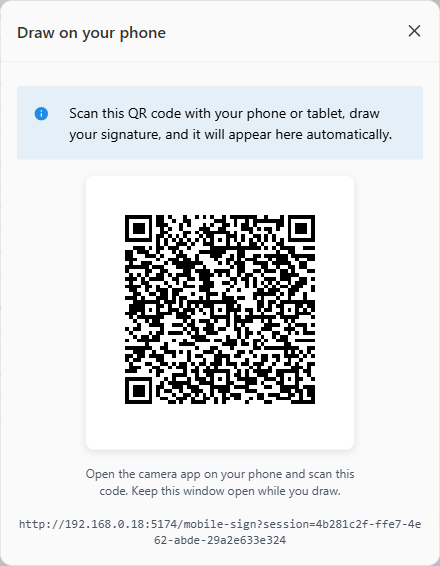
| 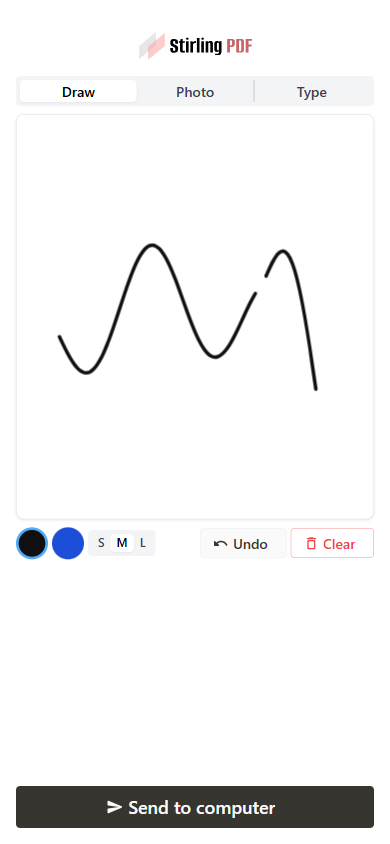
| 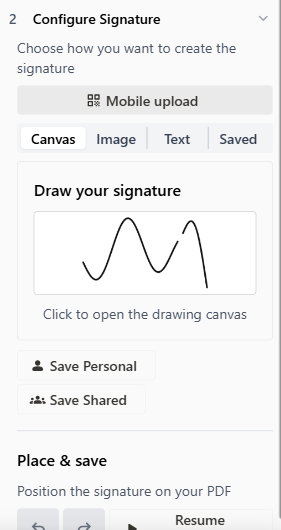
|
## How to test
1. Open the app on an address your phone can reach (not `localhost`),
Sign tool → **Mobile upload**, scan the QR.
2. Draw → **Send to computer** → it becomes the active canvas signature
and placement is live: click the PDF to place.
3. Photo tab → arrives in the Image source with a preview. Type tab →
arrives editable in the Text source.
4. Flags: `enableMobileSignature: false` hides the button; signature
still works with the scanner disabled.
Verified end-to-end (all three kinds, portrait/landscape/tablet) plus
`task frontend:check` and the touched backend tests.
---
## Checklist
### General
- [x] I have read the [Contribution
Guidelines](https://github.com/Stirling-Tools/Stirling-PDF/blob/main/CONTRIBUTING.md)
- [x] I have read the [Stirling-PDF Developer
Guide](https://github.com/Stirling-Tools/Stirling-PDF/blob/main/DeveloperGuide.md)
(if applicable)
- [ ] I have read the [How to add new languages to
Stirling-PDF](https://github.com/Stirling-Tools/Stirling-PDF/blob/main/devGuide/HowToAddNewLanguage.md)
(if applicable)
- [x] I have performed a self-review of my own code
- [x] My changes generate no new warnings
### Documentation
- [ ] I have updated relevant docs on [Stirling-PDF's doc
repo](https://github.com/Stirling-Tools/Stirling-Tools.github.io/blob/main/docs/)
(if functionality has heavily changed)
- [x] I have read the section [Add New Translation
Tags](https://github.com/Stirling-Tools/Stirling-PDF/blob/main/devGuide/HowToAddNewLanguage.md#add-new-translation-tags)
(for new translation tags only)
### Translations (if applicable)
- [ ] I ran
[`scripts/counter_translation.py`](https://github.com/Stirling-Tools/Stirling-PDF/blob/main/docs/counter_translation.md)
### UI Changes (if applicable)
- [x] Screenshots or videos demonstrating the UI changes are attached
(e.g., as comments or direct attachments in the PR)
### Testing (if applicable)
- [x] I have run `task check` to verify linters, typechecks, and tests
pass
- [x] I have tested my changes locally. Refer to the [Testing
Guide](https://github.com/Stirling-Tools/Stirling-PDF/blob/main/DeveloperGuide.md#7-testing)
for more details.
A disk-backed processing folder was created with a null trigger, which the
engine reads as manual-only: the create-time backlog sweep ran and the
directory was never looked at again, so nothing a user dropped in afterwards
was processed. Disk folders now carry the folder-watch trigger, which is what
registers the watch on the source's directory.
Storage-backed folders stay manual deliberately — folder-watch only supports
directory sources, and their arrival trigger does not exist yet. Both cases
are pinned by tests, along with the source staying in non-destructive track
mode with its sweep cap.
Removes
`app/saas/src/main/resources/db/migration/saas/V33__api_keys.sql`, the
only file left in that tree.
## Flyway does not run
There is no Flyway dependency in any `build.gradle` and no Flyway
configuration in any properties file. Nothing has executed these for
some time, so `V33` was never applied by anything.
SaaS schema has exactly two writers today:
1. Supabase CLI migrations in the `Stirling-PDF-SaaS` repo, applied by
that repo's PR CI
2. Hibernate `ddl-auto=update` in the app, which only ever adds
## Why delete rather than leave it
A directory of plausible-looking migrations is a trap. The next person
to make a schema change adds a `V34`, assumes it will run, and it
silently does not. I nearly did exactly that while working on
[#7414](https://github.com/Stirling-Tools/Stirling-PDF/pull/7414) before
checking whether Flyway was actually wired.
## Nothing is lost
Both tables it declared, `api_keys` and `api_key_daily_usage`, have JPA
entities (`ApiKey`, `ApiKeyDailyUsage`), so `ddl-auto` creates them.
That is already how they exist on every deployment that has them, since
Flyway was not the thing creating them.
## Checks
No references anywhere: nothing in code, config, gradle or docs mentions
`db/migration`, `flyway` or `V33`. Two code comments mention Flyway
historically, explaining why a column looks the way it does; those are
accurate history and are left alone.
`:saas:compileJava` and `:saas:processResources` green after the
removal.
# Description of Changes
Frontend CI is currently set to run `task frontend:check:all`, which
runs the tests, and then manually runs them a second time with coverage
enabled. This adds about 4 minutes onto the runtime of the frontend
tests for no reason. This PR changes the `frontend:test` rule to respond
to the `COVERAGE` and `CI` env vars to enable coverage analysis of the
frontend tests if the setting tells them to.
# Description of Changes
**PR2 of the encrypt-at-rest initiative — PR1 was #7155** Makes the P1
crypto operable and compliance-credible: admins can see the feature's
state, flip the kill switch over an API instead of raw SQL, encrypt the
pre-existing plaintext backlog, rotate the master key, and every
security-relevant event lands in the audit trail. No frontend — that's
PR3.
**What was changed**
- **Audit events** — new `STORAGE_ENCRYPTION` audit type, emitted
through a small listener interface so the crypto classes stay plain
objects: `encrypt`, `decrypt` (per-read events honour
`storage.encryption.auditReads`, default **on** — HIPAA reviewers expect
read audit; busy installs can disable), `decrypt.denied` (always),
`key.created/disabled/enabled`, `master.rotated`, `migration.completed`,
plus a `plaintextExport` marker whenever a plaintext copy of
encrypted-at-rest content is served (with `inline` flag to distinguish
in-app view from saved download).
- **Admin API** `/api/v1/admin/storage-encryption` (`hasRole('ADMIN')`):
- `GET /status` — write/decrypt state, **master-key fingerprint**
(SHA-256 prefix for backup verification, never key material), encrypted
vs plaintext file counts, full key list with status history.
- `POST /keys/{id}/disable` / `enable` — the kill switch, now with
active cache invalidation so revocation is immediate on the handling
node (cross-node converges within the 60s cache TTL). Enable is
restricted to DISABLED keys so two ACTIVE keys can't exist per scope.
- `POST /migrate` + `GET /migrate/status` — encrypt-existing job.
- `POST /master/rotate` — key material is never accepted over HTTP; keys
come from config/env.
- **Deliberately no delete endpoint** — key material can be disabled but
never destroyed through the API.
- **Encrypt-existing migration job** — new writes are encrypted from the
moment the flag is on; this converts the backlog. Crash-safe per file:
store the encrypted copy under a NEW storage key → compare-and-swap the
DB row → only then delete the old blob. A CAS miss (user replaced the
file mid-run) discards the job's copy — the user's file always wins.
Worst crash outcome is an orphaned blob, never a lost file; re-runs are
idempotent (`encryption_key_id IS NULL` selection, cursor-paged so
failures can't wedge the loop). Handles all three blobs per row
(main/history/audit-log), runs on a throttled virtual thread,
single-flight guarded.
- **Master-key rotation** — cheap by design thanks to the P1 hierarchy:
rotate re-wraps the handful of KEK rows, zero file I/O. New config
`stirling.security.fileEncryptionKeyPrevious` (+env) gives `unwrap` a
fallback during rotation, and
`stirling.security.fileEncryptionKeyVersion` marks which master wrapped
each row. Runbook: set new key primary + old as previous + bump version
→ restart (startup self-check passes via fallback, warns about pending
rows) → `POST /master/rotate` → remove the previous key.
- **Shared state bean** — `StorageEncryptionState` is built once and
shared by the storage decorator and the admin API, so kill-switch cache
invalidation hits the same caches the decorator reads.
**Reviewer notes**
- The revoked→403 mapping promised for PR2 already landed in #7155 after
manual testing; this PR adds the matching `decrypt.denied` audit event.
- 19 new tests: audit emission (encrypt/decrypt/denied, legacy plaintext
emits nothing), kill-switch immediacy (no TTL wait), rotation
(previous-key fallback, re-wrap + cleanup, idempotent second call),
migration (backlog encrypted byte-identical, CAS-miss discards own copy,
per-file failure counting, concurrent-start rejection, write-disabled
rejection), admin controller status/conflict/not-found paths.
- Full proprietary suite: 2246/2247 green (the one failure is the
pre-existing Windows-symlink FolderIdentitiesTest, unrelated).
---
[ENCRYPTION_AT_REST_TEST_REPORT.html](https://github.com/user-attachments/files/30664158/ENCRYPTION_AT_REST_TEST_REPORT.html)
---------
Co-authored-by: Reece Browne <74901996+reecebrowne@users.noreply.github.com>
# Description of Changes
This PR modernizes the project's Python tooling across GitHub Actions by
migrating CI workflows from pip-based dependency management to `uv` and
aligning Python execution with the engine project's managed environment.
### What was changed
- Replaced `actions/setup-python` and ad-hoc `pip install` steps with
`astral-sh/setup-uv` across CI workflows.
- Configured shared `uv` dependency caching using
`engine/pyproject.toml` and `engine/uv.lock`.
- Updated Python script execution to use `uv run --project engine
--locked` for a consistent runtime environment.
- Replaced package installation steps with `uv sync` for the required
dependency groups (e.g. `tools` and `cucumber`).
- Added Docker image build validation for both production and
development AI engine images.
- Updated workflow cache configuration and Docker build context where
required.
- Removed obsolete Python requirements files that are no longer needed
after the migration.
- Applied minor Python code modernizations, including import cleanup,
modern built-in generic type annotations (`list[...]`, `tuple[...]`,
`float | None`), and small style improvements.
- Removed unnecessary Python formatter/linter extensions from the
development container configuration.
### Why the change was made
- Standardize Python dependency management across the repository.
- Reduce duplicated dependency installation logic in CI.
- Improve workflow performance through shared dependency caching.
- Ensure all Python utilities execute against the same locked dependency
set managed by the engine project.
- Simplify long-term maintenance by eliminating legacy requirements
files and pip-specific workflow steps.
---
## Checklist
### General
- [ ] I have read the [Contribution
Guidelines](https://github.com/Stirling-Tools/Stirling-PDF/blob/main/CONTRIBUTING.md)
- [ ] I have read the [Stirling-PDF Developer
Guide](https://github.com/Stirling-Tools/Stirling-PDF/blob/main/DeveloperGuide.md)
(if applicable)
- [ ] I have read the [How to add new languages to
Stirling-PDF](https://github.com/Stirling-Tools/Stirling-PDF/blob/main/devGuide/HowToAddNewLanguage.md)
(if applicable)
- [ ] I have performed a self-review of my own code
- [ ] My changes generate no new warnings
### Documentation
- [ ] I have updated relevant docs on [Stirling-PDF's doc
repo](https://github.com/Stirling-Tools/Stirling-Tools.github.io/blob/main/docs/)
(if functionality has heavily changed)
- [ ] I have read the section [Add New Translation
Tags](https://github.com/Stirling-Tools/Stirling-PDF/blob/main/devGuide/HowToAddNewLanguage.md#add-new-translation-tags)
(for new translation tags only)
### Translations (if applicable)
- [ ] I ran
[`scripts/counter_translation.py`](https://github.com/Stirling-Tools/Stirling-PDF/blob/main/docs/counter_translation.md)
### UI Changes (if applicable)
- [ ] Screenshots or videos demonstrating the UI changes are attached
(e.g., as comments or direct attachments in the PR)
### Testing (if applicable)
- [ ] I have run `task check` to verify linters, typechecks, and tests
pass
- [ ] I have tested my changes locally. Refer to the [Testing
Guide](https://github.com/Stirling-Tools/Stirling-PDF/blob/main/DeveloperGuide.md#7-testing)
for more details.
---------
Signed-off-by: Carsten Drewes <c.drewes@stud.uni-hannover.de>
Co-authored-by: albanobattistella <34811668+albanobattistella@users.noreply.github.com>
Co-authored-by: kastenherri <116314318+kastenherri@users.noreply.github.com>
Co-authored-by: Anthony Stirling <77850077+Frooodle@users.noreply.github.com>
Co-authored-by: Copilot <223556219+Copilot@users.noreply.github.com>
Co-authored-by: James Brunton <jbrunton96@gmail.com>
Auto-generated by stirlingbot[bot].
Regenerates `frontend/editor/src/portal/generated/docsManifest.json`
from the Stirling docs repo via `npm run docs:sync`.
Signed-off-by: stirlingbot[bot] <stirlingbot[bot]@users.noreply.github.com>
Co-authored-by: stirlingbot[bot] <195170888+stirlingbot[bot]@users.noreply.github.com>
# Description of Changes
PR 1 of the failure-notification work: a durable, team-scoped record of
**why a policy run failed**, surfaced in the portal with the triage
actions each failure allows.
Today a failed policy run is not quite invisible, but it is unusable:
the ledger marks the file `ERROR`, and the audit aspect keeps the
exception message and status code. Nothing classifies either one,
nothing surfaces them, and neither offers a next step. If the file came
from a folder, bucket or webhook there is also no user watching, so
nobody learns it never made it through. This adds the record and the
read surface; the remediation that acts on documents comes later (see
below).
## What this does
**A failure kind registry as data.** `FailureKind` describes what can go
wrong: a stable wire id, i18n keys, an English fallback, and four facets
the review surface needs (`Stage`, `Severity`, `Remedy`, `Scope`). It is
shaped like the existing `ExceptionUtils.ErrorCode` and *links* to that
vocabulary rather than replacing it.
**Classification off structured codes, not message matching.** Policy
steps dispatch over loopback HTTP, so a tool's 4xx arrives as a
`RestClientResponseException` whose body is the Problem Details document
carrying `errorCode`. `FailureClassifier` reads that. Anything
unrecognised becomes `UNKNOWN`, which is the point: every failed run
gets an addressable record from day one, and which kinds to promote next
is answered by production frequency rather than guesswork.
**Actions declared by a kind, implemented as beans.** A kind lists the
`FailureActionId`s it offers; behaviour lives in `FailureAction` beans
resolved by id — the idiom this codebase already uses for `InputSource`,
`PolicyOutputSink` and `PolicyTrigger`. A kind cannot be sent an action
it never declared (400), so an incoherent pairing is unreachable rather
than merely unrendered. A new kind ships as a registry entry plus copy:
no new endpoint, no UI change.
**Repeat folding.** Recording folds a genuine repeat into the existing
incident instead of inserting again, keyed on `(team_id, dedup_key)`.
That matters for a snapshot-mode source that re-lists every file on each
sweep: the same broken file is one incident, not one per sweep. Distinct
files keep distinct rows. The unique constraint is enforced by the
database, and a writer that loses the insert race folds into the
winner's row.
One granularity caveat worth naming: nothing populates `file_id` in this
PR, so every row has it NULL. A FILE-scoped kind therefore dedups on
`policy + run` rather than `policy + file`. That still yields one row
per document for the sources shipped here, because the folder, S3 and
webhook sources each start one run per file; it stops holding as soon as
a single run carries several documents, which is why editor-origin
reporting (item 3 below) populates `file_id`.
**No document identity is stored.** No file name, no content. `fileId`
is an opaque reference only the owner's own client can resolve locally.
`detail` keeps the raw message (the only diagnostic an `UNKNOWN` failure
has) with anything path- or filename-shaped stripped on the way in,
capped at 2,000 characters. `PolicyExecutor`'s type-mismatch message now
reports the *extension* rather than the filename, since that message
becomes the stored `detail`.
**Access.** Reads and triage are leader-only, gated exactly the way
`PolicyController` gates policy editing, with the single-user carve-out
when login is disabled. Every read and write is scoped to the caller's
own team from the authenticated principal — there is no team parameter
on the API.
Self-hosted needs no migration: the table is created from the entity by
`ddl-auto=update`, as with every other table.
## What this does not do yet
- **Actions are incident dispositions, not document dispositions.**
Acknowledge and Dismiss change how a failure is displayed and touch
nothing else — not the document, not the processed-file ledger, not the
run, not any output destination. That is what makes them safe to offer
against `UNKNOWN`, and why there is no Approve/Release yet.
- **Two kinds only.** `INPUT_PASSWORD_PROTECTED` and `UNKNOWN`.
Everything else classifies as `UNKNOWN` and shows its raw message.
- **Editor-origin failures are not reported.** Every row is `PROCESSOR`.
`FailureOrigin.EDITOR` and `API` exist in the enum but nothing writes
them.
- **The list is dev-only for now.** The section renders behind
`import.meta.env.DEV`, so it ships in no production bundle. The
endpoints are live and gated.
- **No retention or per-team cap** on `file_run_events`. Tracked
separately.
- **No suspend-and-prompt.** `PolicyInputRequiredException` and the
engine's `suspend()` exist but nothing throws it, so a run cannot pause
to ask for a password today.
- **SaaS needs a migration** in `Stirling-PDF-SaaS` (`CREATE TABLE IF
NOT EXISTS stirling_pdf.file_run_events`), per the convention documented
at `app/saas/src/main/resources/application-saas.properties:21`.
## What follows in later PRs
1. **Map the remaining error codes to specific kinds** — corrupted file,
OCR unavailable, output destination unreachable, entitlement refusals,
and so on — each with its own copy and its own action set, replacing
today's `UNKNOWN` catch-all with a named notification in the review UI.
2. **Real remediation actions** attached to those kinds: fix (supply a
password and resume), skip (drop this file, continue the batch), and
decline (reject an incoming file outright), acting on the held document
rather than only on the incident row. This is where the
suspend-and-prompt path gets wired.
3. **Editor-origin reporting**, so a failure a user hits in the editor
lands in the same queue as one from a bucket.
4. **The user-facing review surface**: notifications with a sticky
review section, per-file badges, and an export gate, with the dev-only
list here replaced by the real thing.
## How to test
Needs a SaaS or proprietary build with login enabled, and an account
that leads a team.
1. Create a policy in the Processor with any step (Auto-redact is fine)
and a source you can drop files into.
2. Upload two files that will fail it: **a password-protected PDF**, and
**a corrupted PDF** (truncate a valid one, or rename a `.csv` to
`.pdf`).
3. Let the policy run and fail on both.
4. Go to the portal's **Documents** view and scroll to **Failures** (dev
builds only).
Expect two rows:
- **Password-protected document** — classified from `E004`, with the
kind's own labels **"I'll unlock this"** and **"Skip this file"** rather
than generic wording.
- **Unrecognised failure** — the corrupted file, classified `UNKNOWN`
(`E001` is not claimed by a kind yet), showing its raw message with
generic **Acknowledge** / **Dismiss**.
Neither row contains a file name anywhere, including in the raw message.
Press **Show raw JSON** to read exactly what the server returned. Acting
on a row transitions it and comes back with both buttons disabled and a
reason.
Re-running the same batch increments the occurrence count on the
existing rows rather than adding new ones; two *different*
password-protected files produce two separate rows.
---
## Checklist
### General
- [ ] I have read the [Contribution
Guidelines](https://github.com/Stirling-Tools/Stirling-PDF/blob/main/CONTRIBUTING.md)
- [ ] I have read the [Stirling-PDF Developer
Guide](https://github.com/Stirling-Tools/Stirling-PDF/blob/main/DeveloperGuide.md)
(if applicable)
- [ ] I have read the [How to add new languages to
Stirling-PDF](https://github.com/Stirling-Tools/Stirling-PDF/blob/main/devGuide/HowToAddNewLanguage.md)
(if applicable)
- [ ] I have performed a self-review of my own code
- [ ] My changes generate no new warnings
### Documentation
- [ ] I have updated relevant docs on [Stirling-PDF's doc
repo](https://github.com/Stirling-Tools/Stirling-Tools.github.io/blob/main/docs/)
(if functionality has heavily changed)
- [ ] I have read the section [Add New Translation
Tags](https://github.com/Stirling-Tools/Stirling-PDF/blob/main/devGuide/HowToAddNewLanguage.md#add-new-translation-tags)
(for new translation tags only)
### Translations (if applicable)
- [ ] I ran
[`scripts/counter_translation.py`](https://github.com/Stirling-Tools/Stirling-PDF/blob/main/docs/counter_translation.md)
### UI Changes (if applicable)
- [ ] Screenshots or videos demonstrating the UI changes are attached
(e.g., as comments or direct attachments in the PR)
### Testing (if applicable)
- [ ] I have run `task check` to verify linters, typechecks, and tests
pass
# Description of Changes
> Stacked on #7264, sibling of #7283. Independent of #7283 — the only
overlap is two additive lines in `core/query/keys.ts` and
`core/api/config.ts`. Either can merge first.
## The problem
`useEndpointConfig` kept its own cache: a module-level `globalFetchDone`
boolean, a mutable `globalEndpointCache` object, and a
`resetGlobalCache()` called from the JWT listener. Which consumer
mounted first decided who paid for the request, and nothing invalidated
it except a page reload.
## End state
One shared query for the whole availability map; each of the 12
consumers projects the endpoints it asked for. **251 lines to 101**,
same return shape, no consumer changes.
| | Before | After |
|---|---|---|
| Cross-consumer cache | `globalFetchDone` + mutable module object |
query key |
| Invalidation | `resetGlobalCache()` mutating that object |
`invalidateQueries` |
| Per-endpoint check | own `useState` triple | query keyed by endpoint |
Behaviour kept deliberately:
- **Unknown endpoints and any failure still read as enabled.** This
fires before auth settles, and disabling every tool on a hiccup is worse
than letting one call fail later.
- **`retry` is off for the availability map.** The fallback *is* the
answer, so retrying only doubles a request every logged-out visitor
makes on load.
## Desktop is untouched
`desktop/hooks/useEndpointConfig.ts` shadows this module entirely — no
shared code, so core converting doesn't affect it and there's no
half-migrated state.
It's 482 lines of orchestration rather than fetching: dependency-ready
gating, `tauriBackendService` and `selfHostedServerMonitor`
subscriptions, a 2.5s timeout retry for backend startup, a legacy
`?endpoints=` fallback for old servers, and SaaS-routing optimism that
rewrites disabled endpoints to enabled. It also has no test coverage to
convert against, and it decides whether tools appear at all in the
desktop app.
That's a different job from this one and wants its own review. Next PR.
## Testing
9 new tests: projection onto the requested subset, one request across
consumers, unknown-endpoint fallback, failure fallback with no retry,
empty-list no-fetch, JWT invalidation, and the three single-endpoint
cases.
`task frontend:check` green: 1677 tests across 192 files, typecheck on
all five flavours, eslint, dpdm, prettier.
Co-authored-by: Reece Browne <74901996+reecebrowne@users.noreply.github.com>
# Description of Changes
Fix automate unrunnable tools
## Problem
- Remove Image failed in Automate with `Tool operation not supported:
removeImage`
- Its registry entry had `operationConfig: undefined` even though the
config existed and was already tested
- The Automate picker only filtered on `supportsAutomate`, never on
`operationConfig` — so broken tools were selectable and failed only at
run time
## Fixes
- Wire up `removeImage` and `pageLayout` operation configs (both already
existed, just never registered)
- Exclude `validateSignature` (report tool, not on the operationConfig
seam) and `scannerEffect` (no frontend implementation) via
`supportsAutomate: false`
- Picker now also filters on `operationConfig`, so this class of bug
can't reach users again
- `overlay-pdfs` returns 400 instead of 500 when overlay files or mode
are missing
- Fix `new URL().pathname` Windows path bug that stopped 2 test suites
from loading
---
## Checklist
### General
- [ ] I have read the [Contribution
Guidelines](https://github.com/Stirling-Tools/Stirling-PDF/blob/main/CONTRIBUTING.md)
- [ ] I have read the [Stirling-PDF Developer
Guide](https://github.com/Stirling-Tools/Stirling-PDF/blob/main/DeveloperGuide.md)
(if applicable)
- [ ] I have read the [How to add new languages to
Stirling-PDF](https://github.com/Stirling-Tools/Stirling-PDF/blob/main/devGuide/HowToAddNewLanguage.md)
(if applicable)
- [ ] I have performed a self-review of my own code
- [ ] My changes generate no new warnings
### Documentation
- [ ] I have updated relevant docs on [Stirling-PDF's doc
repo](https://github.com/Stirling-Tools/Stirling-Tools.github.io/blob/main/docs/)
(if functionality has heavily changed)
- [ ] I have read the section [Add New Translation
Tags](https://github.com/Stirling-Tools/Stirling-PDF/blob/main/devGuide/HowToAddNewLanguage.md#add-new-translation-tags)
(for new translation tags only)
### Translations (if applicable)
- [ ] I ran
[`scripts/counter_translation.py`](https://github.com/Stirling-Tools/Stirling-PDF/blob/main/docs/counter_translation.md)
### UI Changes (if applicable)
- [ ] Screenshots or videos demonstrating the UI changes are attached
(e.g., as comments or direct attachments in the PR)
### Testing (if applicable)
- [ ] I have run `task check` to verify linters, typechecks, and tests
pass
- [ ] I have tested my changes locally. Refer to the [Testing
Guide](https://github.com/Stirling-Tools/Stirling-PDF/blob/main/DeveloperGuide.md#7-testing)
for more details.
## What
Makes Storybook render components with the same CSS the app gives them.
- The preview loaded the token primitives but **not the editor's
semantic token layer** (`styles/theme.css`), so components styled on
those variables rendered unthemed — three onboarding stories were
importing it by hand to stop their modal surfaces rendering transparent.
It's now loaded in the preview and the workarounds are gone.
- **Portal stories render inside the `.portal-scope` wrapper** PortalApp
mounts, so the portal's scoped reset and typography apply to them
exactly as in the app — and, deliberately, to nothing else.
- The folder stories invented their own hex colours, two of which aren't
values the app's `FOLDER_COLOR_PALETTE` can produce. They now use the
palette, so they can't drift from what a user can actually pick.
Deliberately does **not** load `tailwind.css` — tailwind is on its way
out of the editor, so matching the token layer alone is the target
state.
## Story colours route through the tokens, enforced
Stories were exempt from the `code-colors` lint, and it showed:
hardcoded hexes for surfaces the tokens already name (chat bubbles,
borders, demo backgrounds), `var(--x, #hex)` fallbacks that mask a
renamed token by silently painting the stale colour, and mocked category
accents for which real `--color-cat-*` tokens exist.
- Styling literals now use tokens; the dead fallbacks are stripped.
- The stories exemption is removed from `theme-lint`, so this can't
regress.
- Colours that are **the datum itself** — `ColorInput` values, signature
ink, per-policy accents, brand-mark swatches — stay literal via
`theme-allow-color`, hoisted to named consts so the exemption and its
reason sit together.
A practical side effect: stories styled on tokens actually respond to
the dark-mode toolbar toggle, which is what makes a dark-theme a11y pass
meaningful later.
## The a11y gate now runs dark as well as light
Contrast is most of what axe reports and it is theme-dependent, so a
light-only gate left half the surface unmeasured — and it only becomes
measurable at all once the tokens above actually flip. `SCAN_THEME=dark`
pins the theme for a whole scan run, every a11y task runs both themes,
and each theme has its own baseline:
- **light** re-recorded against the themed rendering (the old baseline
measured colours the app never shows): 831 stories with violations
- **dark** recorded for the first time: 798 stories with violations, 980
story-rule pairs, zero render failures across the full sweep
Verified end to end: dark scans measure against dark surfaces (`#18181b`
vs `#ffffff`), both baselines self-check clean, and a live scan of
stories that changed on main after recording passes both gates.
Nightly's timeout doubles for the second sweep.
## Testing
Typecheck (all variants), ESLint and Prettier pass. Onboarding, folder,
portal and control stories render in the browser scan (39/39) with the
per-story CSS imports removed; every story touched by the colour sweep
renders too (58/58). `task frontend:lint:colors` passes with stories
included.
# Description of Changes
Currently when calculating the output file type for some tools, the
system will get it wrong because it doesn't know about what the default
parameters in tools are, so if it doesn't have a value for some key,
it'll just bail out and say "it might not be compatible". This PR adds
logic to `ToolIO` to read the default values set for the parameters if
the tool has `ToolIOCase`s and takes them into account when figuring out
the output type. I've built it with horrible Java reflection magic to
avoid having to specify the default for params twice, which will make it
impossible for the defaults to disagree with each other. This just runs
once at startup so there's negligible performance impact.
The change is easily tested with Change Parameters, which is just
`add-password` behind the scenes but with the password params omitted
(so Change Password is always PDF->PDF, never encrypted like Add
Password).
Also (somewhat hackily) fixes a bug I noticed where saving a Change
Permissions step then leaving and returning to the pipeline will cause
the step to be reloaded as Add Password. I've added a system to
disambiguate tools which share the same endpoint (which is only these
two currently).
## Currently
<img width="455" height="135" alt="image"
src="https://github.com/user-attachments/assets/c8867d6a-599b-4f21-a2db-4a1b6ac22d73"
/>
## Now
<img width="415" height="122" alt="image"
src="https://github.com/user-attachments/assets/bd8d1bab-f00a-421b-8c91-5af0d2ad5335"
/>
# Description of Changes
Nightlies keep failing because the Playwright tests only run on Chrome
in PRs. This PR changes it so that we run all 3 browsers in all
(frontend) PRs so we catch these things before they merge in. They run
in parallel so it won't take any more time for the CI to finish.
# Description of Changes
Continued effort towards removing all uses of the any type in our
frontend code (last PR was #7326). This PR fixes 7 more folders and
removes them from the exclude list. All of them were localised within
the folder in the exclude list so again were pretty easy to fix.
# Description of Changes
This PR replaces multiple hardcoded English UI strings with translation
keys to improve localization consistency throughout the editor.
### What was changed
- Added new translation entries for:
- AI chat panel header and empty state
- Generic dropdown placeholders and empty states
- Generic input placeholder (`Enter value`)
- Tool renderer "tool not found" message
- Signature pen size placeholder
- Updated shared components to use translated fallback placeholders
instead of hardcoded English text:
- `DropdownListWithFooter`
- `EditableSecretField`
- `GroupedFormatDropdown`
- `LanguagePicker`
- `PenSizeSelector`
- Localized the AI chat panel:
- Assistant title
- Empty state message
- Input placeholder
- Localized the fallback error message displayed when a tool cannot be
resolved.
### Why the change was made
Several shared UI components and the AI assistant interface contained
hardcoded English strings, preventing proper localization and creating
an inconsistent multilingual experience. Moving these strings into the
translation system ensures they can be translated alongside the rest of
the application and provides reusable defaults for shared components.
---
## Checklist
### General
- [ ] I have read the [Contribution
Guidelines](https://github.com/Stirling-Tools/Stirling-PDF/blob/main/CONTRIBUTING.md)
- [ ] I have read the [Stirling-PDF Developer
Guide](https://github.com/Stirling-Tools/Stirling-PDF/blob/main/DeveloperGuide.md)
(if applicable)
- [ ] I have read the [How to add new languages to
Stirling-PDF](https://github.com/Stirling-Tools/Stirling-PDF/blob/main/devGuide/HowToAddNewLanguage.md)
(if applicable)
- [ ] I have performed a self-review of my own code
- [ ] My changes generate no new warnings
### Documentation
- [ ] I have updated relevant docs on [Stirling-PDF's doc
repo](https://github.com/Stirling-Tools/Stirling-Tools.github.io/blob/main/docs/)
(if functionality has heavily changed)
- [ ] I have read the section [Add New Translation
Tags](https://github.com/Stirling-Tools/Stirling-PDF/blob/main/devGuide/HowToAddNewLanguage.md#add-new-translation-tags)
(for new translation tags only)
### Translations (if applicable)
- [ ] I ran
[`scripts/counter_translation.py`](https://github.com/Stirling-Tools/Stirling-PDF/blob/main/docs/counter_translation.md)
### UI Changes (if applicable)
- [ ] Screenshots or videos demonstrating the UI changes are attached
(e.g., as comments or direct attachments in the PR)
### Testing (if applicable)
- [ ] I have run `task check` to verify linters, typechecks, and tests
pass
- [ ] I have tested my changes locally. Refer to the [Testing
Guide](https://github.com/Stirling-Tools/Stirling-PDF/blob/main/DeveloperGuide.md#7-testing)
for more details.
Auto-generated by stirlingbot[bot]
This PR updates the frontend license report based on changes to
package.json dependencies.
Signed-off-by: stirlingbot[bot] <stirlingbot[bot]@users.noreply.github.com>
Co-authored-by: stirlingbot[bot] <195170888+stirlingbot[bot]@users.noreply.github.com>
Bumps the react group with 2 updates in the /frontend directory:
[@types/react](https://github.com/DefinitelyTyped/DefinitelyTyped/tree/HEAD/types/react)
and
[@types/react-dom](https://github.com/DefinitelyTyped/DefinitelyTyped/tree/HEAD/types/react-dom).
Updates `@types/react` from 19.2.17 to 19.2.18
<details>
<summary>Commits</summary>
<ul>
<li>See full diff in <a
href="https://github.com/DefinitelyTyped/DefinitelyTyped/commits/HEAD/types/react">compare
view</a></li>
</ul>
</details>
<br />
Updates `@types/react-dom` from 19.2.3 to 19.2.4
<details>
<summary>Commits</summary>
<ul>
<li>See full diff in <a
href="https://github.com/DefinitelyTyped/DefinitelyTyped/commits/HEAD/types/react-dom">compare
view</a></li>
</ul>
</details>
<br />
Dependabot will resolve any conflicts with this PR as long as you don't
alter it yourself. You can also trigger a rebase manually by commenting
`@dependabot rebase`.
[//]: # (dependabot-automerge-start)
[//]: # (dependabot-automerge-end)
---
<details>
<summary>Dependabot commands and options</summary>
<br />
You can trigger Dependabot actions by commenting on this PR:
- `@dependabot rebase` will rebase this PR
- `@dependabot recreate` will recreate this PR, overwriting any edits
that have been made to it
- `@dependabot show <dependency name> ignore conditions` will show all
of the ignore conditions of the specified dependency
- `@dependabot ignore <dependency name> major version` will close this
group update PR and stop Dependabot creating any more for the specific
dependency's major version (unless you unignore this specific
dependency's major version or upgrade to it yourself)
- `@dependabot ignore <dependency name> minor version` will close this
group update PR and stop Dependabot creating any more for the specific
dependency's minor version (unless you unignore this specific
dependency's minor version or upgrade to it yourself)
- `@dependabot ignore <dependency name>` will close this group update PR
and stop Dependabot creating any more for the specific dependency
(unless you unignore this specific dependency or upgrade to it yourself)
- `@dependabot unignore <dependency name>` will remove all of the ignore
conditions of the specified dependency
- `@dependabot unignore <dependency name> <ignore condition>` will
remove the ignore condition of the specified dependency and ignore
conditions
</details>
Signed-off-by: dependabot[bot] <support@github.com>
Co-authored-by: dependabot[bot] <49699333+dependabot[bot]@users.noreply.github.com>
# Description of Changes
Smaller scope than #6689 to try and get this finished.
Replace ESLint and dpdm with Oxlint, a TS linter written in Rust so its
performance is dramatically better than the existing tools we use.
## Speed improvement
- Current ESLint run: 13.76s
- Current dpdm run: 3.59s
- Total time: 17.35s
- New Oxlint run: 0.90s
So Oxlint is about a 20x speed improvement.
## Differences
When I last tried to do this, we could recreate our rules identically
with Oxlint, but that's not true any more. Oxlint has no current
equivalent for ESLint's `no-restricted-syntax` rule, which we were using
to ban usages of `<button>` and stuff in specific components to try and
encourage them to use our shared UI. This is a very recent addition to
our linting config, and personally I'm willing to drop it for now at
least. We can still ban specific imports in files, so the files which we
were trying to enforce shared UI will still ban directly importing
Mantine, so that'll probably be most of the cases still caught, but I
think there are other ways we can encourage using the shared UI beyond
just using the linter for it.
I did try building a custom TS rule for it and it only slowed it down a
tiny bit (it took 1.1s) but it had to be built on an unreleased alpha
API which just sounds like a maintenance headache we don't need to deal
with for a rule that we don't really need.
# Description of Changes
Continued effort towards removing all uses of the `any` type in our
frontend code. This PR fixes 10 more folders and removes them from the
exclude list. All of them were really simple fixes.
# Description of Changes
Fixes the WebKit nightly failures ([run
31067620195](https://github.com/Stirling-Tools/Stirling-PDF/actions/runs/31067620195/attempts/1)):
8 tests failed on `stubbed-webkit` only, and every one of them logs the
same thing in its trace:
```
IndexedDB add error: UnknownError: Error preparing Blob/File data to be stored in object store
```
## What broke
`storeStirlingFile` stores the `File` itself in IndexedDB, so multi-GB
uploads are persisted by reference and never materialize in JS memory.
That came in with #7175 (`data: stirlingFile` replacing `data: await
stirlingFile.arrayBuffer()`), which is a real memory win and worth
keeping.
WebKit refuses blob values whenever it can't write the blob's backing
file, and rejects the request with the error above. The rejection was
only `console.error`d, so on WebKit **no upload ever persisted**, and
everything that reads the bytes back behaved as if the upload never
happened:
- `file-state-across-tools` — file gone after navigating; the sidebar
shows "No files yet"
- `compare` — `FileSelectorPicker: upload failed`, so the slot stays
`data-slot-state="empty"`
- `classification-grouping` / `classification-heuristic-upload` — the
label backfill and thumbnails read from IDB (`not in IndexedDB (likely
remote-only stub)`), so files land in "Recent" with no category headers
Chromium and Firefox store blobs fine, and PR CI only runs the `stubbed`
(chromium) project, so nightly was the only gate that could catch it.
## The fix
Try the blob first, keep a fallback:
- `storeStirlingFile`'s `add` is extracted into `addFileRecord` so it
can run twice
- if the value was a Blob and the failure is `UnknownError` /
`DataCloneError`, re-add the record with an `ArrayBuffer` copy and set
`blobValuesSupported = false`, so later files in that session go
straight to the copy path instead of losing the blob attempt every time
- deliberately narrow: `QuotaExceededError` and `ConstraintError` still
propagate, because a copy would fail the same way and retrying would
hide the real cause
- dropped two internal `console.error`s: every caller already reports
(`addFiles`, `FileSelectorPicker`, `zipFileService` collects into
`result.errors`), so they were duplicate noise
Every writer goes through `storeStirlingFile` (uploads, the file picker,
zip extraction, folder automation, `IndexedDBContext`), so this one seam
covers all of them. The read paths already accept either shape (`new
Blob([record.data], ...)`).
Net effect: Chromium and Firefox keep the no-copy path; engines that
refuse blobs degrade to the pre-#7175 behaviour instead of silently
losing files. On such an engine a very large file can still exhaust
renderer memory — the fallback warns about exactly that. Fixing that
properly means chunked storage, which is out of scope here.
## Verification
Reproduced and confirmed the cause by A/B on a branch that predates
#7175: as-is 8/8 pass on WebKit, and applying only #7175's `data:
stirlingFile` line reproduces the exact CI failure set.
| Check | Result |
|---|---|
| `stubbed-webkit`: the 8 nightly failures +
`classification-heuristic-upload` | 9 passed |
| `stubbed-webkit`: `files-page`, `page-editor-rotation`,
`encrypted-pdf-unlock` | 32 passed, 1 skipped |
| `stubbed` (chromium): the same specs + `files-page` | 35 passed, 1
skipped |
| Frontend unit suite | 210 files, 1797 passed |
| `typecheck:core`, `typecheck:proprietary`, eslint, prettier | clean |
New unit coverage in `fileStorage.blobFallback.test.ts` pins the
contract over `fake-indexeddb` with `add` instrumented to count blob vs
copy attempts: blob path when accepted, blob-then-copy when refused (and
readable back), one attempt only for later files, and quota not retried.
---
## Checklist
### General
- [x] I have read the [Contribution
Guidelines](https://github.com/Stirling-Tools/Stirling-PDF/blob/main/CONTRIBUTING.md)
- [x] I have read the [Stirling-PDF Developer
Guide](https://github.com/Stirling-Tools/Stirling-PDF/blob/main/DeveloperGuide.md)
(if applicable)
- [x] I have performed a self-review of my own code
- [x] My changes generate no new warnings
### Testing (if applicable)
- [x] Frontend typecheck (core + proprietary), eslint, prettier, the
unit suite, and the affected Playwright specs on chromium and webkit all
pass
Co-authored-by: Anthony Stirling <77850077+Frooodle@users.noreply.github.com>
A folder mirrored from a directory on disk now appears at the root of the
files view, in both grid and list, carrying the processing tag and showing
the path it mirrors. It is its own entry kind rather than a synthesised
FolderRecord: there is no stored folder behind it, and its id is a
processing-folder id, not the branded UUID a FolderRecord's id is parsed as.
Read-only for now — the directory is the source of truth, so the row offers
none of the stored-folder actions that would have no meaning on the user's
own filesystem. Browsing its contents comes next.
A processing folder can now front a directory on the server's disk as well as
an app storage folder. Disk directories are pinned to a new non-destructive
'track' mode on the folder source — the existing default consumes (deletes)
processed files, which must never be what a folder over someone's Downloads
does — and a per-sweep limit caps how much one run takes on without narrowing
what the sweep observes, so the ledger stays honest and the remainder follows
on later sweeps.
The editor gains a client for the compose route, a shared store behind
useProcessingFolders (one fetch for every consumer, mutations refresh them
all), the 'Processing folder' tag on folder cards and rows, and an offer to
process the PDFs already in the user's Downloads folder with live progress
driven by the runs the server reports actually starting.
Classification follows the policy's own split: the server classifies when the
AI engine is on, the browser loop when it is off — and a paused Classification
policy stops both, so a folder can never resurrect a capability an admin
paused.
Fix#6121
# Description of Changes
<!--
Please provide a summary of the changes, including:
- What was changed
- Why the change was made
- Any challenges encountered
Closes (#6121 )
-->
This PR expands the viewer ruler/measurement tool with real-world scale
support. Users can now apply preset scales, define custom scales,
calibrate a scale by drawing a reference measurement and entering its
known real-world distance, and view measurements with scaled real-world
values.
It also refactors PDF `/Measure` and `/VP` scale extraction out of
`EmbedPdfViewer` into a dedicated utility, centralizes ruler state
management in a dedicated hook, persists ruler measurements and selected
scales per file during the browser session, remembers the last
calibration unit locally, and updates the ruler overlay so measurements
remain aligned with the PDF page during rotation and scrolling.
**New Files**
- `RulerMeasurementLayer.tsx` - Renders ruler measurements in the SVG
overlay, including lines, points, labels, page/scaled values, delete
controls, live previews, clear controls, and label visibility modes.
- `RulerScaleSettingsButton.tsx` - Adds the scale settings
button/popover to the viewer toolbar.
- `ScaleCalibrationDialog.tsx` - Provides the calibration modal where
users enter a known real-world distance to calculate the scale
automatically.
- `ScaleSettingsPanel.tsx` - Provides preset scales, custom scale input,
calibration entry point, active scale display, and reset controls.
- `useMeasurementManager.ts` - Centralizes ruler state, custom scale
state, calibration flow, per-file measurements, session persistence, and
loading of PDF-derived scale data.
- `measurementPreferences.ts` - Persists the last calibration unit in
`localStorage`.
- `measurementTypes.ts` - Defines shared measurement, point, scale, page
scale, and viewport scale types.
- `measurementUtils.ts` - Provides unit conversion, scale calculation,
validation, formatting, calibration helpers, and session storage
helpers.
- `measurementUtils.test.ts` - Adds unit tests for scale calculations,
unit conversion, preset parsing, ratio derivation, and calibration.
- `pdfMeasurementExtraction.ts` - Moves PDF `/Measure` and `/VP` scale
extraction into a dedicated utility.
**Changed Files**
- `EmbedPdfViewer.tsx` - Removes inline PDF scale extraction and
delegates ruler/measurement state to `useMeasurementManager`; integrates
the ruler overlay, custom scale support, restored measurements, and
calibration dialog.
- `LocalEmbedPDF.tsx` - Adds page-level metadata used by the ruler
overlay, including page width, height, and native page rotation.
- `RotateAPIBridge.tsx` - Adds immediate rotation update propagation so
ruler measurements can update their page-anchored positions during
rotation changes.
- `RulerOverlay.tsx` - Refactors the ruler overlay to use shared
measurement types/utilities, support custom scales, calibration
measurements, restored measurements, measurement change listeners,
rotation-aware positioning, and scroll compensation, also holding Alt
key will activate pass-through behavior so labels do not block ruler
interactions.
- `useViewerWorkbenchBarButtons.tsx` - Adds the ruler scale settings
action and coordinates ruler, pan mode, and calibration behavior.
- `ViewerContext.tsx` - Adds immediate rotation notification support
used by ruler measurements while viewer rotation changes are applied.
- `en-GB/translation.toml` and `en-US/translation.toml` - Add UI text
for scale settings, calibration actions, ruler measurement values, and
ruler label controls.
---
## Checklist
### General
- [X] I have read the [Contribution
Guidelines](https://github.com/Stirling-Tools/Stirling-PDF/blob/main/CONTRIBUTING.md)
- [X] I have read the [Stirling-PDF Developer
Guide](https://github.com/Stirling-Tools/Stirling-PDF/blob/main/DeveloperGuide.md)
(if applicable)
- [x] I have read the [How to add new languages to
Stirling-PDF](https://github.com/Stirling-Tools/Stirling-PDF/blob/main/devGuide/HowToAddNewLanguage.md)
(if applicable)
- [X] I have performed a self-review of my own code
- [X] My changes generate no new warnings
### Documentation
- [ ] I have updated relevant docs on [Stirling-PDF's doc
repo](https://github.com/Stirling-Tools/Stirling-Tools.github.io/blob/main/docs/)
(if functionality has heavily changed)
- [x] I have read the section [Add New Translation
Tags](https://github.com/Stirling-Tools/Stirling-PDF/blob/main/devGuide/HowToAddNewLanguage.md#add-new-translation-tags)
(for new translation tags only)
### Translations (if applicable)
- [ ] I ran
[`scripts/counter_translation.py`](https://github.com/Stirling-Tools/Stirling-PDF/blob/main/docs/counter_translation.md)
### UI Changes (if applicable)
- [x] Screenshots or videos demonstrating the UI changes are attached
(e.g., as comments or direct attachments in the PR)
Current scale panel :
<img width="1316" height="515" alt="Captura de tela de 2026-05-31
21-57-53"
src="https://github.com/user-attachments/assets/df0ffb7d-4546-450c-8380-409658852a87"
/>
Current calibration input :
<img width="1021" height="522" alt="Captura de tela de 2026-05-31
21-59-52"
src="https://github.com/user-attachments/assets/e17c14e7-fec7-42e9-af48-33ef825acb6c"
/>
Example of usage :
<img width="1316" height="760" alt="Captura de tela de 2026-05-31
22-31-01"
src="https://github.com/user-attachments/assets/fcd3578e-1eaa-42d3-b30b-3fc87c796f90"
/>
### Testing (if applicable)
- [X] I have run `task check` to verify linters, typechecks, and tests
pass
- [X] I have tested my changes locally. Refer to the [Testing
Guide](https://github.com/Stirling-Tools/Stirling-PDF/blob/main/DeveloperGuide.md#7-testing)
for more details.
---------
Co-authored-by: Anthony Stirling <77850077+Frooodle@users.noreply.github.com>
# Description of Changes
The restructuring of the frontend PR (#7062) has highlighted a couple of
issues with the source which are currently hidden due to the structure
of the code. This PR fixes the issues in Watched Folders:
- There's a circular dependency in TS code
- The `.gitignore` file excludes the watched folders dir by accident
# Description of Changes
> Stacked on #7264 — review that first. This diff is against its branch.
## The problem
`AppConfigContext` hand-rolled a query client: a `fetchCountRef` dedupe
guard, an exponential-backoff retry loop with its own `sleep()`, a
`hasResolvedConfig` flag, and manual 401/5xx branching. All to fetch one
endpoint that 80 files read.
## End state
Same provider, same public contract, React Query underneath. **250 lines
to 142**, and no consumer file changes.
| | Before | After |
|---|---|---|
| Dedupe | `fetchCountRef` guard | query key |
| Retry | `for` loop + `sleep()` + backoff maths | `retry` +
`retryDelay` |
| 401 | caught in the component, sets default config | `fetchAppConfig`
returns the default — the retry predicate and error state only see real
failures |
| Auth pages | early return inside the fetch | `enabled` |
| Resolved-yet tracking | `hasResolvedConfig` state | derived from the
query |
`fetchAppConfig` moves to `core/api/config.ts` with the simulation hook
and request options, so the context no longer knows how config is
fetched.
**Behaviour change:** config survives a provider remount instead of
refetching. That matters on desktop, where a connection-mode switch
remounts the tree — and #7264's cache reset already clears it on exactly
that transition.
## Testing
The existing 12-case contract test passes unchanged apart from the query
wrapper. It caught a real mistake: `failureCount` is 0-based in v5, so
`<= maxRetries` gave one attempt too many.
Four cases added — cached remount, `maxRetries` honoured, 4xx not
retried, `autoFetch` off.
`task frontend:check` green: 1672 tests across 191 files, typecheck on
all five flavours, eslint, dpdm, prettier.
## Coming next
| PR | Scope |
|---|---|
| 3 | `useEndpointConfig` — core (251 lines) plus a 482-line desktop
override with its own dependency polling. Split out of this PR;
different risk profile, and it deserves its own review. |
| 4 | `useAdminSettings` (20 consumers) and the config sections |
| 5 | Polling loops → `refetchInterval` |
| 6 | Finish the Processor, collapse to one client |
| 7 | Tool execution — mutation state only |
---------
Co-authored-by: Reece Browne <74901996+reecebrowne@users.noreply.github.com>
# Description of Changes
This change reorganizes frontend dependencies by moving development-only
packages into `devDependencies`, removing obsolete packages, and
updating several development tooling dependencies to newer versions.
### What was changed
- Moved runtime-independent packages to `devDependencies`:
- `@iconify/react`
- `globals`
- Removed unused TypeScript ESLint packages:
- `@typescript-eslint/eslint-plugin`
- `@typescript-eslint/parser`
- Updated development dependencies:
- `@iconify-json/material-symbols` → `1.2.83`
- `@iconify/utils` → `3.1.4`
- `globals` → `17.7.0`
These changes reduce redundant dependency declarations and ensure
packages are classified according to their actual usage. The main
challenge was distinguishing direct dependencies from packages already
provided transitively by frontend tooling.
---
## Checklist
### General
- [ ] I have read the [Contribution
Guidelines](https://github.com/Stirling-Tools/Stirling-PDF/blob/main/CONTRIBUTING.md)
- [ ] I have read the [Stirling-PDF Developer
Guide](https://github.com/Stirling-Tools/Stirling-PDF/blob/main/DeveloperGuide.md)
(if applicable)
- [ ] I have read the [How to add new languages to
Stirling-PDF](https://github.com/Stirling-Tools/Stirling-PDF/blob/main/devGuide/HowToAddNewLanguage.md)
(if applicable)
- [ ] I have performed a self-review of my own code
- [ ] My changes generate no new warnings
### Documentation
- [ ] I have updated relevant docs on [Stirling-PDF's doc
repo](https://github.com/Stirling-Tools/Stirling-Tools.github.io/blob/main/docs/)
(if functionality has heavily changed)
- [ ] I have read the section [Add New Translation
Tags](https://github.com/Stirling-Tools/Stirling-PDF/blob/main/devGuide/HowToAddNewLanguage.md#add-new-translation-tags)
(for new translation tags only)
### Translations (if applicable)
- [ ] I ran
[`scripts/counter_translation.py`](https://github.com/Stirling-Tools/Stirling-PDF/blob/main/docs/counter_translation.md)
### UI Changes (if applicable)
- [ ] Screenshots or videos demonstrating the UI changes are attached
(e.g., as comments or direct attachments in the PR)
### Testing (if applicable)
- [ ] I have run `task check` to verify linters, typechecks, and tests
pass
- [ ] I have tested my changes locally. Refer to the [Testing
Guide](https://github.com/Stirling-Tools/Stirling-PDF/blob/main/DeveloperGuide.md#7-testing)
for more details.
## The problem
Three pieces of user data (pro status, avatar metadata, profile picture)
were being fetched from four different places: `initializeAuth` on
mount, the `SIGNED_IN` handler, the `TOKEN_REFRESHED` handler, and the
post-upgrade path.
On a fresh login the first two both see a session, so everything got
fetched twice. It didn't stop after login either — Supabase re-fires
`SIGNED_IN` on token refresh and tab-visibility wakeups, so a refresh
that emitted both events cost around 7 Supabase reads.
## The fix
All four call sites now go through one `loadUserData(session)` that is
idempotent per identity.
The guard key is `user.id` + `is_anonymous`:
- not the access token, which changes on every refresh and would defeat
the guard entirely
- the anonymous flag matters because a guest to authenticated upgrade
keeps the same user id, and that is the one case where the data
genuinely does need reloading
**Per login: 6 fetches to 3. A repeat `SIGNED_IN` or `TOKEN_REFRESHED`
fetches nothing.** The tests count real calls rather than asserting on
shape.
## Two behaviour changes worth naming
- `initializeAuth` now awaits the full load, so the initial spinner also
waits on the profile-picture URL. Net login is still faster, since an
entire duplicate pass is gone.
- A tab-wake `SIGNED_IN` no longer revalidates entitlements. That
revalidation was accidental rather than designed — `refreshProStatus()`
is the intended path, and post-checkout is already handled by
`CheckoutContext`.
## Scope
Supabase-origin traffic only. This does not touch the ~20 authenticated
requests hitting `SupabaseAuthenticationFilter`, because those go to the
Stirling backend rather than the hosted Supabase project. That is a
separate problem and is unmeasured, so it needs measuring before
anything is optimised. Remaining items (a double `/api/v1/team/my`
fetch, an effect keyed on `[user]` identity in `FolderContext`, the
`portalAccess` spinner flash, and caching the auth filter's per-request
Postgres round-trips) are tracked separately.
## Verification
```
npx tsc --noEmit --project editor/src/saas/tsconfig.json # exit 0
npx eslint --max-warnings=0 editor/src/saas/auth # exit 0
npx prettier --check editor/src/saas/auth/ # clean
npx vitest run --project saas # 75 passed (20 files)
```
Bumps com.sun.xml.bind:jaxb-core from 4.0.7 to 4.0.9.
[](https://docs.github.com/en/github/managing-security-vulnerabilities/about-dependabot-security-updates#about-compatibility-scores)
Dependabot will resolve any conflicts with this PR as long as you don't
alter it yourself. You can also trigger a rebase manually by commenting
`@dependabot rebase`.
[//]: # (dependabot-automerge-start)
[//]: # (dependabot-automerge-end)
---
<details>
<summary>Dependabot commands and options</summary>
<br />
You can trigger Dependabot actions by commenting on this PR:
- `@dependabot rebase` will rebase this PR
- `@dependabot recreate` will recreate this PR, overwriting any edits
that have been made to it
- `@dependabot show <dependency name> ignore conditions` will show all
of the ignore conditions of the specified dependency
- `@dependabot ignore this major version` will close this PR and stop
Dependabot creating any more for this major version (unless you reopen
the PR or upgrade to it yourself)
- `@dependabot ignore this minor version` will close this PR and stop
Dependabot creating any more for this minor version (unless you reopen
the PR or upgrade to it yourself)
- `@dependabot ignore this dependency` will close this PR and stop
Dependabot creating any more for this dependency (unless you reopen the
PR or upgrade to it yourself)
</details>
Signed-off-by: dependabot[bot] <support@github.com>
Co-authored-by: dependabot[bot] <49699333+dependabot[bot]@users.noreply.github.com>
Bumps org.sonarqube from 7.2.3.7755 to 7.3.1.8318.
[](https://docs.github.com/en/github/managing-security-vulnerabilities/about-dependabot-security-updates#about-compatibility-scores)
Dependabot will resolve any conflicts with this PR as long as you don't
alter it yourself. You can also trigger a rebase manually by commenting
`@dependabot rebase`.
[//]: # (dependabot-automerge-start)
[//]: # (dependabot-automerge-end)
---
<details>
<summary>Dependabot commands and options</summary>
<br />
You can trigger Dependabot actions by commenting on this PR:
- `@dependabot rebase` will rebase this PR
- `@dependabot recreate` will recreate this PR, overwriting any edits
that have been made to it
- `@dependabot show <dependency name> ignore conditions` will show all
of the ignore conditions of the specified dependency
- `@dependabot ignore this major version` will close this PR and stop
Dependabot creating any more for this major version (unless you reopen
the PR or upgrade to it yourself)
- `@dependabot ignore this minor version` will close this PR and stop
Dependabot creating any more for this minor version (unless you reopen
the PR or upgrade to it yourself)
- `@dependabot ignore this dependency` will close this PR and stop
Dependabot creating any more for this dependency (unless you reopen the
PR or upgrade to it yourself)
</details>
Signed-off-by: dependabot[bot] <support@github.com>
Co-authored-by: dependabot[bot] <49699333+dependabot[bot]@users.noreply.github.com>
# Description of Changes
- **What:** Corrected the pt-BR (Brazilian Portuguese) `download`
translation from `"Baixar (JSON)"` to `"Baixar"` in
`frontend/editor/public/locales/pt-BR/translation.toml`, in both the
root table (line 32) and the `[fileManager]` section (line 3577).
- **Why:** The generic `download` key flows through
`useFileActionTerminology` (`download: t("download", "Download")`) into
the shared download button rendered on tool-result screens (e.g.
`ReviewToolStep`). Because the string was `"Baixar (JSON)"`, every
tool's Download button showed "Baixar (JSON)" for pt-BR users — implying
a JSON export regardless of the actual output format. This mislabeling
was locale-wide (all pt-BR users, all tool downloads). Session
autocapture confirmed the confusion: a pt-BR user on `/convert`
repeatedly clicked a button whose text was exactly "Baixar (JSON)", then
abandoned the flow. Nothing crashed — it's a confusing label, not a
functional break.
- **Scope / verification:** en-US uses plain `"Download"` for this key
and pt-PT already uses `"Transferir"`; no other locale carried the
`"(JSON)"` suffix on the download key, so the defect was isolated to
pt-BR. Only translation values changed — no keys added/removed, so
translation counts are unaffected.
Note: I scoped this to the mislabel — the exact symptom users observed.
The report also mentions the download being a silent anchor-click with
no success toast; that's a separate, broader UX enhancement in
`ReviewToolStep`/`WorkbenchBar`/`downloadService`, so it's intentionally
left out of this focused translation fix.
---
## Checklist
### General
- [x] I have read the [Contribution
Guidelines](https://github.com/Stirling-Tools/Stirling-PDF/blob/main/CONTRIBUTING.md)
- [x] I have performed a self-review of my own code
- [x] My changes generate no new warnings
### Translations (if applicable)
- [x] Only a value correction in `pt-BR`; no translation tags added or
removed.
---
*Created with [PostHog Code](https://posthog.com/code?ref=pr) from [an
inbox
report](posthog-code://inbox/019f655d-bd60-78c2-ba59-98c23243ed57).*
Co-authored-by: posthog-eu[bot] <226701856+posthog-eu[bot]@users.noreply.github.com>
# Description of Changes
This change adds a version-scoped override mechanism for dependencies
whose published metadata does not expose a detectable license.
- Added `app/license-overrides.json` with verified Apache License 2.0
metadata for:
- `com.hubspot.immutables:immutables-exceptions:1.9`
- `com.hubspot:algebra:1.5`
- Added `ModuleLicenseOverrideFilter` as custom `buildSrc` logic for the
Gradle dependency license report plugin.
- Applied overrides only when the exact `group:artifact:version` matches
and no usable license metadata was detected.
- Added automatic maintenance of the override file:
- Removes overrides when the dependency is no longer resolved.
- Removes overrides when the dependency starts publishing valid license
metadata.
- Migrates stale overrides to newer unresolved versions and clears their
metadata for re-verification.
- Adds null-valued placeholders for newly detected dependencies without
license metadata.
- Preserves populated overrides for newer versions when already present.
- Added Gradle version-aware dependency ordering for override migration.
- Registered `app/license-overrides.json` as an input for license-report
and license-check preparation tasks.
- Centralized the dependency license report plugin version in
`buildSrc`.
- Added unit tests covering override application, cleanup, migration,
exact-version matching, concurrent versions, placeholder generation, and
numeric version ordering.
- Added documentation describing the override lifecycle, verification
requirements, maintenance workflow, and validation commands.
- Replaced broad null-license allowances for the two HubSpot modules
with explicit Apache License 2.0 metadata.
- Added accepted GNU Lesser General Public License name variants
encountered in dependency metadata.
The change was made because some dependencies have known upstream
licenses but do not publish license metadata in a form detected by the
Gradle license report plugin. Previously, these dependencies were
permitted through module-specific null-license exceptions, leaving
incomplete information in the generated report. The new mechanism
supplies verified metadata without overriding valid metadata published
by dependencies.
---
## Checklist
### General
- [ ] I have read the [Contribution
Guidelines](https://github.com/Stirling-Tools/Stirling-PDF/blob/main/CONTRIBUTING.md)
- [ ] I have read the [Stirling-PDF Developer
Guide](https://github.com/Stirling-Tools/Stirling-PDF/blob/main/DeveloperGuide.md)
(if applicable)
- [ ] I have read the [How to add new languages to
Stirling-PDF](https://github.com/Stirling-Tools/Stirling-PDF/blob/main/devGuide/HowToAddNewLanguage.md)
(if applicable)
- [ ] I have performed a self-review of my own code
- [ ] My changes generate no new warnings
### Documentation
- [ ] I have updated relevant docs on [Stirling-PDF's doc
repo](https://github.com/Stirling-Tools/Stirling-Tools.github.io/blob/main/docs/)
(if functionality has heavily changed)
- [ ] I have read the section [Add New Translation
Tags](https://github.com/Stirling-Tools/Stirling-PDF/blob/main/devGuide/HowToAddNewLanguage.md#add-new-translation-tags)
(for new translation tags only)
### Translations (if applicable)
- [ ] I ran
[`scripts/counter_translation.py`](https://github.com/Stirling-Tools/Stirling-PDF/blob/main/docs/counter_translation.md)
### UI Changes (if applicable)
- [ ] Screenshots or videos demonstrating the UI changes are attached
(e.g., as comments or direct attachments in the PR)
### Testing (if applicable)
- [ ] I have run `task check` to verify linters, typechecks, and tests
pass
- [ ] I have tested my changes locally. Refer to the [Testing
Guide](https://github.com/Stirling-Tools/Stirling-PDF/blob/main/DeveloperGuide.md#7-testing)
for more details.
# Description of Changes
This PR refactors Gradle caching across the GitHub Actions workflows to
improve cache reuse, reduce dependency resolution overhead, and shorten
CI execution times.
### What was changed
- Replaced multiple `gradle/actions/setup-gradle` steps with a unified
`actions/cache`-based Gradle User Home cache strategy.
- Standardized cache paths across workflows to include:
- `~/.gradle/caches`
- `~/.gradle/wrapper`
- Introduced consistent cache keys using:
- Runner OS
- Runner architecture
- JDK version
- Hashes of Gradle wrapper, version catalog, Gradle build files, and
project build scripts.
- Added restore keys to maximize cache hit rates across similar
environments.
- Added a new **`gradle-cache-prime`** job in the main build workflow
that:
- Restores or creates the shared Gradle cache.
- Resolves backend dependencies before downstream jobs execute.
- Makes the populated cache available to subsequent jobs.
- Updated workflow dependencies so Gradle-based jobs wait for the cache
priming job before execution.
- Simplified and unified Gradle cache handling across numerous CI
workflows, including backend builds, OpenAPI generation, database
migration tests, Docker tests, Tauri builds, Swagger generation,
enterprise builds, release workflows, and license generation.
- Updated workflow comments to reflect the new caching strategy and
shared cache behavior.
### Why the change was made
The previous workflows used a mixture of Gradle setup actions and
partial dependency caches, leading to duplicated dependency downloads,
inconsistent cache behavior, and longer CI runtimes. Consolidating all
workflows onto a shared Gradle User Home cache with a dedicated cache
priming job improves cache reuse, reduces unnecessary dependency
resolution, and makes CI execution more consistent.
---
## Checklist
### General
- [ ] I have read the [Contribution
Guidelines](https://github.com/Stirling-Tools/Stirling-PDF/blob/main/CONTRIBUTING.md)
- [ ] I have read the [Stirling-PDF Developer
Guide](https://github.com/Stirling-Tools/Stirling-PDF/blob/main/DeveloperGuide.md)
(if applicable)
- [ ] I have read the [How to add new languages to
Stirling-PDF](https://github.com/Stirling-Tools/Stirling-PDF/blob/main/devGuide/HowToAddNewLanguage.md)
(if applicable)
- [ ] I have performed a self-review of my own code
- [ ] My changes generate no new warnings
### Documentation
- [ ] I have updated relevant docs on [Stirling-PDF's doc
repo](https://github.com/Stirling-Tools/Stirling-Tools.github.io/blob/main/docs/)
(if functionality has heavily changed)
- [ ] I have read the section [Add New Translation
Tags](https://github.com/Stirling-Tools/Stirling-PDF/blob/main/devGuide/HowToAddNewLanguage.md#add-new-translation-tags)
(for new translation tags only)
### Translations (if applicable)
- [ ] I ran
[`scripts/counter_translation.py`](https://github.com/Stirling-Tools/Stirling-PDF/blob/main/docs/counter_translation.md)
### UI Changes (if applicable)
- [ ] Screenshots or videos demonstrating the UI changes are attached
(e.g., as comments or direct attachments in the PR)
### Testing (if applicable)
- [ ] I have run `task check` to verify linters, typechecks, and tests
pass
- [ ] I have tested my changes locally. Refer to the [Testing
Guide](https://github.com/Stirling-Tools/Stirling-PDF/blob/main/DeveloperGuide.md#7-testing)
for more details.
# Description of Changes
- Updated expired share-link cleanup to delete related `FileShareAccess`
records before deleting their parent `FileShare` records.
- Wrapped the cleanup operation in a transaction to ensure the deletion
order is enforced atomically.
- Prevents foreign-key constraint violations and scheduled-task failures
during cleanup.
- The full backend check was limited by a Gradle distribution
download/network error.
```cmd
[backend:dev:proprietary] 16:25:43.362 [scheduled-vt-2] WARN org.hibernate.orm.jdbc.error - HHH000247: ErrorCode: 23503, SQLState: 23503
[backend:dev:proprietary] 16:25:43.362 [scheduled-vt-2] WARN org.hibernate.orm.jdbc.error - Referentielle Integrität verletzt: "FKQ6V4QH5LFCAWII0ABRVSJO5SG: PUBLIC.FILE_SHARE_ACCESSES FOREIGN KEY(FILE_SHARE_ID) REFERENCES PUBLIC.FILE_SHARES(FILE_SHARE_ID) (CAST(97 AS BIGINT))"
[backend:dev:proprietary] Referential integrity constraint violation: "FKQ6V4QH5LFCAWII0ABRVSJO5SG: PUBLIC.FILE_SHARE_ACCESSES FOREIGN KEY(FILE_SHARE_ID) REFERENCES PUBLIC.FILE_SHARES(FILE_SHARE_ID) (CAST(97 AS BIGINT))"; SQL statement:
[backend:dev:proprietary] delete from file_shares where file_share_id=? [23503-240]
[backend:dev:proprietary] 16:25:43.380 [scheduled-vt-2] ERROR o.s.s.s.TaskUtils$LoggingErrorHandler - Unexpected error occurred in scheduled task
[backend:dev:proprietary] org.springframework.dao.DataIntegrityViolationException: could not execute statement [Referentielle Integrität verletzt: "FKQ6V4QH5LFCAWII0ABRVSJO5SG: PUBLIC.FILE_SHARE_ACCESSES FOREIGN KEY(FILE_SHARE_ID) REFERENCES PUBLIC.FILE_SHARES(FILE_SHARE_ID) (CAST(97 AS BIGINT))"
[backend:dev:proprietary] Referential integrity constraint violation: "FKQ6V4QH5LFCAWII0ABRVSJO5SG: PUBLIC.FILE_SHARE_ACCESSES FOREIGN KEY(FILE_SHARE_ID) REFERENCES PUBLIC.FILE_SHARES(FILE_SHARE_ID) (CAST(97 AS BIGINT))"; SQL statement:
[backend:dev:proprietary] delete from file_shares where file_share_id=? [23503-240]] [delete from file_shares where file_share_id=?]; SQL [delete from file_shares where file_share_id=?]; constraint [FKQ6V4QH5LFCAWII0ABRVSJO5SG]
[backend:dev:proprietary] at org.springframework.orm.jpa.hibernate.HibernateExceptionTranslator.convertHibernateAccessException(HibernateExceptionTranslator.java:169)
[backend:dev:proprietary] at org.springframework.orm.jpa.hibernate.HibernateExceptionTranslator.convertHibernateAccessException(HibernateExceptionTranslator.java:131)
[backend:dev:proprietary] at org.springframework.orm.jpa.hibernate.HibernateExceptionTranslator.translateExceptionIfPossible(HibernateExceptionTranslator.java:105)
[backend:dev:proprietary] at org.springframework.orm.jpa.vendor.HibernateJpaDialect.translateExceptionIfPossible(HibernateJpaDialect.java:223)
[backend:dev:proprietary] at org.springframework.orm.jpa.JpaTransactionManager.doCommit(JpaTransactionManager.java:557)
[backend:dev:proprietary] at org.springframework.transaction.support.AbstractPlatformTransactionManager.processCommit(AbstractPlatformTransactionManager.java:794)
[backend:dev:proprietary] at org.springframework.transaction.support.AbstractPlatformTransactionManager.commit(AbstractPlatformTransactionManager.java:757)
[backend:dev:proprietary] at org.springframework.transaction.interceptor.TransactionAspectSupport.commitTransactionAfterReturning(TransactionAspectSupport.java:687)
[backend:dev:proprietary] at org.springframework.transaction.interceptor.TransactionAspectSupport.invokeWithinTransaction(TransactionAspectSupport.java:408)
[backend:dev:proprietary] at org.springframework.transaction.interceptor.TransactionInterceptor.invoke(TransactionInterceptor.java:130)
[backend:dev:proprietary] at org.springframework.aop.framework.ReflectiveMethodInvocation.proceed(ReflectiveMethodInvocation.java:179)
[backend:dev:proprietary] at org.springframework.dao.support.PersistenceExceptionTranslationInterceptor.invoke(PersistenceExceptionTranslationInterceptor.java:135)
[backend:dev:proprietary] at org.springframework.aop.framework.ReflectiveMethodInvocation.proceed(ReflectiveMethodInvocation.java:179)
[backend:dev:proprietary] at org.springframework.data.jpa.repository.support.CrudMethodMetadataPostProcessor$CrudMethodMetadataPopulatingMethodInterceptor.invoke(CrudMethodMetadataPostProcessor.java:166)
[backend:dev:proprietary] at org.springframework.aop.framework.ReflectiveMethodInvocation.proceed(ReflectiveMethodInvocation.java:179)
[backend:dev:proprietary] at org.springframework.aop.framework.JdkDynamicAopProxy.invoke(JdkDynamicAopProxy.java:222)
[backend:dev:proprietary] at jdk.proxy4/jdk.proxy4.$Proxy246.deleteAll(Unknown Source)
[backend:dev:proprietary] at stirling.software.proprietary.storage.service.StorageCleanupService.cleanupExpiredShareLinks(StorageCleanupService.java:71)
[backend:dev:proprietary] at java.base/jdk.internal.reflect.DirectMethodHandleAccessor.invoke(DirectMethodHandleAccessor.java:104)
[backend:dev:proprietary] at java.base/java.lang.reflect.Method.invoke(Method.java:565)
[backend:dev:proprietary] at org.springframework.scheduling.support.ScheduledMethodRunnable.runInternal(ScheduledMethodRunnable.java:128)
[backend:dev:proprietary] at org.springframework.scheduling.support.ScheduledMethodRunnable.lambda$run$1(ScheduledMethodRunnable.java:122)
[backend:dev:proprietary] at io.micrometer.observation.Observation.observe(Observation.java:569)
[backend:dev:proprietary] at org.springframework.scheduling.support.ScheduledMethodRunnable.run(ScheduledMethodRunnable.java:122)
[backend:dev:proprietary] at org.springframework.scheduling.config.Task$OutcomeTrackingRunnable.run(Task.java:88)
[backend:dev:proprietary] at org.springframework.scheduling.support.DelegatingErrorHandlingRunnable.run(DelegatingErrorHandlingRunnable.java:54)
[backend:dev:proprietary] at java.base/java.util.concurrent.Executors$RunnableAdapter.call(Executors.java:545)
[backend:dev:proprietary] at java.base/java.util.concurrent.FutureTask.runAndReset(FutureTask.java:369)
[backend:dev:proprietary] at java.base/java.util.concurrent.ScheduledThreadPoolExecutor$ScheduledFutureTask.run(ScheduledThreadPoolExecutor.java:310)
[backend:dev:proprietary] at java.base/java.util.concurrent.ThreadPoolExecutor.runWorker(ThreadPoolExecutor.java:1090)
[backend:dev:proprietary] at java.base/java.util.concurrent.ThreadPoolExecutor$Worker.run(ThreadPoolExecutor.java:614)
[backend:dev:proprietary] at java.base/java.lang.VirtualThread.run(VirtualThread.java:460)
[backend:dev:proprietary] Caused by: org.hibernate.exception.ConstraintViolationException: could not execute statement [Referentielle Integrität verletzt: "FKQ6V4QH5LFCAWII0ABRVSJO5SG: PUBLIC.FILE_SHARE_ACCESSES FOREIGN KEY(FILE_SHARE_ID) REFERENCES PUBLIC.FILE_SHARES(FILE_SHARE_ID) (CAST(97 AS BIGINT))"
[backend:dev:proprietary] Referential integrity constraint violation: "FKQ6V4QH5LFCAWII0ABRVSJO5SG: PUBLIC.FILE_SHARE_ACCESSES FOREIGN KEY(FILE_SHARE_ID) REFERENCES PUBLIC.FILE_SHARES(FILE_SHARE_ID) (CAST(97 AS BIGINT))"; SQL statement:
[backend:dev:proprietary] delete from file_shares where file_share_id=? [23503-240]] [delete from file_shares where file_share_id=?]
[backend:dev:proprietary] at org.hibernate.dialect.H2Dialect.lambda$buildSQLExceptionConversionDelegate$0(H2Dialect.java:840)
[backend:dev:proprietary] at org.hibernate.exception.internal.StandardSQLExceptionConverter.convert(StandardSQLExceptionConverter.java:34)
[backend:dev:proprietary] at org.hibernate.engine.jdbc.spi.SqlExceptionHelper.convert(SqlExceptionHelper.java:115)
[backend:dev:proprietary] at org.hibernate.engine.jdbc.internal.ResultSetReturnImpl.executeUpdate(ResultSetReturnImpl.java:184)
[backend:dev:proprietary] at org.hibernate.engine.jdbc.mutation.internal.AbstractMutationExecutor.performNonBatchedMutation(AbstractMutationExecutor.java:145)
[backend:dev:proprietary] at org.hibernate.engine.jdbc.mutation.internal.MutationExecutorSingleNonBatched.performNonBatchedOperations(MutationExecutorSingleNonBatched.java:53)
[backend:dev:proprietary] at org.hibernate.engine.jdbc.mutation.internal.AbstractMutationExecutor.execute(AbstractMutationExecutor.java:66)
[backend:dev:proprietary] at org.hibernate.persister.entity.mutation.AbstractDeleteCoordinator.doStaticDelete(AbstractDeleteCoordinator.java:268)
[backend:dev:proprietary] at org.hibernate.persister.entity.mutation.AbstractDeleteCoordinator.delete(AbstractDeleteCoordinator.java:79)
[backend:dev:proprietary] at org.hibernate.action.internal.EntityDeleteAction.execute(EntityDeleteAction.java:119)
[backend:dev:proprietary] at org.hibernate.engine.spi.ActionQueue.executeActions(ActionQueue.java:634)
[backend:dev:proprietary] at org.hibernate.engine.spi.ActionQueue.executeActions(ActionQueue.java:505)
[backend:dev:proprietary] at org.hibernate.event.internal.AbstractFlushingEventListener.performExecutions(AbstractFlushingEventListener.java:381)
[backend:dev:proprietary] at org.hibernate.event.internal.DefaultFlushEventListener.onFlush(DefaultFlushEventListener.java:40)
[backend:dev:proprietary] at org.hibernate.event.service.internal.EventListenerGroupImpl.fireEventOnEachListener(EventListenerGroupImpl.java:138)
[backend:dev:proprietary] at org.hibernate.internal.SessionImpl.fireFlush(SessionImpl.java:1484)
[backend:dev:proprietary] at org.hibernate.internal.SessionImpl.managedFlush(SessionImpl.java:481)
[backend:dev:proprietary] at org.hibernate.internal.SessionImpl.flushBeforeTransactionCompletion(SessionImpl.java:2111)
[backend:dev:proprietary] at org.hibernate.internal.SessionImpl.beforeTransactionCompletion(SessionImpl.java:2033)
[backend:dev:proprietary] at org.hibernate.engine.jdbc.internal.JdbcCoordinatorImpl.beforeTransactionCompletion(JdbcCoordinatorImpl.java:410)
[backend:dev:proprietary] at org.hibernate.resource.transaction.backend.jdbc.internal.JdbcResourceLocalTransactionCoordinatorImpl.beforeCompletionCallback(JdbcResourceLocalTransactionCoordinatorImpl.java:166)
[backend:dev:proprietary] at org.hibernate.resource.transaction.backend.jdbc.internal.JdbcResourceLocalTransactionCoordinatorImpl$TransactionDriverControlImpl.commitNoRollbackOnly(JdbcResourceLocalTransactionCoordinatorImpl.java:248)
[backend:dev:proprietary] at org.hibernate.resource.transaction.backend.jdbc.internal.JdbcResourceLocalTransactionCoordinatorImpl$TransactionDriverControlImpl.commit(JdbcResourceLocalTransactionCoordinatorImpl.java:242)
[backend:dev:proprietary] at org.hibernate.engine.transaction.internal.TransactionImpl.commit(TransactionImpl.java:89)
[backend:dev:proprietary] at org.springframework.orm.jpa.JpaTransactionManager.doCommit(JpaTransactionManager.java:553)
[backend:dev:proprietary] ... 27 common frames omitted
[backend:dev:proprietary] Caused by: org.h2.jdbc.JdbcSQLIntegrityConstraintViolationException: Referentielle Integrität verletzt: "FKQ6V4QH5LFCAWII0ABRVSJO5SG: PUBLIC.FILE_SHARE_ACCESSES FOREIGN KEY(FILE_SHARE_ID) REFERENCES PUBLIC.FILE_SHARES(FILE_SHARE_ID) (CAST(97 AS BIGINT))"
[backend:dev:proprietary] Referential integrity constraint violation: "FKQ6V4QH5LFCAWII0ABRVSJO5SG: PUBLIC.FILE_SHARE_ACCESSES FOREIGN KEY(FILE_SHARE_ID) REFERENCES PUBLIC.FILE_SHARES(FILE_SHARE_ID) (CAST(97 AS BIGINT))"; SQL statement:
[backend:dev:proprietary] delete from file_shares where file_share_id=? [23503-240]
[backend:dev:proprietary] at org.h2.message.DbException.getJdbcSQLException(DbException.java:520)
[backend:dev:proprietary] at org.h2.message.DbException.getJdbcSQLException(DbException.java:489)
[backend:dev:proprietary] at org.h2.message.DbException.get(DbException.java:223)
[backend:dev:proprietary] at org.h2.message.DbException.get(DbException.java:199)
[backend:dev:proprietary] at org.h2.constraint.ConstraintReferential.checkRow(ConstraintReferential.java:363)
[backend:dev:proprietary] at org.h2.constraint.ConstraintReferential.checkRowRefTable(ConstraintReferential.java:380)
[backend:dev:proprietary] at org.h2.constraint.ConstraintReferential.checkRow(ConstraintReferential.java:254)
[backend:dev:proprietary] at org.h2.table.Table.fireConstraints(Table.java:1208)
[backend:dev:proprietary] at org.h2.table.Table.fireAfterRow(Table.java:1226)
[backend:dev:proprietary] at org.h2.command.dml.Delete.update(Delete.java:81)
[backend:dev:proprietary] at org.h2.command.dml.DataChangeStatement.update(DataChangeStatement.java:77)
[backend:dev:proprietary] at org.h2.command.CommandContainer.update(CommandContainer.java:139)
[backend:dev:proprietary] at org.h2.command.Command.executeUpdate(Command.java:306)
[backend:dev:proprietary] at org.h2.command.Command.executeUpdate(Command.java:250)
[backend:dev:proprietary] at org.h2.jdbc.JdbcPreparedStatement.executeUpdateInternal(JdbcPreparedStatement.java:213)
[backend:dev:proprietary] at org.h2.jdbc.JdbcPreparedStatement.executeUpdate(JdbcPreparedStatement.java:172)
[backend:dev:proprietary] at com.zaxxer.hikari.pool.ProxyPreparedStatement.executeUpdate(ProxyPreparedStatement.java:61)
[backend:dev:proprietary] at com.zaxxer.hikari.pool.HikariProxyPreparedStatement.executeUpdate(HikariProxyPreparedStatement.java)
[backend:dev:proprietary] at org.hibernate.engine.jdbc.internal.ResultSetReturnImpl.executeUpdate(ResultSetReturnImpl.java:181)
[backend:dev:proprietary] ... 48 common frames omitted
```
---
## Checklist
### General
- [ ] I have read the [Contribution
Guidelines](https://github.com/Stirling-Tools/Stirling-PDF/blob/main/CONTRIBUTING.md)
- [ ] I have read the [Stirling-PDF Developer
Guide](https://github.com/Stirling-Tools/Stirling-PDF/blob/main/DeveloperGuide.md)
(if applicable)
- [ ] I have read the [How to add new languages to
Stirling-PDF](https://github.com/Stirling-Tools/Stirling-PDF/blob/main/devGuide/HowToAddNewLanguage.md)
(if applicable)
- [ ] I have performed a self-review of my own code
- [ ] My changes generate no new warnings
### Documentation
- [ ] I have updated relevant docs on [Stirling-PDF's doc
repo](https://github.com/Stirling-Tools/Stirling-Tools.github.io/blob/main/docs/)
(if functionality has heavily changed)
- [ ] I have read the section [Add New Translation
Tags](https://github.com/Stirling-Tools/Stirling-PDF/blob/main/devGuide/HowToAddNewLanguage.md#add-new-translation-tags)
(for new translation tags only)
### Translations (if applicable)
- [ ] I ran
[`scripts/counter_translation.py`](https://github.com/Stirling-Tools/Stirling-PDF/blob/main/docs/counter_translation.md)
### UI Changes (if applicable)
- [ ] Screenshots or videos demonstrating the UI changes are attached
(e.g., as comments or direct attachments in the PR)
### Testing (if applicable)
- [ ] I have run `task check` to verify linters, typechecks, and tests
pass
- [ ] I have tested my changes locally. Refer to the [Testing
Guide](https://github.com/Stirling-Tools/Stirling-PDF/blob/main/DeveloperGuide.md#7-testing)
for more details.
## Goal
Three related improvements to how policies and file state behave in the
editor: classification no longer blocks the user, policy enforcement
pipelines across a batch upload instead of waiting for the whole drop,
and file-state changes no longer re-render the entire UI.
## 1. Classification never blocks (and never versions)
Classification is metadata-only — it reads a document and records
labels; it never rewrites the file. Previously it ran like an
enforcement policy: it blocked viewing/editing behind the "Enforcing
policy…" overlay, forked a new versioned child (an `automate` entry in
version history), and could run before other policies — letting the user
in, then a later enforcement policy would fork a version and drop their
edits.
Now classification:
- **Never blocks.** A classification run never marks a file `enforcing`
(badge map + viewer overlay both skip it), so the file stays fully
viewable/editable while it runs.
- **No version bump, no history entry.** Its result is stamped onto the
file's existing stub in place (workspace + IndexedDB) — the labels just
appear as tags. It targets the document's *current leaf*, so an edit
made during the async run still gets the tags; a run that completes with
no outputs settles cleanly instead of pinning in-flight.
- **Always runs last** in an enforcement chain (regardless of configured
order, pinned at persist-time too), so every enforcement policy finishes
forking versions before the user is let in.
## 2. Pipeline policy enforcement across a batch upload
Dropping ~50 files enforced policies only *after the whole drop finished
scanning* — every file got the "Enforcing policy" overlay together, then
processing began. Root cause: the chunked `ADD_FILES` dispatches in
`addFiles` were never separated by an event-loop yield, so React batched
them into a single commit and the enforcement effect fired once over the
full list.
**Fix** (`core/contexts/file/fileActions.ts`): after each chunk, `await`
that chunk's IndexedDB writes, then yield a macrotask so React commits
the rows and runs the enforcement dispatch *before* the next chunk
scans. Files start enforcing as their rows land, overlapping with the
rest of the drop. Persistence is streamed per chunk (the policy auto-run
reads bytes from IndexedDB with no in-memory fallback).
**Second fix — bounded dispatch window**
(`proprietary/components/policies/usePolicyAutoRun.ts`): even with
streamed dispatch, the drop still *looked* serial — each dispatch POSTs
the file's bytes, and firing them all at once saturates the browser's
per-origin connection pool, so the status polls and output downloads of
already-running files queued behind the pending uploads; nothing visibly
progressed until the last upload drained. Dispatch is now gated behind a
small concurrency window (4), keeping connections free so early files
run, poll, and complete while later ones are still dispatching. The
first status poll also fires at 500ms (then the normal 2s cadence) so
fresh runs show real progress immediately. The batch test asserts the
window (dispatches overlap but never exceed 4).
## 3. Selector subscriptions for file state (no more whole-UI
re-renders)
`FileContext` published `{state, selectors}` through a plain React
context, so **every** consumer re-rendered on **every** state change —
one file's new version re-rendered the entire workspace.
**Phase 1 — infra** (`file/contexts.ts`, `file/fileHooks.ts`,
`FileContext.tsx`): the state context is replaced by a stable
subscription store (`FileStoreContext`); hooks are rebuilt on
`useSyncExternalStoreWithSelector` (the `use-sync-external-store` shim
react-redux uses — new direct dep, React 19 compatible). Each consumer
now re-renders only when its selected slice changes:
- `useStirlingFileStub(id)` → only that file's record
- `useAllFiles` → file-list changes only (immune to selection/UI churn)
- `useFileSelection`/`useSelectedFiles` → selection + the *selected*
files' records only
- `useFileUI` → its three UI scalars; `useFileContext` → files + pinned
slices
- `useFileState` keeps its whole-state contract for existing broad
consumers
A render-count test (`fileHooks.selector.test.tsx`) locks the bail-out
contract.
**Phase 2 — hot-path rows**: sidebar `FileItem` is memoized (with stable
empty-array props), so one file's change re-renders one row, not the
list. Active Files thumbnails were already memoized.
**Phase 3 — narrow the hottest consumers**: always-mounted whole-state
consumers migrated to slices — `Workbench`, `EmbedPdfViewer`, `Viewer`,
`NonPdfViewer`, `WorkbenchBar`, `ViewerContext`, `ViewerShareButton`,
`ZoomAPIBridge`, `ViewerAnnotationControls`, `ConvertSettings`,
`DismissAllErrorsButton`, `FileEditorThumbnail`,
`usePageEditorDropdownState`, `useSaveShortcut`, plus a new
non-subscribing `useFileSelectors()` for event-time reads
(`ReviewToolStep`, `useViewerReadAloud`, `useExitWarning`). Net effect:
selection/UI churn no longer re-renders the viewer/workbench, and a
version landing touches only components observing the files slice.
Broad readers (`FileSidebar`, `PageEditor`, `FileEditor`, `Redact`,
`FormFill`) deliberately stay on `useFileState` — they read most of the
state anyway.
**Hardening**: store notifications run in a layout effect (subscribers
re-render before paint — no stale frames), and outside production
`useFileSelectors()` wraps its selectors to `console.error` if one is
invoked during render (those reads don't subscribe, so render-time use
would silently go stale — not statically lintable, so it's guarded at
runtime; the full test suite passes under the guard).
## 4. Policy indicators: shared icons, non-blocking run chip, no pulse
- Badges and enforcement overlays now take their glyph from the shared
`policyCategoryIcon` map (the same source the processor's catalogue
uses) — label icon for classification, shield for security — instead of
a hardcoded shield everywhere.
- A non-blocking run (classification) shows a small accent-tinted pill
in the top-right of the Active Files card (category icon + loader) and
the normal spinning badge in the sidebar, via a new `background` badge
flag that nothing gates on. When the run finishes, the tagged files keep
a plain category badge.
- The post-run pulse/glow on sidebar badges is gone (with its `recent`
plumbing): spinner while running, static category icon when done.
## Verification
Full CI gate locally: `og:check`, `typecheck:all` (all variants),
`lint`, `format:check`, `build`, `test` (1366 — incl. the render-count
contract test, the classification-order/import unit tests, and the
61-file batch integration test driving the real dispatch → poll → import
→ chain effects), `storybook:build` — all green.
## Held for follow-up (not in this PR)
- **Reuse one PDFium engine across viewer file switches** (kills the
per-open "Loading PDF Engine" rebuild). Implemented on branch
`viewer/reuse-pdfium-engine`, but review found a confirmed leak
(orphaned PDFium handles when switching files mid-load); needs an
in-flight-load teardown before shipping.
Consolidates the enterprise procurement and legal work into one PR off
`main`. Supersedes #7020 (closed; every commit from it is contained
here). Sits on top of PAYG prepaid bundles (#7032) and the `--color-*` →
`--c-*` portal token rename.
## Why
Enterprise procurement was a mock. The stage screens read from a fake
state machine, the "agreement" was prose hardcoded in a component, and
nothing a buyer did was recorded anywhere. To actually sell to an
enterprise we need three things it didn't have: a real document they can
read and sign, a record that proves they signed that exact version, and
a licence that flips when they pay.
## What
**The agreement is a real versioned document**
- Registry at `resources/legal/manifest.json` +
`legal/<id>/<version>/*.md`. Publishing a new version is a markdown file
and a manifest bump, no code change. `@`-prefixed parts are generated
sections.
- `AgreementAssembler` builds MSA (Part A) + generated Order Form (Part
B) + DPA (Part C) as one document. Only the Order Form varies per deal.
- `AgreementPdfRenderer` goes through our own pipeline (commonmark →
`FileToPdf`/WeasyPrint), so we dogfood it.
- Immutable signature record pinning document id and version, a SHA-256
of the exact rendered markdown, the variable snapshot, typed signatory
details, timestamp and IP.
**Legal document pages and consent logging**
- `GET /api/v1/legal/{docId}` serves any registry document; a viewer
modal renders it with a draft badge. The SLA exhibit is viewable for the
first time.
- `legal_consent` + `POST /api/v1/legal/consent`. EULA clickwrap is
recorded once: at trial start, or at the quote step only if there was no
trial.
**Quote and Agreement are separate steps**
The quote step is a plain itemised review (figures, renewal, PO) with
download and "Accept quote". Accepting advances to the agreement and
does not charge Stripe. Signing the agreement is still the commitment
point.
**One quote number**
We no longer mint our own reference. The Stripe quote number is the
identifier everywhere, so the UI and the memo can't disagree.
`quote_number` is nullable until Stripe assigns it at finalisation
(`20260808000000`).
**Payment takes the deal live**
`invoice.paid` on the stripe-webhook moves the deal to live and the UI
reflects it. Nothing watched for payment before, so a paid customer sat
in "payment" forever. Needs `invoice.paid` enabled on the webhook
endpoint in the Stripe dashboard.
**Security**
Any signup could self-issue a $0 enterprise licence, from three things
compounding: leader-on-signup, no entitlement gate, and no ACV floor.
So: `startTrial` now has a stage guard (it was replacing committed
licences), the offline `.lic` is gated on entitlement, the ACV floor is
enforced before the quote persists, and the air-gap check reads the
quote's deployment rather than the deal's. Invitee emails are redacted
in logs. Dev and Storybook were hitting real Stripe; both now route
through `resolveDemoResponse`.
**Removed the dead procurement island**
The original stage-by-stage page survived the rebuild with no route and
no consumer, so it was invisible to review but still cost a reader's
time. 16 unreferenced files, 182 lines of superseded API, 53 orphaned
en-US keys, and `Procurement.css` from 1665 to 968 lines. Nothing
deleted had a live consumer.
## Screenshots
Home, deal underway (hero card footer):
<!-- home-in-procurement.png -->
Quote builder, step 1:
<!-- quote-builder.png -->
Agreement, ready to sign:
<!-- agreement-signing.png -->
Payment and live:
<!-- stage-payment.png / stage-live.png -->
## How to test
**Storybook** covers every state without a backend:
```bash
cd frontend && npm run storybook
```
Then `Portal/Procurement/*`:
| Story | What to look at |
| --- | --- |
| `DealStatusHero` — Trial / Quote / Agreement / Payment / Live | One
hero per stage: progress band, one-line status, stage CTA |
| `QuoteBuilder` — Default | 4 steps. Users + volume drive the price;
Governance and PDF size are multipliers; step 4 is the itemised review |
| `ProcurementAgreement` — Default / Signing | Header actions,
always-visible scrollbar on the paper, one-line signature row |
| `ProcurementStages` — Payment / Live / License | "View & pay invoice"
opens Stripe directly; licence key and `.lic` download |
| `Views/Home` — Subscribed In Procurement | The hero in real page
context |
Note: `ProcurementAgreement` renders "Could not load the agreement" in
Storybook because it fetches the document from the backend. The chrome
is accurate, the paper body needs the app.
**Full flow** needs SaaS running and a linked team:
1. Home → **Explore enterprise** → trial setup (deployment + seats).
EULA is recorded here.
2. **Build your quote** → 4 steps → Generate. Buyer details are required
first.
3. Review the itemised quote → **Accept quote**. Confirm Stripe was
*not* charged.
4. Agreement → tick, fill signatory, **Sign agreement**. Check
`procurement_signature` for the version and content hash.
5. **View & pay invoice** → pay in Stripe test mode → deal should move
to live on the `invoice.paid` webhook.
Worth reviewing specifically: the licence cannot be issued without
entitlement (step 3 before payment), and `startTrial` on an
already-committed deal is rejected rather than overwriting.
## Verification
- `:saas compileJava` + `spotlessJavaCheck`
- `task frontend:check:all` green end to end: 9 typecheck variants,
eslint at zero warnings, `theme-lint`, `lint:css`, prettier, build,
**1656 tests across 188 files**
- 7 deno tests on the `invoice.paid` handler, covering all four shapes
Stripe uses for the subscription reference
## Open, not addressed here
- **The commercial model contradicts itself in three places.** The Order
Form says annual-in-advance, the MSA §2.3/§3.2 implies otherwise, the
quote engine computes `tcv = annualNet × termYears` flat, and Stripe
only invoices one year. Needs a decision before this is customer-facing.
- The 25 MB data-processing increments vs the ×1.4/×2.4 size multiplier,
deferred pending Matt.
- All legal text is **draft**. It renders with a draft badge and is not
presented as executed; counsel's read is still a publish gate.
- `{{subprocessor_url}}` / `{{eula_url}}` awaiting marketing's final
links.
- `frontend-a11y` is red on pre-existing portal contrast debt, deferred
by decision.
## Schema notes
Two migrations land on the SaaS side (`v3`), both applied by that repo's
PR CI:
- `20260808000000` drops the NOT NULL on
`procurement_quote.quote_number`, which is required rather than cosmetic
— the number now comes from Stripe at finalisation, so a draft holds
NULL, and `ddl-auto` cannot drop an existing NOT NULL itself.
- `20260809000000` adds `procurement_deal.last_paid_invoice_id`,
nullable.
Nothing here needs a migration in this repo: Flyway is not on the
classpath, so the Java side only ever adds via `ddl-auto`, and Postgres
migrations run ahead of the app deploy.
Fixes the two nightly frontend jobs that started failing after #7163
(new design, part one). Two unrelated causes, one small fix each.
## Accessibility scan (`--c-primary-hover`)
The full a11y scan flagged a colour-contrast violation on the portal
pipelines ToolPicker story. #7163 moved the light canvas from
`--p-gray-50` (#f9fafb) to the slightly darker `--p-paper` (#f5f4f1),
but the accent text colour stayed put. That token doubles as the label
colour for quiet and tertiary buttons, so the pairing slipped from
4.64:1 to 4.41:1 purely from the background change.
Darkening the custom-theme mix from 85% to 80% primary puts it back at
4.89:1. It is also the hover fill for primary buttons, where a
marginally deeper blue is if anything more correct.
Only the nightly caught this because PR runs scan just the stories whose
files changed, and #7163 did not touch that story file.
## Cross-browser Playwright (right-click Copy menu)
Failed in Firefox only. The feature itself is fine in every browser. The
test hit-tested a word using a fixed fraction of the page box, and the
page is auto-fit to the viewer, so the rendered text scales with the
viewport. The Firefox and WebKit projects run at 1280x720, where the
page renders about 375px wide and the first line of text is only a few
pixels tall. #7163 shrank the viewer area slightly (the rails now float
with a gutter), which shrank the auto-fit page just enough to tip that
fraction to landing below the glyphs. Nothing was selected, so no menu
appeared.
Pinning 1920x1080 for that one test makes the glyphs comfortably larger
than the click tolerance everywhere, rather than re-tuning a fraction
that was only ever a couple of pixels from failing.
A Firefox skip was considered and rejected: the sibling clipboard test
is already Chromium-only and its comment states the Copy menu is covered
cross-browser by this test, so skipping would leave the menu with no
Firefox coverage at all.
## Verification
Test pinned run is green across chromium, firefox and webkit. Contrast
checked with the theme linter's contrast report.
# Description of Changes
## The problem
The editor has no query client. ~295 `apiClient` call sites, each mount
refetching what the last one just got, and three module-level caches
reimplementing dedupe, retry and invalidation by hand — each shaped
differently.
The Processor (`frontend/editor/src/portal`) has run on TanStack Query
since #7135. The editor never got it.
## End state
The editor has a query client, and the three read-only fetch sites that
convert safely now use it. `@tanstack/react-query` is already a
dependency — no new package.
**Foundation**
| File | |
|---|---|
| `core/query/queryClient.ts` | `baseQueryOptions` + client factory. The
portal now builds its client from the same options. `networkMode:
"always"` — `navigator.onLine` describes internet reachability, which
says nothing about a bundled backend on 127.0.0.1 or a self-hosted
server on the LAN. |
| `core/query/keys.ts` | `["editor", resource, ...params]` |
| `core/query/staleTime.ts` + `desktop/query/staleTime.ts` | Config
staleTime: `Infinity` on web, 5 min on desktop |
| `core/api/config.ts`, `core/api/users.ts` | Fetch functions, mirroring
`portal/api/*` |
| `core/tests/utils/TestQueryProvider.tsx` | |
| `desktop/components/DesktopQueryCacheReset.tsx` | |
`QueryClientProvider` mounts at the top of
`core/components/AppProviders.tsx`. That diff looks large but is one
wrapper plus the reindent underneath it.
**Converted.** All three keep their existing return shape, so no
consumer changes.
| | Before |
|---|---|
| `useFooterInfo` | Fetched twice — Footer and admin legal section |
| `useGroupEnabled` | Refetched on every mount |
| `UserSelector` | Refetched the whole roster on each of two mount
sites, and again whenever `t` or `user` changed identity |
**Desktop needs more than the provider.** `operationRouter` resolves the
same relative path to the local bundled backend, a self-hosted server,
or the SaaS backend. Query caches by key, not by resolved URL, so a
cached entry can outlive the backend that filled it. `group-enabled`
routes this way, so this PR introduces the hazard and carries the fix:
`DesktopQueryCacheReset` calls `resetQueries()` when the connection mode
changes or the self-hosted server goes up or down, and
`CONFIG_STALE_TIME` is finite on desktop as a backstop.
**Behaviour changes**
- All three sites now retry once on failure (client default). None
retried before, so a failing request sits in `loading` for one extra
attempt plus backoff.
- `staleTime: Infinity` on web means admin edits to legal links no
longer appear on remount within a session. Saving those already prompts
a restart, so this is accepted rather than incidental.
- Desktop `useGroupEnabled` shows the *translated* offline reason on
first render. The old code showed raw English for one render.
- `UserSelector` drops three `console.log`s that were dumping user
records to the console.
## Decisions
**1. The foundation doesn't ship alone.** A provider nothing consumes
gives a reviewer nothing to react to and rots if the follow-up stalls,
so it lands with the cheapest safe conversions.
**2. Hooks keep their existing return shape.** The alternative is
switching to `{ data, isPending, error }` and updating consumers now.
Cost of my choice: we carry a `loading`-shaped façade indefinitely, and
consumers don't get `isFetching`/`refetch` without a second pass. Taken
because it's what keeps each later migration a one-file diff.
**3. Shared defaults, separate instances.** The editor and the Processor
mount as *sibling* routes, not nested — they never coexist in one tree.
Both clients now come from the same `baseQueryOptions`, so behaviour
can't drift. A single shared instance would only buy cache surviving
navigation between the two products, which is worth little while they
share no keys, and it breaks the contract three portal tests rely on
(`createPortalQueryClient()` returning a fresh client per test). That
belongs in the collapse PR. Consequence meanwhile: the desktop reset
covers the editor client only — harmless, since the portal isn't in
desktop builds.
**4. The desktop reset is wholesale.** A mode switch already remounts
the SaaS provider tree, so there's nothing to preserve, and an allowlist
of "mode-sensitive" keys would be a trap every new query has to remember
to join.
## Coming next
Ordered by consumers per line changed.
| PR | Scope |
|---|---|
| 2 | `AppConfigContext` + `useEndpointConfig` — ~80 consumers, deletes
~200 lines of hand-rolled cache, retry and dedupe |
| 3 | `useAdminSettings` (20 consumers) and the config sections |
| 4 | Polling loops → `refetchInterval` |
| 5 | Finish the Processor's remaining files, collapse to one client |
| 6 | Tool execution — mutation state only, narrowly scoped |
Not in scope, deliberately: `usePdfLibLinks` (its cache is a refcounted
ArrayBuffer lifetime manager), thumbnail hooks, watched-folder IndexedDB
reads, the desktop health monitors. Unifying
`endpointAvailabilityService` / `saasAppConfigService` with the query
cache would mean handing `operationRouter` a query client — its own PR
if a second reason appears.
## Testing
`task frontend:check` green: 1666 tests across 191 files, typecheck on
all five flavours, eslint `--max-warnings=0`, dpdm, prettier.
New tests cover request de-duplication, per-group key isolation, the
desktop offline short-circuit, and the cache reset. The reset test was
verified to fail against the `clear()` implementation it replaced.
`UserSelector` has no test beyond its existing stories.
One existing test needed a wrapper: `Login.test.tsx` renders `<Login />`
in isolation, and `AuthLayout` → `Footer` → `useFooterInfo` now needs a
client. The real `/login` route is already inside `AppProviders`, so
this is test isolation, not a runtime gap.
Rollback is a clean revert — nothing persists outside the React tree.
# Description of Changes
* Adds a `windows-11-arm` CI/release leg (NSIS, Microsoft JDK 25,
updater keys); JPDFium natives deliberately excluded
(`jpdfiumPlatforms=none`) until published, so don't ship ARM64
installers to users yet
* Defaults `WEBKIT_DISABLE_DMABUF_RENDERER=1` on Linux (crash switching
tools on NVIDIA)
* Strips the bundled libwayland from AppImages (blank window on Fedora
Wayland)
* Blocks off-app webview navigation + window drop guard + close failsafe
(drag-drop bricks the app)
* 120s startup grace before the backend is declared unhealthy, restart
success only announced after a real health check ("Backend stopped
unexpectedly" spam and likely the OAuth port churn)
* Verified: green `windows-arm64` build (234 MB NSIS artifact) and green
Linux run with libwayland confirmed stripped
* JPDFium fixes for multi threading issues
---
## Checklist
### General
- [ ] I have read the [Contribution
Guidelines](https://github.com/Stirling-Tools/Stirling-PDF/blob/main/CONTRIBUTING.md)
- [ ] I have read the [Stirling-PDF Developer
Guide](https://github.com/Stirling-Tools/Stirling-PDF/blob/main/DeveloperGuide.md)
(if applicable)
- [ ] I have read the [How to add new languages to
Stirling-PDF](https://github.com/Stirling-Tools/Stirling-PDF/blob/main/devGuide/HowToAddNewLanguage.md)
(if applicable)
- [ ] I have performed a self-review of my own code
- [ ] My changes generate no new warnings
### Documentation
- [ ] I have updated relevant docs on [Stirling-PDF's doc
repo](https://github.com/Stirling-Tools/Stirling-Tools.github.io/blob/main/docs/)
(if functionality has heavily changed)
- [ ] I have read the section [Add New Translation
Tags](https://github.com/Stirling-Tools/Stirling-PDF/blob/main/devGuide/HowToAddNewLanguage.md#add-new-translation-tags)
(for new translation tags only)
### Translations (if applicable)
- [ ] I ran
[`scripts/counter_translation.py`](https://github.com/Stirling-Tools/Stirling-PDF/blob/main/docs/counter_translation.md)
### UI Changes (if applicable)
- [ ] Screenshots or videos demonstrating the UI changes are attached
(e.g., as comments or direct attachments in the PR)
### Testing (if applicable)
- [ ] I have run `task check` to verify linters, typechecks, and tests
pass
- [ ] I have tested my changes locally. Refer to the [Testing
Guide](https://github.com/Stirling-Tools/Stirling-PDF/blob/main/DeveloperGuide.md#7-testing)
for more details.
# Description of Changes
Fixes a startup failure introduced by #7155 and reported against `task
backend:dev:saas`.
**What goes wrong**
`StorageProviderConfig.storageEncryptionState(...)` is created on every
startup, in every profile. When `storage.encryption.enabled` is false —
the default, and what SaaS ships — the `||` short-circuit evaluates
`fileEncryptionKeyRepository.count()`, a live query against
`file_encryption_keys`:
```java
if (writeEnabled || fileEncryptionKeyRepository.count() > 0) { // <- always runs when the flag is off
```
That table only exists if `ddl-auto=update` managed to create it. When
it cannot — permissions on a shared Supabase branch DB, concurrent DDL
from several developers, schema ordering — **ddl-auto logs and
continues**, so the situation used to be a warning nobody noticed. Now
it is a query that throws during bean creation and takes the whole
context down.
Two things make this sting in SaaS specifically: `storage.enabled` is
false there, so before this feature nothing ever touched the table; and
`hibernate.default_schema=stirling_pdf` means the table has to exist in
a schema the app may not be able to create in.
There is a second exposure on the request path:
`suppressDirectDownloads()` also counts (60s cached), so even a
surviving boot could 500 on downloads.
**Fix**
- The boot probe runs only when `storage.enabled` is true, so a
deployment that does not use storage never touches the table.
- Registry reads are wrapped. The boot probe degrades to "no keys"
rather than propagating; `suppressDirectDownloads()` **fails safe by
suppressing** rather than issuing a presigned URL it cannot vouch for.
Losing the direct-download fast path is recoverable; serving ciphertext
is not.
**Safety is unchanged, and that is the important part.** The decorator
is still installed unconditionally, so any blob carrying the `SPDFEAR1`
magic is still decrypted via lazy materialisation or fails loudly — the
eager probe only ever bought *earlier* master-key verification. A node
that can actually serve stored files has `storage.enabled` on by
definition, which is exactly the node the drifted-node protection is
for; that test now configures it that way, and a new test pins that the
decorator remains installed even with storage off.
**Tests** — storage-disabled never calls `count()`; an unreadable
registry still boots *and* still suppresses direct downloads; the
decorator stays installed with storage off; storage-enabled still
probes. Full proprietary suite green apart from the pre-existing
Windows-symlink `FolderIdentitiesTest` failure, which is environmental
and unrelated.
**Note on scope:** deliberately minimal so it can land quickly. The
Aikido `findAll()` code-quality finding lives in #7173 only
(`rotateMasterKey` does not exist on main), so it is fixed there rather
than here. #7173 will be rebased once this merges.
---
## Checklist
### General
- [x] I have read the [Contribution
Guidelines](https://github.com/Stirling-Tools/Stirling-PDF/blob/main/CONTRIBUTING.md)
- [x] I have read the [Stirling-PDF Developer
Guide](https://github.com/Stirling-Tools/Stirling-PDF/blob/main/DeveloperGuide.md)
(if applicable)
- [ ] I have read the [How to add new languages to
Stirling-PDF](https://github.com/Stirling-Tools/Stirling-PDF/blob/main/devGuide/HowToAddNewLanguage.md)
(if applicable)
- [x] I have performed a self-review of my own code
- [x] My changes generate no new warnings
### Documentation
- [ ] I have updated relevant docs on [Stirling-PDF's doc
repo](https://github.com/Stirling-Tools/Stirling-Tools.github.io/blob/main/docs/)
(if functionality has heavily changed)
- [ ] I have read the section [Add New Translation
Tags](https://github.com/Stirling-Tools/Stirling-PDF/blob/main/devGuide/HowToAddNewLanguage.md#add-new-translation-tags)
(for new translation tags only)
### Translations (if applicable)
- [ ] I ran
[`scripts/counter_translation.py`](https://github.com/Stirling-Tools/Stirling-PDF/blob/main/docs/counter_translation.md)
### UI Changes (if applicable)
- [ ] Screenshots or videos demonstrating the UI changes are attached
(e.g., as comments or direct attachments in the PR)
### Testing (if applicable)
- [x] I have run `task check` to verify linters, typechecks, and tests
pass
- [x] I have tested my changes locally. Refer to the [Testing
Guide](https://github.com/Stirling-Tools/Stirling-PDF/blob/main/DeveloperGuide.md#7-testing)
for more details.
## Overview
First part of the move over to the new designs. This lays the groundwork
(shared brand components, button/nav styling, theme tokens) and applies
it across the editor and the processor. Later parts will build on top of
it.
## What's changed
**Branding**
- Shared `Logo` and `BrandMark` components used everywhere, so the mark
and wordmark are identical across the editor, processor, auth pages and
the chat FAB.
- The sidebar logo doubles as the editor to processor switcher, morphing
into a chevron on hover. It only appears for users who can actually
reach the processor.
**Navigation and layout**
- Both sidebars restructured onto the floating nav surface treatment,
with rounded panels sitting on the app canvas.
- The editor file sidebar is now three sections (controls, PDF Library,
settings) and the workbench top bar and tools panel match.
- Added a collapse toggle to both sidebars, with an animated expand and
collapse and a tidy icon rail when collapsed. The processor did not have
a desktop collapse before.
**Components**
- Buttons and action icons now share one styling system, so both react
to the same tokens.
- Secondary buttons in dark mode use a neutral fill and border instead
of inheriting the primary colour.
- Status badges default to a clean dot with no background, with a filled
pill as the alternative.
- Metric strips gained a row layout with an optional leading icon.
**Theme**
- Colour tokens consolidated. Literal colours live only in the palette
file, everything else references the semantic `--c-*` tokens.
- `saas-theme.css` removed and the parts that were genuinely needed
moved into the shared theme, so all builds get them.
- The colour linter enforces this across the app and runs in CI.
## Notes
- Nothing functional should change here, it is styling plus the sidebar
collapse feature.
- Main has been merged in. The Sources and billing pages picked up
changes from main during that merge and are worth a look alongside the
new styling.
---------
Co-authored-by: Reece Browne <74901996+reecebrowne@users.noreply.github.com>
# Description of Changes
Mac builds in PRs are not currently signed, which means you can't run
them when downloaded. This restores the functionality so that Mac builds
are always signed.
# Description of Changes
Fixes the `playwright-e2e-live` failure seen on [run
30694073128](https://github.com/Stirling-Tools/Stirling-PDF/actions/runs/30694073128).
The backend never started:
```
> Could not resolve org.springframework.boot:spring-boot-buildpack-platform:4.0.6.
> Could not GET 'https://repo.maven.apache.org/maven2/.../spring-boot-buildpack-platform-4.0.6.pom'.
Received status code 429 from server: Too Many Requests
> There are 14 more failures with identical causes.
BUILD FAILED in 21s
```
Gradle was throttled by Maven Central while resolving the buildscript
classpath, `:stirling-pdf:bootRun` died, and the runner's "backend
exited before becoming ready" guard aborted the suite before a single
test ran.
`e2e-live.yml` was the only Java-running workflow with no Gradle
dependency cache, no `setup-gradle`, and no Maven mirror env - every
sibling (`backend-build.yml`, `db-migration-test.yml`,
`coverage-aggregate.yml`) has all three. So it downloaded the Gradle
distribution and resolved the entire classpath cold from Maven Central
on every single run, and eventually got throttled.
Added:
- the same `Cache Gradle dependency artifacts` + `Setup Gradle` pair
used by `backend-build.yml`
- `MAVEN_USER` / `MAVEN_PASSWORD` / `MAVEN_PUBLIC_URL` on the two
Gradle-invoking steps, so runs that have the secrets use the internal
mirror instead of hitting Central
- a `Prime Gradle dependencies` step that retries 3x with backoff.
Gradle does not retry 429s, and doing the cold resolve up front means a
rate-limit failure retries cheaply instead of killing a backgrounded
`bootRun` twenty minutes in
Side benefit: the job gets faster once the cache is warm.
## Notes for reviewers
- The 429 itself is transient infrastructure behaviour - a re-run would
likely have gone green. The defect being fixed is that this job had no
cache to fall back on, so it was exposed to it on every run.
- `:stirling-pdf:classes` does not trigger a frontend build
(`buildWithFrontend` defaults off, `app/core/build.gradle:147`), so
priming before the Vite build step is safe. It is not wasted work either
- `bootRun` compiles the same classes.
- This PR originally also carried a fix for the `tauri-build`
updater-key failure on that same run. #7181 fixes that more simply and
has been merged, so that half has been dropped here.
- Workflow changes cannot be fully verified locally; a CI run on this
branch is the real check.
---
## Checklist
### General
- [x] I have read the [Contribution
Guidelines](https://github.com/Stirling-Tools/Stirling-PDF/blob/main/CONTRIBUTING.md)
- [x] I have read the [Stirling-PDF Developer
Guide](https://github.com/Stirling-Tools/Stirling-PDF/blob/main/DeveloperGuide.md)
(if applicable)
- [ ] I have read the [How to add new languages to
Stirling-PDF](https://github.com/Stirling-Tools/Stirling-PDF/blob/main/devGuide/HowToAddNewLanguage.md)
(if applicable)
- [x] I have performed a self-review of my own code
- [x] My changes generate no new warnings
### Documentation
- [ ] I have updated relevant docs on [Stirling-PDF's doc
repo](https://github.com/Stirling-Tools/Stirling-Tools.github.io/blob/main/docs/)
(if functionality has heavily changed)
- [ ] I have read the section [Add New Translation
Tags](https://github.com/Stirling-Tools/Stirling-PDF/blob/main/devGuide/HowToAddNewLanguage.md#add-new-translation-tags)
(for new translation tags only)
### Translations (if applicable)
- [ ] I ran
[`scripts/counter_translation.py`](https://github.com/Stirling-Tools/Stirling-PDF/blob/main/docs/counter_translation.md)
### UI Changes (if applicable)
- [ ] Screenshots or videos demonstrating the UI changes are attached
(e.g., as comments or direct attachments in the PR)
### Testing (if applicable)
- [x] I have run `task check` to verify linters, typechecks, and tests
pass
- [x] I have tested my changes locally. Refer to the [Testing
Guide](https://github.com/Stirling-Tools/Stirling-PDF/blob/main/DeveloperGuide.md#7-testing)
for more details.
# Description of Changes
Unused translations test takes ~8 seconds to run on my computer with no
contention, but when my CPU is under heavy contention, it often takes
>20 seconds and occasionally goes over the 30 second timeout. This PR
changes the test to use [a trie](https://en.wikipedia.org/wiki/Trie) to
more efficiently search for the strings, taking the test down to ~1.8
seconds. I've also increased the timeout for the missing & unused
translations tests for belt-and-braces.
# Description of Changes
The `task backend:test` command automatically spawns new Java processes
in the dock on Mac as it runs, which takes the focus away from whatever
the developer is doing at the time. This is because there's missing a
missing `headless` tag in the `build.gradle` file (the tests don't spawn
or require any windows, so they run fine headless).
Also adds a `task backend:test:force` rule to run the tests without
cache because the cache was getting in the way of testing this.
<img width="175" height="98" alt="image"
src="https://github.com/user-attachments/assets/d4524959-9c25-4513-bf34-9fd48310c4d3"
/>
Bumps org.apache.pdfbox:jbig2-imageio from 3.0.4 to 3.0.5.
[](https://docs.github.com/en/github/managing-security-vulnerabilities/about-dependabot-security-updates#about-compatibility-scores)
Dependabot will resolve any conflicts with this PR as long as you don't
alter it yourself. You can also trigger a rebase manually by commenting
`@dependabot rebase`.
[//]: # (dependabot-automerge-start)
[//]: # (dependabot-automerge-end)
---
<details>
<summary>Dependabot commands and options</summary>
<br />
You can trigger Dependabot actions by commenting on this PR:
- `@dependabot rebase` will rebase this PR
- `@dependabot recreate` will recreate this PR, overwriting any edits
that have been made to it
- `@dependabot show <dependency name> ignore conditions` will show all
of the ignore conditions of the specified dependency
- `@dependabot ignore this major version` will close this PR and stop
Dependabot creating any more for this major version (unless you reopen
the PR or upgrade to it yourself)
- `@dependabot ignore this minor version` will close this PR and stop
Dependabot creating any more for this minor version (unless you reopen
the PR or upgrade to it yourself)
- `@dependabot ignore this dependency` will close this PR and stop
Dependabot creating any more for this dependency (unless you reopen the
PR or upgrade to it yourself)
</details>
Signed-off-by: dependabot[bot] <support@github.com>
Co-authored-by: dependabot[bot] <49699333+dependabot[bot]@users.noreply.github.com>
Bumps org.apache.pdfbox:jbig2-imageio from 3.0.4 to 3.0.5.
[](https://docs.github.com/en/github/managing-security-vulnerabilities/about-dependabot-security-updates#about-compatibility-scores)
Dependabot will resolve any conflicts with this PR as long as you don't
alter it yourself. You can also trigger a rebase manually by commenting
`@dependabot rebase`.
[//]: # (dependabot-automerge-start)
[//]: # (dependabot-automerge-end)
---
<details>
<summary>Dependabot commands and options</summary>
<br />
You can trigger Dependabot actions by commenting on this PR:
- `@dependabot rebase` will rebase this PR
- `@dependabot recreate` will recreate this PR, overwriting any edits
that have been made to it
- `@dependabot show <dependency name> ignore conditions` will show all
of the ignore conditions of the specified dependency
- `@dependabot ignore this major version` will close this PR and stop
Dependabot creating any more for this major version (unless you reopen
the PR or upgrade to it yourself)
- `@dependabot ignore this minor version` will close this PR and stop
Dependabot creating any more for this minor version (unless you reopen
the PR or upgrade to it yourself)
- `@dependabot ignore this dependency` will close this PR and stop
Dependabot creating any more for this dependency (unless you reopen the
PR or upgrade to it yourself)
</details>
Signed-off-by: dependabot[bot] <support@github.com>
Co-authored-by: dependabot[bot] <49699333+dependabot[bot]@users.noreply.github.com>
Bumps [dompurify](https://github.com/cure53/DOMPurify) from 3.4.11 to
3.4.12.
<details>
<summary>Release notes</summary>
<p><em>Sourced from <a
href="https://github.com/cure53/DOMPurify/releases">dompurify's
releases</a>.</em></p>
<blockquote>
<h2>DOMPurify 3.4.12</h2>
<ul>
<li>Fixed an issue where a hook would not get called for custom
elements, thanks <a
href="https://github.com/Rikuxx0"><code>@Rikuxx0</code></a></li>
<li>Hardened the handling of hooks removing elements, <a
href="https://github.com/mkrause-bee360"><code>@mkrause-bee360</code></a></li>
<li>Added support for a few new SVG attributes, thanks <a
href="https://github.com/cbn-falias"><code>@cbn-falias</code></a> &
<a
href="https://github.com/Develop-KIM"><code>@Develop-KIM</code></a></li>
<li>Hardened the handling of declarative partial updates</li>
<li>Updated the documentation is several spots, README, wiki, etc.</li>
<li>Bumped several dependencies where possible</li>
</ul>
</blockquote>
</details>
<details>
<summary>Commits</summary>
<ul>
<li><a
href="https://github.com/cure53/DOMPurify/commit/a9ca1e537422319a557a9a2aa61f003b23b4a197"><code>a9ca1e5</code></a>
release: 3.4.12 (<a
href="https://redirect.github.com/cure53/DOMPurify/issues/1537">#1537</a>)</li>
<li>See full diff in <a
href="https://github.com/cure53/DOMPurify/compare/3.4.11...3.4.12">compare
view</a></li>
</ul>
</details>
<br />
[](https://docs.github.com/en/github/managing-security-vulnerabilities/about-dependabot-security-updates#about-compatibility-scores)
Dependabot will resolve any conflicts with this PR as long as you don't
alter it yourself. You can also trigger a rebase manually by commenting
`@dependabot rebase`.
[//]: # (dependabot-automerge-start)
[//]: # (dependabot-automerge-end)
---
<details>
<summary>Dependabot commands and options</summary>
<br />
You can trigger Dependabot actions by commenting on this PR:
- `@dependabot rebase` will rebase this PR
- `@dependabot recreate` will recreate this PR, overwriting any edits
that have been made to it
- `@dependabot show <dependency name> ignore conditions` will show all
of the ignore conditions of the specified dependency
- `@dependabot ignore this major version` will close this PR and stop
Dependabot creating any more for this major version (unless you reopen
the PR or upgrade to it yourself)
- `@dependabot ignore this minor version` will close this PR and stop
Dependabot creating any more for this minor version (unless you reopen
the PR or upgrade to it yourself)
- `@dependabot ignore this dependency` will close this PR and stop
Dependabot creating any more for this dependency (unless you reopen the
PR or upgrade to it yourself)
You can disable automated security fix PRs for this repo from the
[Security Alerts
page](https://github.com/Stirling-Tools/Stirling-PDF/network/alerts).
</details>
Signed-off-by: dependabot[bot] <support@github.com>
Co-authored-by: dependabot[bot] <49699333+dependabot[bot]@users.noreply.github.com>
Co-authored-by: Anthony Stirling <77850077+Frooodle@users.noreply.github.com>
[//]: # (dependabot-start)
⚠️ **Dependabot is rebasing this PR** ⚠️
Rebasing might not happen immediately, so don't worry if this takes some
time.
Note: if you make any changes to this PR yourself, they will take
precedence over the rebase.
---
[//]: # (dependabot-end)
Bumps `pdfboxVersion` from 3.0.7 to 3.0.8.
Updates `org.apache.pdfbox:preflight` from 3.0.7 to 3.0.8
Updates `org.apache.pdfbox:xmpbox` from 3.0.7 to 3.0.8
Updates `org.apache.pdfbox:pdfbox` from 3.0.7 to 3.0.8
Updates `org.apache.pdfbox:pdfbox-io` from 3.0.7 to 3.0.8
Dependabot will resolve any conflicts with this PR as long as you don't
alter it yourself. You can also trigger a rebase manually by commenting
`@dependabot rebase`.
[//]: # (dependabot-automerge-start)
[//]: # (dependabot-automerge-end)
---
<details>
<summary>Dependabot commands and options</summary>
<br />
You can trigger Dependabot actions by commenting on this PR:
- `@dependabot rebase` will rebase this PR
- `@dependabot recreate` will recreate this PR, overwriting any edits
that have been made to it
- `@dependabot show <dependency name> ignore conditions` will show all
of the ignore conditions of the specified dependency
- `@dependabot ignore this major version` will close this PR and stop
Dependabot creating any more for this major version (unless you reopen
the PR or upgrade to it yourself)
- `@dependabot ignore this minor version` will close this PR and stop
Dependabot creating any more for this minor version (unless you reopen
the PR or upgrade to it yourself)
- `@dependabot ignore this dependency` will close this PR and stop
Dependabot creating any more for this dependency (unless you reopen the
PR or upgrade to it yourself)
</details>
Signed-off-by: dependabot[bot] <support@github.com>
Co-authored-by: dependabot[bot] <49699333+dependabot[bot]@users.noreply.github.com>
Bumps eclipse-temurin from `b27ca47` to `f9bd881`.
[](https://docs.github.com/en/github/managing-security-vulnerabilities/about-dependabot-security-updates#about-compatibility-scores)
You can trigger a rebase of this PR by commenting `@dependabot rebase`.
[//]: # (dependabot-automerge-start)
[//]: # (dependabot-automerge-end)
---
<details>
<summary>Dependabot commands and options</summary>
<br />
You can trigger Dependabot actions by commenting on this PR:
- `@dependabot rebase` will rebase this PR
- `@dependabot recreate` will recreate this PR, overwriting any edits
that have been made to it
- `@dependabot show <dependency name> ignore conditions` will show all
of the ignore conditions of the specified dependency
- `@dependabot ignore this major version` will close this PR and stop
Dependabot creating any more for this major version (unless you reopen
the PR or upgrade to it yourself)
- `@dependabot ignore this minor version` will close this PR and stop
Dependabot creating any more for this minor version (unless you reopen
the PR or upgrade to it yourself)
- `@dependabot ignore this dependency` will close this PR and stop
Dependabot creating any more for this dependency (unless you reopen the
PR or upgrade to it yourself)
</details>
> **Note**
> Automatic rebases have been disabled on this pull request as it has
been open for over 30 days.
---------
Signed-off-by: dependabot[bot] <support@github.com>
Co-authored-by: dependabot[bot] <49699333+dependabot[bot]@users.noreply.github.com>
Co-authored-by: Anthony Stirling <77850077+Frooodle@users.noreply.github.com>
Bumps `bouncycastleVersion` from 1.84 to 1.85.
Updates `org.bouncycastle:bcprov-jdk18on` from 1.84 to 1.85
<details>
<summary>Changelog</summary>
<p><em>Sourced from <a
href="https://github.com/bcgit/bc-java/blob/main/docs/releasenotes.html">org.bouncycastle:bcprov-jdk18on's
changelog</a>.</em></p>
<blockquote>
<!-- raw HTML omitted -->
<!-- raw HTML omitted -->
<!-- raw HTML omitted -->
<!-- raw HTML omitted -->
<!-- raw HTML omitted -->
<p><!-- raw HTML omitted --><!-- raw HTML omitted -->2.2.1 Version<!--
raw HTML omitted --><!-- raw HTML omitted -->
Release: 1.85, 1.85.1<!-- raw HTML omitted -->
Date: 2026, July 12th</p>
<!-- raw HTML omitted -->
</blockquote>
<p>... (truncated)</p>
</details>
<details>
<summary>Commits</summary>
<ul>
<li>See full diff in <a
href="https://github.com/bcgit/bc-java/commits">compare view</a></li>
</ul>
</details>
<br />
Updates `org.bouncycastle:bcpkix-jdk18on` from 1.84 to 1.85
<details>
<summary>Changelog</summary>
<p><em>Sourced from <a
href="https://github.com/bcgit/bc-java/blob/main/docs/releasenotes.html">org.bouncycastle:bcpkix-jdk18on's
changelog</a>.</em></p>
<blockquote>
<!-- raw HTML omitted -->
<!-- raw HTML omitted -->
<!-- raw HTML omitted -->
<!-- raw HTML omitted -->
<!-- raw HTML omitted -->
<p><!-- raw HTML omitted --><!-- raw HTML omitted -->2.2.1 Version<!--
raw HTML omitted --><!-- raw HTML omitted -->
Release: 1.85, 1.85.1<!-- raw HTML omitted -->
Date: 2026, July 12th</p>
<!-- raw HTML omitted -->
</blockquote>
<p>... (truncated)</p>
</details>
<details>
<summary>Commits</summary>
<ul>
<li>See full diff in <a
href="https://github.com/bcgit/bc-java/commits">compare view</a></li>
</ul>
</details>
<br />
Updates `org.bouncycastle:bcutil-jdk18on` from 1.84 to 1.85
<details>
<summary>Changelog</summary>
<p><em>Sourced from <a
href="https://github.com/bcgit/bc-java/blob/main/docs/releasenotes.html">org.bouncycastle:bcutil-jdk18on's
changelog</a>.</em></p>
<blockquote>
<!-- raw HTML omitted -->
<!-- raw HTML omitted -->
<!-- raw HTML omitted -->
<!-- raw HTML omitted -->
<!-- raw HTML omitted -->
<p><!-- raw HTML omitted --><!-- raw HTML omitted -->2.2.1 Version<!--
raw HTML omitted --><!-- raw HTML omitted -->
Release: 1.85, 1.85.1<!-- raw HTML omitted -->
Date: 2026, July 12th</p>
<!-- raw HTML omitted -->
</blockquote>
<p>... (truncated)</p>
</details>
<details>
<summary>Commits</summary>
<ul>
<li>See full diff in <a
href="https://github.com/bcgit/bc-java/commits">compare view</a></li>
</ul>
</details>
<br />
Dependabot will resolve any conflicts with this PR as long as you don't
alter it yourself. You can also trigger a rebase manually by commenting
`@dependabot rebase`.
[//]: # (dependabot-automerge-start)
[//]: # (dependabot-automerge-end)
---
<details>
<summary>Dependabot commands and options</summary>
<br />
You can trigger Dependabot actions by commenting on this PR:
- `@dependabot rebase` will rebase this PR
- `@dependabot recreate` will recreate this PR, overwriting any edits
that have been made to it
- `@dependabot show <dependency name> ignore conditions` will show all
of the ignore conditions of the specified dependency
- `@dependabot ignore this major version` will close this PR and stop
Dependabot creating any more for this major version (unless you reopen
the PR or upgrade to it yourself)
- `@dependabot ignore this minor version` will close this PR and stop
Dependabot creating any more for this minor version (unless you reopen
the PR or upgrade to it yourself)
- `@dependabot ignore this dependency` will close this PR and stop
Dependabot creating any more for this dependency (unless you reopen the
PR or upgrade to it yourself)
</details>
---------
Signed-off-by: dependabot[bot] <support@github.com>
Co-authored-by: dependabot[bot] <49699333+dependabot[bot]@users.noreply.github.com>
Co-authored-by: Anthony Stirling <77850077+Frooodle@users.noreply.github.com>
Bumps [windows](https://github.com/microsoft/windows-rs) from 0.61.3 to
0.62.2.
<details>
<summary>Commits</summary>
<ul>
<li>See full diff in <a
href="https://github.com/microsoft/windows-rs/commits">compare
view</a></li>
</ul>
</details>
<br />
[](https://docs.github.com/en/github/managing-security-vulnerabilities/about-dependabot-security-updates#about-compatibility-scores)
Dependabot will resolve any conflicts with this PR as long as you don't
alter it yourself. You can also trigger a rebase manually by commenting
`@dependabot rebase`.
[//]: # (dependabot-automerge-start)
[//]: # (dependabot-automerge-end)
---
<details>
<summary>Dependabot commands and options</summary>
<br />
You can trigger Dependabot actions by commenting on this PR:
- `@dependabot rebase` will rebase this PR
- `@dependabot recreate` will recreate this PR, overwriting any edits
that have been made to it
- `@dependabot show <dependency name> ignore conditions` will show all
of the ignore conditions of the specified dependency
- `@dependabot ignore this major version` will close this PR and stop
Dependabot creating any more for this major version (unless you reopen
the PR or upgrade to it yourself)
- `@dependabot ignore this minor version` will close this PR and stop
Dependabot creating any more for this minor version (unless you reopen
the PR or upgrade to it yourself)
- `@dependabot ignore this dependency` will close this PR and stop
Dependabot creating any more for this dependency (unless you reopen the
PR or upgrade to it yourself)
</details>
Signed-off-by: dependabot[bot] <support@github.com>
Co-authored-by: dependabot[bot] <49699333+dependabot[bot]@users.noreply.github.com>
Co-authored-by: Anthony Stirling <77850077+Frooodle@users.noreply.github.com>
# Description of Changes
- The multi-node compose stack + behave suite (11 features)
- The nightly multinode-e2e job in build-enterprise.yml
cuke features are
cluster_health - both nodes boot healthy and join the Valkey backplane
load_balancing - traffic spreads across nodes; no spurious 401 when
bounced
cross_node_auth - a token from one node validates on all nodes (shared
DB keys)
shared_state - teams/sources/org visible from every node
policy_management - create/rename/delete a policy on any node, reflected
everywhere
source_management - source CRUD cross-node; referenced source can't be
deleted anywhere
connections - S3 connection resolves (secret masked) and deletes
cluster-wide
processor_ledger - files processed exactly once even when both nodes
trigger together
policy_run_coordination - a run on one node is visible from every node
rate_limiting - rate-limit counters shared via Valkey, not per node
failover - LB keeps serving when a node dies; recovered node accepts
existing tokens
can now start a full node system with
export PREMIUM_KEY=<your licence key> ./start-multinode-test.sh
starts a 40 person org DB install with multi node and database
(--no-seed to have without DB on startup)
4 teams
1 s3 connection
1 policy
---
## Checklist
### General
- [ ] I have read the [Contribution
Guidelines](https://github.com/Stirling-Tools/Stirling-PDF/blob/main/CONTRIBUTING.md)
- [ ] I have read the [Stirling-PDF Developer
Guide](https://github.com/Stirling-Tools/Stirling-PDF/blob/main/DeveloperGuide.md)
(if applicable)
- [ ] I have read the [How to add new languages to
Stirling-PDF](https://github.com/Stirling-Tools/Stirling-PDF/blob/main/devGuide/HowToAddNewLanguage.md)
(if applicable)
- [ ] I have performed a self-review of my own code
- [ ] My changes generate no new warnings
### Documentation
- [ ] I have updated relevant docs on [Stirling-PDF's doc
repo](https://github.com/Stirling-Tools/Stirling-Tools.github.io/blob/main/docs/)
(if functionality has heavily changed)
- [ ] I have read the section [Add New Translation
Tags](https://github.com/Stirling-Tools/Stirling-PDF/blob/main/devGuide/HowToAddNewLanguage.md#add-new-translation-tags)
(for new translation tags only)
### Translations (if applicable)
- [ ] I ran
[`scripts/counter_translation.py`](https://github.com/Stirling-Tools/Stirling-PDF/blob/main/docs/counter_translation.md)
### UI Changes (if applicable)
- [ ] Screenshots or videos demonstrating the UI changes are attached
(e.g., as comments or direct attachments in the PR)
### Testing (if applicable)
- [ ] I have run `task check` to verify linters, typechecks, and tests
pass
- [ ] I have tested my changes locally. Refer to the [Testing
Guide](https://github.com/Stirling-Tools/Stirling-PDF/blob/main/DeveloperGuide.md#7-testing)
for more details.
Bumps [postcss](https://github.com/postcss/postcss) from 8.5.12 to
8.5.25.
<details>
<summary>Release notes</summary>
<p><em>Sourced from <a
href="https://github.com/postcss/postcss/releases">postcss's
releases</a>.</em></p>
<blockquote>
<h2>8.5.25</h2>
<ul>
<li>Fixed 8.5.17 visitor regression.</li>
<li>Fixed <code>list.split()</code> for non-string values (by <a
href="https://github.com/amir-rezaei"><code>@amir-rezaei</code></a>).</li>
</ul>
<h2>8.5.24</h2>
<ul>
<li>Preserve the BOM after the processing (by <a
href="https://github.com/hdimer"><code>@hdimer</code></a>).</li>
</ul>
<h2>8.5.23</h2>
<ul>
<li>Do not load source map without <code>opts.from</code> for security
reasons.</li>
</ul>
<h2>8.5.22</h2>
<ul>
<li>Fixed custom property losing semicolon before a comment (by <a
href="https://github.com/sarathfrancis90"><code>@sarathfrancis90</code></a>).</li>
</ul>
<h2>8.5.21</h2>
<ul>
<li>Fixed childless at-rule losing semicolon before comment (by <a
href="https://github.com/sarathfrancis90"><code>@sarathfrancis90</code></a>).</li>
<li>Fixed docs (by <a
href="https://github.com/isker"><code>@isker</code></a>).</li>
</ul>
<h2>8.5.20</h2>
<ul>
<li>Fixed missing space if <code>AtRule#params</code> is set after (by
<a
href="https://github.com/sarathfrancis90"><code>@sarathfrancis90</code></a>).</li>
<li>Fixed mixing AST error on warnings (by <a
href="https://github.com/MahinAnowar"><code>@MahinAnowar</code></a>).</li>
</ul>
<h2>8.5.19</h2>
<ul>
<li>Fixed cleaning <code>before</code> for new nodes inserted to
<code>Root</code> (by <a
href="https://github.com/MahinAnowar"><code>@MahinAnowar</code></a>).</li>
</ul>
<h2>8.5.18</h2>
<ul>
<li>Restricted loading previous source maps file to the
<code>opts.from</code> folder for security reasons (use <code>unsafeMap:
true</code> to disable the check).</li>
</ul>
<h2>8.5.17</h2>
<ul>
<li>Fixed <code>Maximum call stack size exceeded</code> error.</li>
<li>Fixed Prototype hijacking for <code>postcss.fromJSON()</code>.</li>
<li>Fixed <code>Input#origin()</code> for unmapped end position (by <a
href="https://github.com/chatman-media"><code>@chatman-media</code></a>).</li>
</ul>
<h2>8.5.16</h2>
<ul>
<li>Fixed <code>Input#origin()</code> position (by <a
href="https://github.com/mizdra"><code>@mizdra</code></a>).</li>
<li>Fixed <code>raws</code> after rehydrating a JSON AST (by <a
href="https://github.com/sarathfrancis90"><code>@sarathfrancis90</code></a>).</li>
<li>Fixed putting parent-less node in <code>nodes</code> of new node (by
<a
href="https://github.com/MahinAnowar"><code>@MahinAnowar</code></a>).</li>
<li>Fixed computing <code>offset</code> in <code>positionBy()</code> (by
<a
href="https://github.com/greymoth-jp"><code>@greymoth-jp</code></a>).</li>
<li>Fixed <code>rangeBy()</code> on <code>index: 0</code> (by <a
href="https://github.com/sarathfrancis90"><code>@sarathfrancis90</code></a>).</li>
</ul>
<h2>8.5.15</h2>
<ul>
<li>Fixed declaration parsing performance (by <a
href="https://github.com/homanp"><code>@homanp</code></a>).</li>
</ul>
<h2>8.5.14</h2>
<ul>
<li>Fixed custom syntax regression (by <a
href="https://github.com/43081j"><code>@43081j</code></a>).</li>
</ul>
<h2>8.5.13</h2>
<ul>
<li>Fixed <code>postcss-scss</code> commend regression.</li>
</ul>
</blockquote>
</details>
<details>
<summary>Changelog</summary>
<p><em>Sourced from <a
href="https://github.com/postcss/postcss/blob/main/CHANGELOG.md">postcss's
changelog</a>.</em></p>
<blockquote>
<h2>8.5.25</h2>
<ul>
<li>Fixed 8.5.17 visitor regression.</li>
<li>Fixed <code>list.split()</code> for non-string values (by <a
href="https://github.com/amir-rezaei"><code>@amir-rezaei</code></a>).</li>
</ul>
<h2>8.5.24</h2>
<ul>
<li>Preserve the BOM after the processing (by <a
href="https://github.com/hdimer"><code>@hdimer</code></a>).</li>
</ul>
<h2>8.5.23</h2>
<ul>
<li>Do not load source map without <code>opts.from</code> for security
reasons.</li>
</ul>
<h2>8.5.22</h2>
<ul>
<li>Fixed custom property losing semicolon before a comment (by <a
href="https://github.com/sarathfrancis90"><code>@sarathfrancis90</code></a>).</li>
</ul>
<h2>8.5.21</h2>
<ul>
<li>Fixed childless at-rule losing semicolon before comment (by <a
href="https://github.com/sarathfrancis90"><code>@sarathfrancis90</code></a>).</li>
<li>Fixed docs (by <a
href="https://github.com/isker"><code>@isker</code></a>).</li>
</ul>
<h2>8.5.20</h2>
<ul>
<li>Fixed missing space if <code>AtRule#params</code> is set after (by
<a
href="https://github.com/sarathfrancis90"><code>@sarathfrancis90</code></a>).</li>
<li>Fixed mixing AST error on warnings (by <a
href="https://github.com/MahinAnowar"><code>@MahinAnowar</code></a>).</li>
</ul>
<h2>8.5.19</h2>
<ul>
<li>Fixed cleaning <code>before</code> for new nodes inserted to
<code>Root</code> (by <a
href="https://github.com/MahinAnowar"><code>@MahinAnowar</code></a>).</li>
</ul>
<h2>8.5.18</h2>
<ul>
<li>Restricted loading previous source maps file to the
<code>opts.from</code> folder for security reasons (use <code>unsafeMap:
true</code> to disable the check).</li>
</ul>
<h2>8.5.17</h2>
<ul>
<li>Fixed <code>Maximum call stack size exceeded</code> error.</li>
<li>Fixed Prototype hijacking for <code>postcss.fromJSON()</code>.</li>
<li>Fixed <code>Input#origin()</code> for unmapped end position (by <a
href="https://github.com/chatman-media"><code>@chatman-media</code></a>).</li>
</ul>
<h2>8.5.16</h2>
<ul>
<li>Fixed <code>Input#origin()</code> position (by <a
href="https://github.com/mizdra"><code>@mizdra</code></a>).</li>
<li>Fixed <code>raws</code> after rehydrating a JSON AST (by <a
href="https://github.com/sarathfrancis90"><code>@sarathfrancis90</code></a>).</li>
<li>Fixed putting parent-less node in <code>nodes</code> of new node (by
<a
href="https://github.com/MahinAnowar"><code>@MahinAnowar</code></a>).</li>
<li>Fixed computing <code>offset</code> in <code>positionBy()</code> (by
<a
href="https://github.com/greymoth-jp"><code>@greymoth-jp</code></a>).</li>
<li>Fixed <code>rangeBy()</code> on <code>index: 0</code> (by <a
href="https://github.com/sarathfrancis90"><code>@sarathfrancis90</code></a>).</li>
</ul>
<h2>8.5.15</h2>
<!-- raw HTML omitted -->
</blockquote>
<p>... (truncated)</p>
</details>
<details>
<summary>Commits</summary>
<ul>
<li><a
href="https://github.com/postcss/postcss/commit/08c989c43cc87edb1ed71408c2f5164c54fc21df"><code>08c989c</code></a>
Release 8.5.25 version</li>
<li><a
href="https://github.com/postcss/postcss/commit/24f681471645cd960ee760ab7f9e348fbabfd42c"><code>24f6814</code></a>
Fix 8.5.17 visitor regression</li>
<li><a
href="https://github.com/postcss/postcss/commit/f2fa53f11daab3a16c7eb8bcaf5a945142341df3"><code>f2fa53f</code></a>
Add supply chain security requirement to PostCSS plugin guide</li>
<li><a
href="https://github.com/postcss/postcss/commit/10edf0b0606f97b1510e040c27bfd078c48d6ea7"><code>10edf0b</code></a>
fix: return empty array for empty string in list.split (<a
href="https://redirect.github.com/postcss/postcss/issues/2121">#2121</a>)</li>
<li><a
href="https://github.com/postcss/postcss/commit/0ebe8ad591621ab4e48311da47a76974617571f9"><code>0ebe8ad</code></a>
Release 8.5.24 version</li>
<li><a
href="https://github.com/postcss/postcss/commit/73218c64245be53e25d58150e0cc7e984f1d162d"><code>73218c6</code></a>
Update dependencies</li>
<li><a
href="https://github.com/postcss/postcss/commit/9a114f62b0deb37be859102f93b414b49385805a"><code>9a114f6</code></a>
Preserve the BOM when stringifying (<a
href="https://redirect.github.com/postcss/postcss/issues/2119">#2119</a>)</li>
<li><a
href="https://github.com/postcss/postcss/commit/90692619125cb9424f5eafd8c64bc76b2da23db1"><code>9069261</code></a>
Fix types check</li>
<li><a
href="https://github.com/postcss/postcss/commit/eb9e1fe793740bb3280bdf5bf98147f857f011bd"><code>eb9e1fe</code></a>
Release 8.5.23 version</li>
<li><a
href="https://github.com/postcss/postcss/commit/9d19c78ac91108b3f7d7130e55c6fa806c0efb84"><code>9d19c78</code></a>
Update dependencies</li>
<li>Additional commits viewable in <a
href="https://github.com/postcss/postcss/compare/8.5.12...8.5.25">compare
view</a></li>
</ul>
</details>
<details>
<summary>Maintainer changes</summary>
<p>This version was pushed to npm by <a
href="https://www.npmjs.com/~GitHub%20Actions">GitHub Actions</a>, a new
releaser for postcss since your current version.</p>
</details>
<br />
[](https://docs.github.com/en/github/managing-security-vulnerabilities/about-dependabot-security-updates#about-compatibility-scores)
Dependabot will resolve any conflicts with this PR as long as you don't
alter it yourself. You can also trigger a rebase manually by commenting
`@dependabot rebase`.
[//]: # (dependabot-automerge-start)
[//]: # (dependabot-automerge-end)
---
<details>
<summary>Dependabot commands and options</summary>
<br />
You can trigger Dependabot actions by commenting on this PR:
- `@dependabot rebase` will rebase this PR
- `@dependabot recreate` will recreate this PR, overwriting any edits
that have been made to it
- `@dependabot show <dependency name> ignore conditions` will show all
of the ignore conditions of the specified dependency
- `@dependabot ignore this major version` will close this PR and stop
Dependabot creating any more for this major version (unless you reopen
the PR or upgrade to it yourself)
- `@dependabot ignore this minor version` will close this PR and stop
Dependabot creating any more for this minor version (unless you reopen
the PR or upgrade to it yourself)
- `@dependabot ignore this dependency` will close this PR and stop
Dependabot creating any more for this dependency (unless you reopen the
PR or upgrade to it yourself)
You can disable automated security fix PRs for this repo from the
[Security Alerts
page](https://github.com/Stirling-Tools/Stirling-PDF/network/alerts).
</details>
Signed-off-by: dependabot[bot] <support@github.com>
Co-authored-by: dependabot[bot] <49699333+dependabot[bot]@users.noreply.github.com>
Bumps ubuntu from `c4a8d55` to `4fbb8e6`.
> **Note**
> Automatic rebases have been disabled on this pull request as it has
been open for over 30 days.
Signed-off-by: dependabot[bot] <support@github.com>
Co-authored-by: dependabot[bot] <49699333+dependabot[bot]@users.noreply.github.com>
# Description of Changes
Fixes the desktop default-PDF banner that kept returning every launch
after users dismissed it or already set Stirling as default
([#6743](https://github.com/Stirling-Tools/Stirling-PDF/issues/6743),
also tracked in
[#5772](https://github.com/Stirling-Tools/Stirling-PDF/issues/5772) /
[#6270](https://github.com/Stirling-Tools/Stirling-PDF/issues/6270)).
### What changed
- **Persist dismiss:** X closes the banner for the current session only;
**Don't remind me again** (muted secondary action) permanently opts out
via the existing `localStorage` helpers that were never wired.
- **Settings:** General → Default PDF editor includes a **Remind me to
set as default** toggle (on by default), shown only when Stirling is not
already the default, so users can undo a permanent dismiss.
- **Linux detection:** Treat `Stirling-PDF.desktop` / case-insensitive
`*stirling*.desktop` as default, and resolve the real desktop file when
setting the association (fixes “already default but banner still
shows”).
- **InfoBanner:** optional secondary button support for the muted “Don't
remind me again” action.
### macOS quirk (Gatekeeper false positive)
One-click **Set Default** on macOS still uses
`LSSetDefaultRoleHandlerForContentType` — Apple has no public
replacement for document UTIs, so this remains the only single-button
path.
After setting Stirling as default, if a user later switches away with
Finder **Open With → Always Open With** on a *quarantined* (typically
downloaded) PDF, macOS can show:
> Apple could not verify “…pdf” is free of malware…
That is a known Gatekeeper/`LSRiskCategoryHasRedirectedBinding`
behaviour ([Apple Developer Forums
thread](https://developer.apple.com/forums/thread/795994)), not malware
and not something we can suppress from the app. **Safe way to switch
away:** select a PDF → File → Get Info → Open With → choose the app →
**Change All** (avoid Open With → Always on downloaded PDFs).
Closes#6743
---
## Checklist
### General
- [x] I have read the [Contribution
Guidelines](https://github.com/Stirling-Tools/Stirling-PDF/blob/main/CONTRIBUTING.md)
- [x] I have read the [Stirling-PDF Developer
Guide](https://github.com/Stirling-Tools/Stirling-PDF/blob/main/DeveloperGuide.md)
(if applicable)
- [ ] I have read the [How to add new languages to
Stirling-PDF](https://github.com/Stirling-Tools/Stirling-PDF/blob/main/devGuide/HowToAddNewLanguage.md)
(if applicable)
- [x] I have performed a self-review of my own code
- [x] My changes generate no new warnings
### Documentation
- [ ] I have updated relevant docs on [Stirling-PDF's doc
repo](https://github.com/Stirling-Tools/Stirling-Tools.github.io/blob/main/docs/)
(if functionality has heavily changed)
- [x] I have read the section [Add New Translation
Tags](https://github.com/Stirling-Tools/Stirling-PDF/blob/main/devGuide/HowToAddNewLanguage.md#add-new-translation-tags)
(for new translation tags only)
### Translations (if applicable)
- [ ] I ran
[`scripts/counter_translation.py`](https://github.com/Stirling-Tools/Stirling-PDF/blob/main/docs/counter_translation.md)
- New strings added in **en-US only** (`defaultApp.prompt.dontRemind`,
`settings.general.defaultPdfEditorRemind` / `RemindDescription`); other
locales handled separately.
### UI Changes (if applicable)
- [ ] Screenshots or videos demonstrating the UI changes are attached
(e.g., as comments or direct attachments in the PR)
- Banner: session dismiss (X) + muted **Don't remind me again**;
settings toggle only when not already default.
### Testing (if applicable)
- [x] I have run `task check` to verify linters, typechecks, and tests
pass
- [x] I have tested my changes locally. Refer to the [Testing
Guide](https://github.com/Stirling-Tools/Stirling-PDF/blob/main/DeveloperGuide.md#7-testing)
for more details.
#### Test runs
- `task pre-commit:fix` (including toml-sort / locale hygiene)
- `task backend:test` — passed (incl. JaCoCo coverage targets)
- `task frontend:check` — lint, typecheck, format, tests
- `task frontend:test` — **166 files / 1353 tests passed**
- `task engine:check` — typecheck, lint, format; **335 pytest tests
passed**
- Re-ran `unusedTranslations` / `missingTranslations` after new en-US
keys — passed
- Manual: permanent dismiss persists across relaunch; settings remind
toggle restores banner; Linux desktop-file name mismatch addressed in
Rust
Co-authored-by: Wesley <wesley@awka.dev>
Co-authored-by: Anthony Stirling <77850077+Frooodle@users.noreply.github.com>
Bumps the uv group with 1 update in the /engine directory:
[pyasn1](https://github.com/pyasn1/pyasn1).
Updates `pyasn1` from 0.6.3 to 0.6.4
<details>
<summary>Release notes</summary>
<p><em>Sourced from <a
href="https://github.com/pyasn1/pyasn1/releases">pyasn1's
releases</a>.</em></p>
<blockquote>
<h2>Release 0.6.4</h2>
<p>This is a security release.</p>
<ul>
<li>CVE-2026-59885 (GHSA-8ppf-4f7h-5ppj): Fixed quadratic time
complexity in the OBJECT IDENTIFIER and RELATIVE-OID decoders. A small
crafted substrate encoding many arcs could consume excessive CPU.</li>
<li>CVE-2026-59884 (GHSA-m4p7-r5rc-7g4j): Limited BER long-form tag IDs
to 20 octets (140 bits). Unbounded tag IDs allowed a crafted substrate
to consume excessive CPU and memory.</li>
<li>CVE-2026-59886 (GHSA-hm4w-wwcw-mr6r): Fixed excessive memory and CPU
consumption in <code>Real.__float__()</code> for values with large
base-10 exponents.</li>
<li>Pinned PyPI publish GitHub Action to an immutable commit.</li>
</ul>
<p>All changes are noted in the <a
href="https://github.com/pyasn1/pyasn1/blob/main/CHANGES.rst">CHANGELOG</a>.</p>
</blockquote>
</details>
<details>
<summary>Changelog</summary>
<p><em>Sourced from <a
href="https://github.com/pyasn1/pyasn1/blob/main/CHANGES.rst">pyasn1's
changelog</a>.</em></p>
<blockquote>
<h2>Revision 0.6.4, released 08-07-2026</h2>
<ul>
<li>CVE-2026-59885 (GHSA-8ppf-4f7h-5ppj): Fixed quadratic time
complexity in the OBJECT IDENTIFIER and RELATIVE-OID decoders.
A small crafted substrate encoding many arcs could consume
excessive CPU. Arcs are now accumulated in linear time; decoded
values are unchanged (thanks for reporting, tynus2)</li>
<li>CVE-2026-59884 (GHSA-m4p7-r5rc-7g4j): Limited BER long-form tag
IDs to 20 octets (140 bits), matching the OID arc limit introduced
in 0.6.2. Unbounded tag IDs allowed a crafted substrate to consume
excessive CPU and memory; longer tag IDs are now rejected with
PyAsn1Error. Also fixed Tag and TagSet repr() failing on huge tag
(thanks for reporting, mikeappsec)
IDs due to the integer-to-string conversion limit (Python 3.11+)</li>
<li>CVE-2026-59886 (GHSA-hm4w-wwcw-mr6r): Fixed excessive memory and
CPU consumption in Real.<strong>float</strong>() for values with large
base-10
exponents. Conversion no longer materializes huge intermediate
integers; values too large to represent as a Python float raise
OverflowError promptly, and prettyPrint() renders them as
'<!-- raw HTML omitted -->' as before. Also fixed base-10 mantissa
normalization
to use exact integer arithmetic; mantissas larger than 2**53
could previously lose precision through float division
(thanks for reporting, gvozdila)</li>
<li>Pinned PyPI publish GitHub Action to an immutable commit
[pr <a
href="https://redirect.github.com/pyasn1/pyasn1/issues/113">#113</a>](<a
href="https://redirect.github.com/pyasn1/pyasn1/pull/113">pyasn1/pyasn1#113</a>)</li>
</ul>
</blockquote>
</details>
<details>
<summary>Commits</summary>
<ul>
<li><a
href="https://github.com/pyasn1/pyasn1/commit/72e4803405816c371ed3b2cb4be181c47f038406"><code>72e4803</code></a>
Prepare release 0.6.4</li>
<li><a
href="https://github.com/pyasn1/pyasn1/commit/0c19eeb853731db1c717ff125ea001a1e558332d"><code>0c19eeb</code></a>
Pin PyPI publish action to immutable commit (<a
href="https://redirect.github.com/pyasn1/pyasn1/issues/113">#113</a>)</li>
<li><a
href="https://github.com/pyasn1/pyasn1/commit/45bdb19eb7df4b3780fe9c912c63e99bffc39dd9"><code>45bdb19</code></a>
Merge commit from fork</li>
<li><a
href="https://github.com/pyasn1/pyasn1/commit/628e36ecbb5277a3f01572ce418ef54271b165a5"><code>628e36e</code></a>
Merge commit from fork</li>
<li><a
href="https://github.com/pyasn1/pyasn1/commit/e60c691cb91addb8fcefa2f537e85ede6fb1e886"><code>e60c691</code></a>
Merge commit from fork</li>
<li>See full diff in <a
href="https://github.com/pyasn1/pyasn1/compare/v0.6.3...v0.6.4">compare
view</a></li>
</ul>
</details>
<br />
[](https://docs.github.com/en/github/managing-security-vulnerabilities/about-dependabot-security-updates#about-compatibility-scores)
Dependabot will resolve any conflicts with this PR as long as you don't
alter it yourself. You can also trigger a rebase manually by commenting
`@dependabot rebase`.
[//]: # (dependabot-automerge-start)
[//]: # (dependabot-automerge-end)
---
<details>
<summary>Dependabot commands and options</summary>
<br />
You can trigger Dependabot actions by commenting on this PR:
- `@dependabot rebase` will rebase this PR
- `@dependabot recreate` will recreate this PR, overwriting any edits
that have been made to it
- `@dependabot show <dependency name> ignore conditions` will show all
of the ignore conditions of the specified dependency
- `@dependabot ignore <dependency name> major version` will close this
group update PR and stop Dependabot creating any more for the specific
dependency's major version (unless you unignore this specific
dependency's major version or upgrade to it yourself)
- `@dependabot ignore <dependency name> minor version` will close this
group update PR and stop Dependabot creating any more for the specific
dependency's minor version (unless you unignore this specific
dependency's minor version or upgrade to it yourself)
- `@dependabot ignore <dependency name>` will close this group update PR
and stop Dependabot creating any more for the specific dependency
(unless you unignore this specific dependency or upgrade to it yourself)
- `@dependabot unignore <dependency name>` will remove all of the ignore
conditions of the specified dependency
- `@dependabot unignore <dependency name> <ignore condition>` will
remove the ignore condition of the specified dependency and ignore
conditions
You can disable automated security fix PRs for this repo from the
[Security Alerts
page](https://github.com/Stirling-Tools/Stirling-PDF/network/alerts).
</details>
Signed-off-by: dependabot[bot] <support@github.com>
Co-authored-by: dependabot[bot] <49699333+dependabot[bot]@users.noreply.github.com>
Bumps eclipse-temurin from `b27ca47` to `2f1da10`.
> **Note**
> Automatic rebases have been disabled on this pull request as it has
been open for over 30 days.
Signed-off-by: dependabot[bot] <support@github.com>
Co-authored-by: dependabot[bot] <49699333+dependabot[bot]@users.noreply.github.com>
Fixes#7189
Consolidates all 29 `no-duplicate-selectors` violations across 18
stylesheets by merging later duplicate rule blocks into the first
occurrence. Where duplicates had conflicting values, the cascade-winning
(later) value was kept, so computed styles are unchanged.
Also:
- Adds `frontend/stylelint.config.mjs` with only
`no-duplicate-selectors` enabled (Prettier and the theme linter own
everything else).
- Adds a `frontend:lint:css` task, wired into `task frontend:lint` as a
blocking check so regressions can't creep back in.
- Lints all first-party CSS (`editor/**/*.css`, so `public/css` and any
future non-`src` stylesheets are covered too), excluding only the
vendored `cookieconsent.css` and build output via `ignoreFiles`. This
surfaced and fixed 5 additional duplicate selectors in
`cookieconsentCustomisation.css` that weren't in the original issue
report.
Note: `portal/views/Sources.css` goes beyond dedup — the whole
`.portal-sources__connections*` block is deleted as dead code
(unreferenced since the S3 connections redesign in #6965; only
`-actions` in it was an actual duplicate).
🤖 Generated with [Claude Code](https://claude.ai/code)
# Description of Changes
Move the logic for validating params into global exported functions and
attach them to the operation config so that we can access them elsewhere
so things like Pipelines know whether the tool has been configured and
provide a warning if not.
<img width="1264" height="503" alt="image"
src="https://github.com/user-attachments/assets/f320579c-6c08-4c66-a999-015d46df1b33"
/>
# Description of Changes
PR1 of the encrypt-at-rest initiative: user files stored by Stirling (My
Files, workflow files) are now AES-256 encrypted at rest across all
three storage backends, with keys that never leave the deployment.
**What was changed**
- New `EncryptingStorageProvider` decorator wraps whichever
`StorageProvider` backend is configured (local / database / S3). It
encrypts on `store` (Tink AES-256-GCM streaming AEAD, 1 MiB segments)
and transparently decrypts on `load`; legacy plaintext blobs are
detected by magic sniff and pass through untouched, so mixed state is
safe and no migration is required to enable.
- Envelope-encryption key hierarchy: each blob gets a random per-file
DEK, wrapped by a per-team KEK stored (master-key-wrapped) in a new
`file_encryption_keys` registry table; the master key resolves like the
existing credential key — `stirling.security.fileEncryptionKey`
property, `STIRLING_FILE_ENCRYPTION_KEY` env var, or an auto-generated
owner-only `file-encryption.key` in the config dir (cluster mode
requires an explicit shared key, fail-fast).
- Self-describing blob format (`SPDFEAR1` header) carrying the key id,
plaintext length, and the wrapped DEK; the header prefix is bound as GCM
associated data to both the DEK wrap and the payload, so headers cannot
be transplanted between blobs.
- Enabled via `storage.encryption.enabled=true`, gated on a
Pro/Enterprise licence — **write side only**: decryption activates
whenever key rows exist, so switching the flag off or a lapsed licence
can never make previously encrypted files unreadable.
- Key status lifecycle (`ACTIVE`/`RETIRED`/`DISABLED`): `DISABLED` is a
reversible per-team kill switch that fails closed on read; no API path
deletes key material. A revoked download surfaces as **403 Forbidden**
("access revoked"), not a 500, since it is a deliberate policy state
rather than a fault.
- Startup self-check: a master key that cannot unwrap existing key rows
refuses to boot rather than silently starting a second key hierarchy.
- S3 presigned download URLs are suppressed for decorated storage (they
would serve ciphertext); the controller already falls back to
app-streamed downloads.
- `StoredFile`/`StoredObject` gain a nullable `encryption_key_id`
(ddl-auto, no migration); persisted sizes remain plaintext sizes so
quotas and UI are unchanged.
**Why**
Enterprise security questionnaires (and HIPAA/GDPR/CMMC buyers) require
encryption at rest with documented key management; files were previously
plaintext in every backend. Design doc and vendor/standards research
(Purview, Box KeySafe, Google CSE, ISO 32000-2) informed the approach.
## Manually tested end-to-end
Beyond the automated suite, the full flow was exercised against a
running backend (local provider, `storage.encryption.enabled=true`,
login enabled) via the storage API:
1. **Startup** — master key auto-generated with the "back this up"
warning; logs `master key initialised (AES-256-GCM, fingerprint …)` and
`Storage encryption at rest active (writes encrypted)`.
2. **Encrypted at rest** — uploaded a PDF containing a known marker
string; the blob on disk (371 B vs 219 B plaintext) began with the
`SPDFEAR1` header + key id + ciphertext, contained **no `%PDF` signature
and no marker** — not openable as a PDF straight off disk.
3. **Transparent access** — downloading the file through the API
returned it **byte-identical** to the original, marker intact; stored
`sizeBytes` stayed the plaintext size.
4. **Kill switch + reversibility** — set the team key's status directly
in the DB and restarted:
- `DISABLED` → download **failed closed** (`403`, "access to this
content is revoked"), zero plaintext served.
- `ACTIVE` again → file **fully recovered, byte-identical**. Disabling
is a reversible switch on a preserved key row, not destruction.
(The 403 mapping in step 4 was added in this PR after the manual run
first surfaced it as a generic 500.)
## Coming in later PRs
- **PR2 — ops & lifecycle:** audit events for
encrypt/decrypt/key-lifecycle; admin endpoints for the kill switch
(disable/enable) and key status; a background "encrypt existing files"
migration job for turning the feature on over pre-existing plaintext;
master-key rotation (re-wrap KEK rows). Also plans a
key-backup/fingerprint verification command.
- **PR3 — admin UI:** settings section (status, per-team key list with
disable/enable), encrypted-file badge in My Files, i18n.
- **Later:** per-**source** encryption for the Processor pipeline (the
`SOURCE` key scope is already reserved in the schema); pluggable
external KMS / BYOK master-key backends (Vault, AWS/Azure/GCP KMS);
optional FIPS-validated crypto module build for CMMC; and encrypted
egress (PDF-native AES-256) for files leaving the platform.
**Reviewer notes**
- New dependency: `com.google.crypto.tink:tink:1.23.0` (Apache-2.0, pure
Java — bundled in the boot jar, no Docker changes). Pulls protobuf-java
4.33.6, which clears the Aikido-flagged CVE-2024-7254. `./gradlew
checkLicense --no-parallel` passes.
- The `file-encryption.key` file is generated in the config dir on first
use and must be backed up; losing it makes encrypted files unrecoverable
(loud log warning + fingerprint exposed for backup verification).
- Tests cover round-trips on re-openable and one-shot (S3-style)
backends, multi-segment files, legacy passthrough, decrypt-only mode,
disabled-key fail-closed (now asserting the 403 mapping), header/payload
tamper rejection, key-creation races, and presigned-URL suppression.
---
## Checklist
### General
- [x] I have read the [Contribution
Guidelines](https://github.com/Stirling-Tools/Stirling-PDF/blob/main/CONTRIBUTING.md)
- [x] I have read the [Stirling-PDF Developer
Guide](https://github.com/Stirling-Tools/Stirling-PDF/blob/main/DeveloperGuide.md)
(if applicable)
- [ ] I have read the [How to add new languages to
Stirling-PDF](https://github.com/Stirling-Tools/Stirling-PDF/blob/main/devGuide/HowToAddNewLanguage.md)
(if applicable)
- [x] I have performed a self-review of my own code
- [x] My changes generate no new warnings
### Documentation
- [ ] I have updated relevant docs on [Stirling-PDF's doc
repo](https://github.com/Stirling-Tools/Stirling-Tools.github.io/blob/main/docs/)
(if functionality has heavily changed)
- [ ] I have read the section [Add New Translation
Tags](https://github.com/Stirling-Tools/Stirling-PDF/blob/main/devGuide/HowToAddNewLanguage.md#add-new-translation-tags)
(for new translation tags only)
### Translations (if applicable)
- [ ] I ran
[`scripts/counter_translation.py`](https://github.com/Stirling-Tools/Stirling-PDF/blob/main/docs/counter_translation.md)
### UI Changes (if applicable)
- [ ] Screenshots or videos demonstrating the UI changes are attached
(e.g., as comments or direct attachments in the PR)
### Testing (if applicable)
- [x] I have run `task check` to verify linters, typechecks, and tests
pass
- [x] I have tested my changes locally. Refer to the [Testing
Guide](https://github.com/Stirling-Tools/Stirling-PDF/blob/main/DeveloperGuide.md#7-testing)
for more details.
## Why
Spotted while working on #7222. `PIPELINE_OPERATIONS` reads like the
list that decides which tools the pipeline composer offers — its doc
comment literally said *"the operation catalogue the composer builds a
pipeline from"* and *"adding an operation needs no translation work"*.
Nothing has imported it since #6905 replaced it with
`getExecutableTools` over the tool registry.
That makes it worse than dead weight: I added an entry to it to expose
Auto Rotate, and the entry did nothing. The next person will do the
same.
So I swept the editor frontend for the same shape — exported values with
no reference anywhere, including inside their own file — and removed the
confirmed ones.
## What went
**6 wholly dead files**
- `core/components/tooltips/useCertSignTooltips.ts`
- `core/components/tooltips/useCertificateChoiceTips.ts`
- `core/components/tooltips/useSessionManagementTips.ts`
- `core/components/tooltips/useWetSignatureTips.ts`
- `desktop/config/planFeatures.ts`
- `core/hooks/tools/shared/useOperationResults.ts`
**Dead consts and helpers** across core, portal and desktop:
`PIPELINE_OPERATIONS` + `PipelineOperationDef`, `FILE_ORIGINS`,
`DATE_GROUP_ORDER`, `toRgba`, `isSplitMethod`, `useSignatureMode`,
`getCategoryLabel`, `useCommonTranslations`, `useSignatureDetection`,
two `Z_INDEX_*` tokens, `getFontStatusIcon`, `buildUpdatedDocument`,
`INFO_PDF_FILENAME`, `useCustomMetadataTips`, `PORTAL_ACCESS_TONE`,
`MEMBER_STATUS_TONE`, `ASSIGNABLE_ROLES`, `TIER_INFO`, `VIEW_LABELS`,
`lookupVertical`, `lookupEndpoint`, `lookupAgent`, `lookupSource`,
`lookupDestination`, `docsSource`.
`fileProcessingService.ts` keeps only `ProcessedFileMetadata`, which
four files still import. Removing the dead service instance orphaned the
`FileProcessingService` class and its result type, so those went with
it.
**103 en-US translation keys** that only the deleted tooltip hooks and
helpers referenced — the unused-translation audit flags these as soon as
their callers go, so the cleanup isn't complete without them. Only
`en-US` is touched, since that is what the audit gates.
## Kept deliberately
Three things look unused in `core` but are not, and a naive sweep would
have deleted them:
- `Z_ANALYTICS_MODAL` and `DEV_TESTING_ENABLED` — the `saas` and
`proprietary` layers shadow those modules and reference them
- `CLOUD_LAYER_PROBE` — exists to prove layer resolution
## Testing
Deletions only, so the type checker and the suites are the proof:
- `typecheck:all` + `typecheck:portal` — all eight build variants clean
- full `eslint` (zero warnings) and `theme-lint`
- `prettier --check` across the frontend
- full editor suite: **1651 tests, 186 files, all passing**
Three incomplete removals and two orphaned imports were caught by
exactly those gates and fixed before pushing.
## Note
The same 103 keys still exist in the other ~40 locale files. The audit
only gates `en-US`, and translations are usually synced separately, so I
left them — worth a follow-up if you want them pruned too.
Follow-up to #7152.
## Why
Auto Rotate was already selectable as a pipeline step —
`getExecutableTools` lists any registry tool with an `operationConfig`
and an endpoint resolvable from defaults, which it has. But once added,
the settings pane showed *"Displaying these tool params for editing is
not supported yet"* and the step card read *"Runs with default
settings"*.
Both come from the same cause. `classifyToolStepSupport` keys off the
operation config's mappers:
```js
const hasMappers = Boolean(config?.toApiParams && config?.fromApiParams);
if (!hasMappers) return "unsupported";
return entry.automationSettings ? "editable" : "noSettings";
```
Auto Rotate had `automationSettings` but no mappers, because its custom
processor builds its own FormData and never needed them — so it
classified as `unsupported`.
The more consequential half is `serializeToolStep`, which emits
`parameters: {}` for a mapper-less tool. A composed pipeline therefore
ran Auto Rotate on server defaults with no way to change that. "Runs
with default settings" was literal.
## What
Declares `toApiParams` / `fromApiParams` on `autoRotateOperationConfig`,
mapping `detectionMode`, `confidenceThreshold` and `inferUndetected`.
That flips the step to `editable`, so the composer reuses the existing
`AutoRotateAutomationSettings` panel, and the chosen settings now reach
the backend.
**No backend change.** Policy steps already serialise `parameters` as
form fields and the endpoint already accepts these three — verified
against a running server while working on #7152.
## Testing
- New round-trip test in `toolAutomation.test.ts`: the step serialises
to `{detectionMode, confidenceThreshold, inferUndetected}` and
deserialises back with `support: "editable"`, using the real operation
config.
- `core/hooks/tools/shared` + `portal/components/pipelines` suites: 63
tests pass.
- Typecheck across build variants, ESLint, Prettier.
The composer UI itself was not clicked: the portal is not served by the
editor dev server locally, so the verification is the unit test plus the
render path (`PipelineStepSettings` renders `entry.automationSettings`
when support is `editable`, and the registry entry supplies it). Worth a
click-through on the preview deploy.
## Note for maintainers
While tracing this I found `PIPELINE_OPERATIONS` in
`portal/components/pipelines/pipelineOperations.ts` is exported but
never imported — the composer builds its list from the tool registry
instead. `humanizeOperation` in the same file *is* still used as a label
fallback. Left alone here as it is out of scope, but it looks like dead
code worth deleting separately.
Generated with [Claude Code](https://claude.com/claude-code)
# Description of Changes
Storybook files aren't currently being type-checked, but they should be.
A bunch of them had a dodgy import in them (which didn't affect anything
because it was just an `import type` but still worth fixing).
## What
New **Auto Rotate** tool: give it any PDF and it detects each page's
correct orientation and sets `/Rotate` so every page displays upright.
Lossless — only the page rotation metadata changes, content is never
re-rendered.
New endpoint: `POST /api/v1/misc/auto-rotate-pdf`, plus an editor tool
registered next to Rotate.
## How it works
Two-tier detection, per page, both expressed as an additive clockwise
`/Rotate` correction:
1. **Embedded-text fast path** (`AutoRotateDetection`): dominant glyph
direction via `PDFTextStripper`/`TextPosition.getDir()`. Trusted only
with >= 30 glyphs at >= 95% agreement. Near-instant for born-digital
PDFs and needs no external tools. Correction = `(glyphDir -
pageRotation) mod 360` — the sign conventions are pinned by
parameterized fixture tests covering all text-angle x `/Rotate`
combinations.
2. **Tesseract OSD fallback**: pages the text path can't decide are
rendered at 300 DPI grayscale and run through `tesseract --psm 0`.
Corrections apply only above a confidence threshold (default 14.0,
matching OCRmyPDF's `--rotate-pages-threshold`). Rendering honours the
existing `/Rotate`, so the verdict is always additive.
**Conservative by default**: blank pages, mixed-direction pages, and
low-confidence verdicts are skipped, never guessed — the failure mode to
avoid is making a correct page wrong.
### API surface
- `detectionMode`: `auto` (default) | `text` | `osd` — forcing one
method is useful for testing
- `confidenceThreshold`: minimum OSD confidence to apply a correction
- `dryRun=true`: returns a JSON per-page report instead of the PDF
- `pageRotations={"1":90,...}`: applies precomputed corrections without
detection
The frontend uses analyze-then-apply (dryRun, then pageRotations) so
detection runs exactly once per file, and the analysis report can be
shown in the UI.
### UI
The tool's results panel shows a **detection report** for
debugging/tuning: per page — method badge (Text / OCR / Skipped),
confidence score (glyph-dominance % for text, raw OSD score for OCR),
applied rotation, and a skip reason (too little text, mixed directions,
below threshold, OCR not installed...). Settings expose detection mode
and the OSD threshold.
### Dependency handling
Registered in `PageOps` only — deliberately **not** gated on the
`tesseract` group, because the text path works without Tesseract. The
controller checks `isGroupEnabled("tesseract")` at runtime; when it's
missing, scanned pages are skipped with a visible `tesseractUnavailable`
note instead of the whole tool disappearing.
## Testing
- 14 detection unit tests: all text-angle x `/Rotate` fixture
combinations (pins the direction conventions), dominance/glyph-count
guards, OSD output parsing
- 6 controller tests: dryRun report, correction application, explicit
pageRotations, tesseract-unavailable reporting, input validation
- Frontend: typecheck (core/desktop/proprietary), ESLint, Prettier, all
i18n audit tests
- **Live, text path**: fixture with pages at `/Rotate` 0/90/180/270 ->
all pages return upright; report UI verified in the browser
- **Live, OSD path**: image-only "scan" fixture (no text layer) with
pages upright/180/90 -> all detected by OSD at conf ~15-17 and
corrected; closed-loop re-analysis of the output reports 0 pages to
rotate with *higher* confidence than the input
Out of scope: skew correction (that's the OCR tool's `--deskew`); this
fixes 90-degree-multiple orientation only.
# Description of Changes
Change pipelines so that sources and triggers are grouped into a list of
inputs, so you can have a different trigger for each source in the list.
This is necessary because triggers are not universally supported by all
source types. If you wanted to have a pipeline pull from both a folder
and an S3 bucket, the current system allows you to choose "Folder Watch"
as the trigger, which will either do nothing or crash when it's paired
with the S3 bucket.
I've got reservations about actually allowing different triggers for
every source because it allows for user workflows that I don't believe
exist, like "I want this folder to be polled every minute and this other
one to be polled every hour, but they should run the same tools and
should output to the same place". Because of this (with agreement from
Connor, Anthony and Matt) I've changed this PR to artificially limit
pipelines to having 1 input & output at this stage. The backend is still
shaped to support multiple inputs & outputs so it should be trivial to
re-add support for them in the future if we decide we want to, but the
UI can be much simpler and easier to understand with just 1 input and
output.
<img width="1262" height="521" alt="image"
src="https://github.com/user-attachments/assets/809e6803-9f99-436d-9aeb-52dddf0906ff"
/>
# Description of Changes
Currently, desktop PRs only build on Linux, which none of the core
maintainers currently use. Change it so that desktop PRs build Mac and
Windows, so core maintainers can test the built version.
## What
Two related bugs found while looking at why #7187's a11y check behaves
differently on CI than locally.
### 21 stories were never being scanned on CI
The scan tasks only depended on `install`, not `prepare`. On a fresh
checkout that means the generated icon set
(`editor/src/assets/material-symbols-icons.json`, gitignored) doesn't
exist, so every story that reaches `LocalIcon` fails to import:
```
Failed to resolve import "../../../assets/material-symbols-icons.json"
from "editor/src/core/components/shared/LocalIcon.tsx"
```
On CI that was four story files / 21 stories, every run. It works
locally only because our trees already have the file from a previous
build. The scan tasks now depend on `prepare`, like the `build:*` tasks
do.
### The gate reported those runs as clean
Worse than the missing stories: a file that fails to import produces a
**failed suite with no assertions**. Every check in `a11y-check.mjs`
reads assertions, so the file satisfied the manifest, contributed
nothing to compare, and the run printed `✓ no a11y regressions`.
An assertion-less failed suite now fails the gate and points at the scan
log for the underlying resolve error. `--record` refuses in the same
situation, so a baseline can't be written that quietly drops those
stories.
Also switched the affected-story emptiness test to single quotes, since
that list now carries its own per-path quoting (it was producing `[ -z
""a" "b"" ]`).
## Testing
- Deleted the generated asset to reproduce a fresh checkout: the gate
**fails** with the file named and the cause explained, where before it
printed `✓ no a11y regressions` and exited 0.
- With the `prepare` dependency the task regenerates the asset itself
and the previously-invisible files scan: 21 stories, 35 story-rule
pairs, all already baselined.
## What
Fixes the a11y check failing with `permission denied` on any PR that
touches more than one story (currently hitting #7163).
The script that lists which stories to scan printed one path per line.
That list gets pasted into a shell command, so everything after the
first line fell out of the command — the shell treated the second path
as a command of its own and failed.
One-line fix: print the list on a single line.
## Testing
Changed two components and ran the task from both git-bash and
PowerShell — both stories scanned, check passes. #7163's red check
should go green on re-run once this is in.
New SaaS accounts were landing with `team_id = null`. That state is
unrecoverable: portal access derives from leading a team, and signup is
the only place one is assigned.
Five things had to be fixed, all on the signup path. Only the last is a
behaviour change you'd notice.
### 1. Shared-PK entity was routed to `merge()`
`SaasUserExtensions` pre-sets its `@MapsId` id in the constructor, so
Spring Data's id-nullness check treated a brand-new row as existing and
`save()` failed with `AssertionFailure: null identifier`. Now implements
`Persistable` and decides on the creation timestamp — the idiom already
used by `ProcessedFileEntity` and `SourceDocCountEntity`.
This was the blocker. It threw on every signup, and because the failure
was swallowed (see 3) every new account was stranded.
### 2. User and team were committed separately
`createUser()` is annotated `@Transactional` but is called as
`this.createUser(...)`, and self-invocation bypasses the proxy — so the
annotation did nothing. `saveUser()` and `ensurePersonalTeam()` each
committed in their own transaction, leaving a window where a **committed
user was visible with `team_id = null`**. Parallel requests entering
that window each provisioned a team, producing duplicates (observed:
teams 160/161 and 162/163 for one user).
Both writes now happen in one transaction via
`SaasTeamService.saveUserWithPersonalTeam()`. The window is gone, so
there is nothing left to race over.
### 3. A failed team create was swallowed
The old code logged at WARN and committed the user anyway. It now
propagates: the shared transaction rolls the user back, the request
401s, and a retry starts clean. Nothing half-built is committed.
This is the deliberate trade — a transient failure now surfaces instead
of silently producing an account that can never reach the portal.
### 4. Per-request healing removed
`recoverMissingTeam` (added in #7180) ran on **every authenticated
request** whose user had no team, with no mutual exclusion. Under a
burst of parallel requests it was itself a source of concurrent
provisioning. Provisioning belongs to signup alone.
### 5. Policy seeding could not run
`@TransactionalEventListener(AFTER_COMMIT)` leaves the *completed*
transaction bound to the thread, so `JpaPolicyStore.save`'s
`@Transactional` joined it instead of opening a live one — and its `FOR
UPDATE` lock threw `TransactionRequiredException`. Now seeded in
`BEFORE_COMMIT`: the lock has a live transaction, rollback safety is
unchanged (a rolled-back team still leaves no policy), and it stays on a
single pooled connection.
## Verified
`:saas:test` green, both spotless gates green, on top of current `main`.
Manually on a live signup: **one** team per user, and the
concurrent-signup race resolves correctly through the pre-existing
unique-constraint catch (`users_supabase_auth_id_key` violation →
refetch the winner).
12 filter tests needed updating. Two of them asserted behaviour this PR
deliberately removes (`personalTeamFailureSwallowed`,
`assignsTeamWhenMissing`), so they were rewritten to assert the new
contract rather than re-stubbed into passing.
## Not in scope
- **Existing stranded accounts** are not repaired — with the healer
gone, nothing fixes them on the request path. They need a one-off
backfill or deletion.
- **A DB-level invariant.** A partial unique index
(`UNIQUE(created_by_user_id) WHERE is_personal`) would make duplicate
personal teams impossible rather than merely unreachable. Wanted, but it
is a Supabase migration in the SaaS repo, so it is deliberately
separate.
- **Per-request auth cost.** The filter still does two remote-Postgres
round-trips per authenticated request; a frontend request storm makes
that expensive. Being handled separately.
# Description of Changes
The `pre-commit` tool to sort the translations is really slow. It took
~40 seconds to run because it's using a parser which attempts to save
all of the formatting data from the Toml. Our translations toml is
pretty much entirely formatted anyway, so there's no point in trying to
preserve any of that data. The only thing we lose is 5 comments, none of
which are needed anyway and only appear in the US translation file. By
switching to Python stdlib `tomllib` reading and `tomli-w` for writing,
we can make the Toml formatting job take 2.11 seconds, where it used to
take 39.78s. The whole pre-commit job now takes 4.58 seconds.
## What
Two fixes to the pull-request a11y job (#7086 follow-up), both found on
its first day live.
### It now scans a component's stories when the component changes
The job picked its scan set from changed **story files** alone. But a
story renders the live component — editing `Button.tsx` changes what
every Button story shows without touching a story file, and the job
scanned nothing. That's the common way a11y regressions arrive, and it
was exactly the case the job missed.
The scan set now also includes stories whose **same-named sibling source
file changed**: edit `Button.tsx` or `Button.css` and
`Button.stories.tsx` is scanned. Changes that ripple further than a
component's own stories (shared UI, theme tokens) remain the nightly
sweep's job.
### It no longer fails on cold-start infrastructure noise
The job's first real run (#7163) flagged a story as "failed to render".
The story was fine — on a cold dependency cache (**every** CI run), Vite
discovered the preview's own dependency graph mid-run and reloaded the
page, killing whichever story happened to be loading with `Failed to
fetch dynamically imported module`. Reproduced on a cold cache, passes
on a warm one.
- The preview's deps are named in `optimizeDeps.include`, which removes
the mid-run reload (verified cold).
- A batch whose report contains crash-class failures (failures carrying
no axe rule) is retried once — a one-off infrastructure death passes the
retry, a story that genuinely can't render fails both attempts and is
still reported.
Also: the scan-report artifacts were never actually uploading — they
live in a dot-directory, which `upload-artifact` silently skips as
hidden by default. `include-hidden-files: true` fixes that for the PR
job and the nightly, so a red run finally has its evidence attached.
### The glue is Node now, so tasks work from any shell
Raised in review: the pipeline leaned on `bash`, `sed`, `grep`, `sort`
and `tr`. Task runs its commands in an embedded POSIX interpreter, but
those are external binaries it has to find on PATH — and a Windows dev
calling tasks from **PowerShell** has none of them (`sed`/`tr` missing
outright, `sort` resolves to Windows' own, and `bash` resolves to
*WSL's*). Confirmed broken by running the task from PowerShell before
the change.
The batch runner and affected-story detection are now small Node scripts
(`a11y-scan.mjs`, `a11y-changed.mjs`) — the repo already requires Node,
so one implementation serves PowerShell, git-bash and CI alike, instead
of maintaining `.sh`/`.ps1` twins.
## Testing
- Sibling detection: editing `Tabs.tsx` (component only) pulls
`Tabs.stories.tsx` into the scan set; editing a `.css` sibling does the
same; nothing unrelated leaks in.
- **From PowerShell**: `task frontend:storybook:a11y:changed`
early-exits cleanly with no changes, and with a component edit it
detects the sibling, runs the browser scan and passes the gate — same
result from git-bash.
- Cold cache end-to-end: cleared both Vite caches, ran the scan — no
re-optimize, no reload, stories fail only on their (baselined) axe
results.
- Crash classifier: 1 on a synthetic crash report, 0 on axe-only
failures, 0 on a real report — so the retry can't be triggered by
legitimate violations.
- Full scan + gate run green end-to-end; taskfile parses, workflows are
valid YAML, Prettier/ESLint pass.
#7163's red check needs no action from that PR's author — it should go
green on re-run once this lands.
## What
Follow-up to #7073. Turns the story scan into an accessibility gate:
stories run axe in a real browser, and CI flags a change that adds a
**new** violation.
The app has plenty of existing a11y problems (mostly theme-level colour
contrast), so rather than block everything on those, they're recorded in
`.storybook/a11y-baseline.json` and grandfathered. The gate cares about
three things:
- a story breaking a rule it wasn't already breaking
- a story that fails to render at all
- a scan that didn't cover everything it was asked to
Starting point: 839 stories carry a known violation, 1058 story-rule
pairs.
## Where it runs
- **Pull requests** scan only the stories the branch touches — usually
seconds. A full sweep is ~30 minutes, too slow to sit in front of every
merge, and the `frontend` path filter is broad enough that unrelated
changes would pay for it.
- **Nightly** scans every story, so a violation introduced somewhere
other than the story itself — a shared component, a theme token — still
surfaces within a day.
- Both upload their scan reports as artifacts; the reports carry the
offending selector and help text, without which a red run can only be
understood by reproducing it locally.
- **Advisory to start with.** It is deliberately not in
`all-checks-passed`, so it reports without blocking. Worth promoting
once a few weeks of runs show the pass/fail is stable.
## Using it
- **Fixed some violations?** `task frontend:storybook:a11y:record`
re-records so the gate locks the improvement in.
- **Locally:** `task frontend:storybook:a11y:changed` for your branch,
`task frontend:storybook:a11y` for everything.
- **New component?** Its story is picked up automatically.
## Testing
- Every story — 526 files, ~1,450 stories — runs in a real browser with
no render failures, and the gate reports no regressions against the
baseline.
- Running the gate over a single changed story takes seconds, which is
the pull-request path.
- The gate's own behaviour is covered against synthetic scan reports: a
new rule fails, the same rule on more nodes does not, a crashed story
fails, an incomplete scan refuses to report, and re-recording refuses
while anything is crashing.
- Typecheck (all build variants), ESLint and Prettier pass.
## Notes for reviewers
Some of this PR is making the mechanism trustworthy rather than adding
features, so it's worth knowing what changed and why:
- Rule ids come from the axe docs URL in each violation, not a
hand-maintained list of rule names — the old list silently ignored 39 of
axe's 104 rules, including `object-alt`, `target-size` and the table
rules.
- The baseline records **which** rules a story breaks, not how many
nodes break them. Node counts drift between runs because stories fetch
asynchronously and axe samples whatever has rendered, which made
unrelated changes look like regressions. For the same reason the
baseline is the union of repeated scans, so a run can only be a subset
of it.
- A story that fails for a non-a11y reason used to yield no rule id and
was recorded as clean, which hid crashes and could mask real violations.
Those now fail, and re-recording refuses to run while any story is
crashing.
- The scan writes a manifest of every story file it intends to cover and
the check fails unless all of them reported, so a dropped batch can't
read as "no violations".
- Vite was pre-bundling the JSX runtime mid-run and reloading the page,
which crashed whichever stories were loading; those deps are now named
up front and the per-story timeout is above the 5s default.
Colour contrast dominates the baseline and is theme-level, tracked
separately from this.
# Description of Changes
<img width="1270" height="487" alt="image"
src="https://github.com/user-attachments/assets/64894e2b-aab9-42ab-96c2-2c11ba427b52"
/>
Change policies to point towards a source for its output instead of a
dynamically defined output location for the pipeline. This allows for
easy reuse of outputs in different pipelines and makes it impossible to
break complex pipelines by accidentally updating the source but not the
output and vice versa. Also makes outputs a list to match the inputs, so
it's possible for a pipeline to output to multiple locations.
We should consider whether we want to continue calling these Sources
since they're now being used as both inputs and outputs, but that
decision is beyond the scope of this PR.
Also updates the existing S3 DB migration script and adds a new one to
migrate to the new schema. Neither of these scripts are possible with
SQL since it involves parsing and restructuring JSON. I've updated them
so that they only ever run once on startup and mark themselves as
completed.
## The bug
Every SaaS signup after the very first one is created with `team_id =
NULL`, no team membership and no `home_team_id`. A brand-new account:
```
user_id | username | team_id | authenticationtype | home_team_id | memberships
952 | hedewot627@candaba.com | null | web | null | null
```
Since #7070 derives Processor access from leading a team, these accounts
are silently redirected out of the Processor and back to the editor.
## Cause
`SaasTeamService.createPersonalTeam` names every personal team the
literal `"My Team"`, and `stirling_pdf.teams.name` was unique — so the
insert throws a duplicate-key error for the second account onwards. Team
creation is best-effort (caught, logged at WARN), so the account is
created anyway, permanently team-less.
Migration `20251211000000` had already dropped that constraint for
exactly this reason, but it dropped it **by name** while the entity
still declared `@Column(unique = true)`. With Flyway retired for `:saas`
(#7100), `ddl-auto=update` reconciles the schema — so Hibernate
re-created the constraint on the next boot under a generated name the
old `DROP` could never match.
The data bug predates #7070; that PR only made it visible.
## Changes
- **`Team.name` no longer unique.** `TeamController` already enforces
uniqueness for admin-created teams (`existsByNameIgnoreCase` on create
and rename, 409), so nothing user-facing changes. `findByName` is only
used for the `Default`/`Internal` system teams.
- **Existing team-less accounts recover on authentication.** Signup is
the only other place a team is assigned and nothing back-fills
`team_id`, so without this they stay locked out. Guests excluded by
design; healthy accounts short-circuit on a null check (`team` is
`EAGER`).
- **Tests:** team recovered, existing team untouched, guest stays
team-less.
## Deploy order
Needs `20260806000000_teams_name_drop_unique` (SaaS repo, `v3`) to drop
the constraint from the live schema — **deployed after this**, or
Hibernate re-adds it on the next boot.
## Verification
`:saas:compileJava`, `:proprietary:compileJava`, spotless on both, and
the `:saas` team/auth-filter tests (`TeamRecovery`: 3 tests, 0
failures).
One processing folder = one storage-folder source + one marked policy,
composed/torn down together, validated like any policy save, owned by the
calling user (folder ownership is the authz boundary — no team-leader
gate). Creation sweeps the backlog. The policies list, pipelines overview,
and sources overview all filter the pair out; this route serves nothing else.
new_version replaces the input in place; new_file stores unplaced, records
the ledger row (gate + content hash), then places into the folder. The
content-hash tier keeps metadata-only bumps (moves, renames, the placement
save itself) from re-triggering the producing folder.
## What
Gets most of the app's components into Storybook and adds a scan that
runs every story in a real browser, so we have a base to build
accessibility testing on next.
- **~380 new stories**, taking story files from 144 to 526. Components
with a story:
| Layer | Before | After |
|---|---|---|
| core | 41 / 309 (13%) | **183 / 309 (59%)** |
| portal | 91 / 161 (57%) | **127 / 161 (79%)** |
| proprietary | 1 / 105 (1%) | **39 / 105 (37%)** |
| cloud / desktop / saas / portal-saas / prototypes | 0 / 84 | 0 / 84
(unchanged) |
| **Total** | **133 / 659 (20%)** | **349 / 659 (53%)** |
Both columns are counted the same way — every `.tsx` exporting a
component, so the denominator includes things that aren't really visual
units (contexts, providers, barrels). Excluding those it's 22% → 58%.
Either way it's reproducible from the tree rather than a number you have
to take on trust.
- **Scan harness** — the Storybook Vitest addon runs each story in
headless Chromium as a **render/smoke check** (a story must mount
without throwing). New task: `task frontend:storybook:test` (pass a
filter, e.g. `-- Button`). Separate Vitest config so it doesn't touch
the existing jsdom unit tests.
## Scope
- **Stories and Storybook config only, with one exception:** a one-line
fix to `ProviderCard`, which re-rendered forever whenever its optional
`settings` prop was omitted. Called out because it's the only component
source change here.
- The preview gains a `QueryClientProvider` (the portal app has one, so
stories reaching a query hook threw without it), and the scan task now
installs the browser it drives.
- **a11y is report-only** and **nothing runs the scan in CI yet** —
enforcing a11y and wiring it into CI is the follow-up, #7086.
- Components that can't render as an isolated unit are **not** included:
anything needing the full editor runtime (ToolWorkflow / FileManager /
AppConfig / a live PDF engine) or that's headless (providers, gates, API
bridges, config factories). Stories that only rendered by mounting the
whole `AppProviders` tree were dropped for the same reason — that isn't
isolation, and the tree's ErrorBoundary swallowed render failures so
those stories could never fail. A few that need assets the headless
browser can't serve are tagged `!test`, so they still show in the UI but
sit out the scan.
## Testing
Typecheck (all build variants), ESLint, Prettier and the unit suite
pass. Every story in the scanned set mounts without throwing.
## Notes for reviewers
- Stories use the `@app`/`@core`/`@portal`/`@proprietary` aliases (no
deep relative imports) and mock data-fetching components with MSW.
- Running the full suite in one go can flake on the Vite dep-optimizer;
scan in small batches (or by filter) for a stable local run.
## What
Follow-up to #7032. Makes the prepaid-bundle price
**server-authoritative** and removes the percent-coupon rounding drift,
by switching the 12-for-10 discount from a pre-made `percent_off` Stripe
coupon to an **edge-function-computed inline `amount_off` coupon**. Also
folds in Ethan's #7032 review nits.
This is a money-mechanism change, so it was verified against the Deno
tests and is ready for a V2-preview check before rollout.
## SaaS side — already on `v3` (purely additive)
The edge fn + migration were pushed **directly to `v3`** (commit
`4534ff1c1`), since the DB change is purely additive (a
backward-compatible function replacement — no table/column/data
changes):
- `create-payg-bundle-quote`: retrieves the Stripe Price for the bundle,
computes `subtotal = unit_amount x pool_credits` (falls back to
`round(unit_amount_decimal x pool_credits)`), `discount = round(subtotal
x 2 / 12)`, `total = subtotal - discount`; mints a single-use
fixed-amount coupon (`amount_off`, `duration: once`, `max_redemptions:
1`, `redeem_by = valid_until`) and applies it instead of the stored
percent coupon; persists `total` via `p_price_minor`.
- Migration `20260803000000_payg_bundle_quote_stripe_price_minor.sql`:
`payg_set_bundle_quote_stripe` gains `p_price_minor BIGINT DEFAULT NULL`
→ `price_minor = COALESCE(p_price_minor, price_minor)`.
**Deploy choreography (important):** the migration must apply **before**
the edge fn is deployed — the fn now calls the 4-arg
`payg_set_bundle_quote_stripe`. #7032's own Supabase migration is
already on `main`/`v3`.
## This PR (FE)
- **Server-authoritative price:** `bundlePriceMinor` now computes
`subtotal - round(subtotal x (granted-paid)/granted)` (round the
discount, then subtract) — identical to the edge fn — so the pre-mint
estimate matches the `amount_off` charged, and the persisted/frozen
total, to the penny (they previously diverged by a minor unit on
exact-half ties). Tie-case test added.
### Ethan's #7032 review nits
- **1** — comments in `ActivationChoiceModal` / `FreePlanView` no longer
assert the metered subscription is auto-provisioned off the saved card;
they describe it as a known, not-yet-wired follow-up.
- **2** — corrected the price-authority narrative (`stripe.ts`,
`BundleCheckoutModal`): the client-sent `p_price_minor` is a pre-mint
**display estimate only**; the edge fn overwrites `price_minor` with the
server total once the quote is minted. **Verified** the edge fn builds
the Stripe line from `bundle_price_id x pool_credits` with `amount_off`
from the retrieved Price — it never uses the client price.
- **4** — `ensureStripeQuote`'s reuse key now includes the
posture/size/pipeline ids (`buildStripeQuoteSig`), not just pool+PO, so
a same-pool sizing edit re-mints and re-persists instead of leaving
stale sizing on the row.
- **5** — `SpendLimitPicker`: a cleared field (maps to `0`) can no
longer proceed as a `$0` cap — the cap-step Continue is disabled and
`handleContinue` guards on it (empty = incomplete, distinct from the
explicit `null` "No limit").
- **6** — `"prepaid PDFs"` code fallbacks aligned to the `"prepaid
credits"` TOML (`usageMeters`, `PrepaidCapacityCard`).
## Testing
- SaaS Deno: **25/25** (coupon `amount_off == round(subtotal*2/12)`,
`p_price_minor == total` persisted, `unit_amount_decimal` fallback,
exact-half tie, zero-discount path, price/coupon failure paths).
- FE vitest: **50** billing/format tests pass; prettier + eslint clean;
tsc clean for all changed files.
- Pending: manual V2-preview check that the invoice shows a concrete
`-$X.00` discount line (labelled "12 months for the price of 10") equal
to the in-app total.
Closes the residual half of #7032 review finding #2 — once
merged/deployed, the in-app total, the persisted value, and the Stripe
invoice all agree.
---------
Co-authored-by: Reece Browne <74901996+reecebrowne@users.noreply.github.com>
## Problem
The `build (25, saas)` CI job intermittently fails with:
```
The Daemon will expire immediately since the JVM garbage collector is thrashing.
The currently configured max heap space is '512 MiB' and the configured max metaspace is '384 MiB'.
FAILURE: Build failed with an exception.
* What went wrong:
Gradle build daemon has been stopped: since the JVM garbage collector is thrashing
```
`gradle.properties` never set `org.gradle.jvmargs`, so the daemon runs
on Gradle's 512 MiB default heap. The larger builds — the `saas` flavor
in particular, which compiles core + proprietary + saas — exhaust it
under `org.gradle.parallel=true`, and the daemon dies mid-build. It's
flaky (passes on re-run), which makes it a recurring, noisy CI failure.
## Fix
```properties
org.gradle.jvmargs=-Xmx2g -XX:MaxMetaspaceSize=1g
```
2 GiB heap + 1 GiB metaspace gives comfortable headroom on GitHub-hosted
runners and typical dev machines, well clear of the thrash point.
One-line, repo-wide config change.
## Verification
- `./gradlew help` starts the daemon cleanly with the new args (no
malformed-arg failure).
- The real signal is CI: this branch's `build (25, saas)` should stop
OOM-ing.
Split out from #7048 (Plan & Usage) since it's unrelated build
infrastructure.
# Prepaid usage bundles
Teams on pay‑as‑you‑go can **buy a year of PDF processing up front, at a
discount** — *"12 months for the price of 10."* You pre‑buy a pool of
credits; they're spent **before** any metered billing and sit
**outside** the monthly spend limit; unused capacity expires after 12
months.
---
## What this PR delivers
**Buy → quote → invoice → pay (Stripe‑Quotes‑native).**
- A team lead sizes the pool in the calculator (persisted as a quote
row), which doubles as the quote page with a **"Download quote (PDF)"**
— the PDF is **Stripe's own rendered quote** (same mechanism procurement
uses), not an app‑generated document.
- **Finalise** turns the accepted quote into an invoice; the lead can
**download the invoice** or **pay online** (Stripe hosted invoice).
**Card and bank‑transfer / PO** are both supported (payment‑method
fork), on net terms.
- The billing page loads the in‑flight quote/invoice on open, so the CTA
resumes the right step (**View quote** / **Pay invoice to complete**)
and offers **Cancel purchase** (voids the invoice + quote and restarts).
**Prepaid is usable on its own — no subscription required.** The
entitlement gate honours a live prepaid pool in both cases:
- *Unsubscribed*: once the one‑time free grant is spent, a live pool
keeps the team **fully entitled** (all feature gates) rather than
degraded.
- *Subscribed*: a team **at/over its metered cap** but holding a live
pool stays fully entitled — prepaid draws are netted out of metered
spend, so the pool genuinely sits outside the cap.
Only when the free grant **and** the prepaid pool are both empty do
billable categories stop.
**Coordinated SaaS change (ships with this — `Stirling-PDF-SaaS` `v3`
branch):** the `invoice.paid` webhook credits the pool idempotently
(keyed on the invoice id) and settles the quote. Metered‑subscription
provisioning is best‑effort and **classified** — a permanent Stripe 4xx
(the single‑use hosted‑invoice card can't be attached) is a claimed
no‑op (HTTP 200, no retry) so Stripe doesn't redeliver forever; only
transient errors (5xx / connection / rate‑limit) retry. A failed credit
now retries rather than silently dropping a paid bundle.
### Flow
1. Lead sizes the pool and agrees to the terms → the browser sends team
+ capacity + consent, **never a price**.
2. A leader‑gated server function looks up the price and creates a
Stripe **quote** (line quantity = capacity).
3. Lead **finalises** → the quote becomes a Stripe **invoice**; download
it or pay online (card or bank transfer).
4. On `invoice.paid`, the webhook **credits the prepaid pool**
(idempotent) and settles the quote.
5. Usage then draws **free grant → prepaid pool → meter**; the pool is
usable with no subscription.
<img width="1280" height="920" alt="01-activation-fork"
src="https://github.com/user-attachments/assets/e8981dc7-809d-4fc5-bfde-71e619096b7b"
/>
<img width="1280" height="920" alt="02-calculator"
src="https://github.com/user-attachments/assets/81f6b886-1797-4c54-ba18-97d126be78e2"
/>
<img width="1120" height="600" alt="03-free-plan"
src="https://github.com/user-attachments/assets/c4057fde-d965-47dd-93e8-f2f0f612aa73"
/>
<img width="1105" height="1285" alt="04-subscribed-prepaid"
src="https://github.com/user-attachments/assets/9d1d0ef1-29d0-4bd4-9c17-ac5f68f88ca8"
/>
---
## In a follow‑up (not this PR)
1. **Authoritative price via an inline fixed‑amount coupon** *(in
progress in a separate PR).* Replace the percentage 12‑for‑10 coupon
with an edge‑function‑computed **`amount_off`** coupon: the invoice
shows a concrete "−$X.00" discount line, the total is deterministic (no
percentage‑rounding drift), and the persisted price becomes
**server‑authoritative**. Money‑mechanism change — needs validation
against the Stripe test env, so it warrants its own testable PR.
2. **Metered auto‑resume when the pool empties.** Save the paying card
at invoice time (`setup_future_usage`) for card payers → real
`charge_automatically`; a cardless `send_invoice` subscription for
bank‑transfer / PO. This makes the "processing continues at the metered
rate" promise true for everyone.
3. **Provisioning idempotency hardening** (SaaS repo). Idempotency key
on subscription creation + a conditional link RPC, so a webhook
redelivery or link‑RPC failure can't create duplicate or orphaned
subscriptions.
4. **Repo‑wide "credits" copy** across *all* of usage & billing (this PR
only makes its own additions consistent).
---
## Known edges (current state)
- **Cardless teams degrade when the pool empties.** An unsubscribed
bundle team that runs the pool dry hits DEGRADED (metered paused), not
automatic metered continuation — because no metered subscription gets
provisioned off a hosted‑invoice card. The consent copy states
processing "continues at the metered rate"; that promise is
intentionally **ahead of the mechanism** (follow‑up 2), and the 12‑month
term is the runway to deliver it. The prepaid capacity itself stays
fully usable in the meantime.
- **In‑app total vs charge can differ by ≤1¢** until follow‑up 1 lands.
The **shared approval document (the Stripe quote PDF) and the actual
invoice are already Stripe‑authoritative**; the persisted price shown
in‑app is still a front‑end estimate (percentage‑coupon rounding), so it
can differ from Stripe by a rounding cent. Resume‑time drift is fixed
(frozen to persisted); exact‑to‑the‑penny parity arrives with the
authoritative‑price follow‑up.
- **Provisioning idempotency is latent, not live.** The
duplicate/orphan‑subscription window only becomes reachable once
card‑linking (follow‑up 2) makes provisioning actually run; hardening is
tracked as follow‑up 3.
- **One job can overshoot the spend cap via a near‑empty pool.** A
subscribed team that has hit its metered cap but still holds a
*nearly‑exhausted* pool is let through (the pool overrides the cap
gate); if a job needs more than the pool has left, the pool drains to
zero and the **remainder meters**, so that single job's remainder can
bill just past the "never past your spend limit" ceiling. Bounded to one
job's overshoot and only at the pool's tail; the alternative — blocking
the job — would strand paid‑for capacity, so this is a deliberate trade.
---
## Testing
- **Java** — `EntitlementServiceTest` (18) incl.
unsubscribed‑live‑pool‑stays‑FULL,
subscribed‑over‑cap‑with‑pool‑stays‑FULL, and lazy‑read guards.
- **Frontend** — `useBundleFlowState` + `Usage` render tests; portal &
SaaS `tsc`; i18n audit; `lint:colors`; toml‑sort; prettier.
- **SaaS webhook** (`v3`) — Deno tests for terminal‑vs‑transient
provisioning classification (rate‑limit treated as retryable),
credit‑error‑retries, and an end‑to‑end no‑storm assertion on the
unusable‑card path.
*Preview:* the checkout runs in a Supabase function in
`Stirling-PDF-SaaS` (`v3`); a live V2 preview is linked in the
auto‑deploy comment below. Screenshots to be refreshed — the checkout
modal changed since the originals.
## Why
The processor/portal loads slowly because every view fetches its data on
mount with no client-side cache — navigating away and back refetches
everything, and shared data (policies, sources, roster, fleet stats) is
fetched repeatedly. This adopts **TanStack Query** so the portal caches,
dedupes, and revalidates instead.
Follows the Users-page proof-of-concept (kept as the reference A/B
example behind a dev flag); DevTools before/after confirmed revisiting a
cached view now costs zero network calls.
## What
**Shared per-resource query layer** (`portal/queries/`) — the mechanism
for both in-view and cross-view sharing:
- `keys.ts` (flavor-agnostic queryKey factory), `adapters.ts`
(`toAsyncState` → the existing `AsyncState` shape, so view bodies barely
change)
- One **base hook per endpoint**; **derived hooks**
(`usePoliciesOverview`, `useProcessorFlow`, `useOnboardingProgress`)
compose them
- The bundle functions (`fetchPolicies`, `fetchProcessorFlow`,
`useOnboardingProgress`) are decomposed into base queries — otherwise
the caches wouldn't dedupe against each other
**Migrated:** Documents, Policies, Pipelines, Sources + all of Home's
fetching cards. Mutations use `invalidateQueries` (Policies' `version`
bump removed; Source/Pipeline builders invalidate-then-navigate;
ConnectionsTab + S3 picker share one cache).
**SaaS `/team/my` collapse:** `resolveTeam()` reads through the shared
cache (`ensureQueryData`), so roster + teams resolve it once (2→1), with
a direct-fetch fallback when no provider is mounted.
`QueryClientProvider` is mounted once at the portal root (`PortalApp`),
above the router, so the cache survives navigation.
## Impact on duplicate fetches
- **In-view:** Home `/policies` ×3, `/policies/runs` ×3, `/sources` ×2,
`/v1/editor/deployment` ×2 → **1× each** per mount
- **Cross-view:** Policies / Sources / Users / EditorAdmin /
Infrastructure reuse Home's warmed cache within `staleTime` (no refetch
on navigation)
- **SaaS Users:** `/team/my` 2× → **1×**
## Testing
- Portal typecheck + SaaS typecheck, ESLint (`--max-warnings=0`),
Prettier — all green
- **224 portal tests pass** (existing component tests wrapped in a
shared `QueryClient` test provider)
- New: `queries/sharing.test.tsx` (in-view: 3 consumers → 1 fetch each;
cross-view: remount → 0 refetch) and a `/team/my` collapse assertion in
`UsersReactQuery.test.tsx`
## Notes for reviewers
- Keys are intentionally flavor-agnostic (local vs SaaS routing lives
inside the api fns), so one key addresses whichever backend the flavor
build resolves.
- `staleTime` 30s / `gcTime` 5m defaults; tier-dependent resources key
on tier.
- Users view keeps its dev flag/legacy path deliberately as the
documented reference.
# Description of Changes
Adds implicitly defined folders to the list of locations that folder
sources can look in, including the legacy watchedFolder folders, and the
server storage location (if enabled). Also adds a settings UI for
defining the list of allowed folders instead of having to manually edit
`settings.yml` (please excuse the styling, that's the standard styling
of the Processor, hoping it gets fixed by one of the styling PRs).
<img width="888" height="786" alt="image"
src="https://github.com/user-attachments/assets/cf6d0705-adcf-463c-8e80-6901a652068b"
/>
<img width="1103" height="713" alt="image"
src="https://github.com/user-attachments/assets/b7244592-249a-4149-994f-3a2b750f25f9"
/>
Follow-up to #7009, which built the theme token layer (`primitives` →
`colors` → `compat`). This PR moves the whole app onto it, removes
hardcoded colours, turns on enforcement so they can't come back, and
adds a user-selectable accent.
## What this does
- **Semantic tokens everywhere** — legacy colour aliases and raw hex are
rewritten to `--c-*` tokens (`--c-surface*`, `--c-text*`, `--c-primary`,
…). Straight rename, no visual change. Genuine literals (brand/OAuth,
colour pickers, data-viz) are left as-is.
- **Fixes missing colours** — some tokens the migration referenced were
never defined, so a few surfaces (login button, auth banners, badges,
procurement view) silently lost their colour. All defined now, and they
adapt to light/dark and the accent automatically.
- **Blocking colour lint** — CI now fails on hardcoded colours,
undefined tokens, or unreadable low-contrast status colours.
- **User-selectable accent** — light and dark each get their own accent
from Settings → Appearance, contrast-clamped so text stays legible.
"Default" keeps the standard blue.
## Still to come
Remaining inline-style hex, the legacy token-definition files
(`theme.css`, `tokens.css`), and folding `zIndex.ts` onto the dimension
tokens.
## Testing
`task frontend:check:all` green; light/dark and accent switching
spot-checked.
# Description of Changes
Multiple named **personal** API keys per user, replacing the single
opaque per-user key.
- Create (name + one-time secret), list, and revoke named keys from the
portal Infrastructure → API Keys tab. Works self-hosted and SaaS
(`X-API-KEY`).
- Per-key usage stats (today / trailing 30 days / lifetime);
API-processed documents are attributed to the specific key in the
processor's Documents feed.
- The legacy single per-user key keeps working and is lazily represented
as a named key. Rotating it revokes its migrated shadow row so the old
secret stops authenticating.
- Per-user (not per-key) rate limiting plus a per-user active-key cap,
so minting keys can't multiply the daily quota. Name-length cap;
race-safe migration and usage recording.
Keys are strictly personal: one owner, full access, no sharing.
Team-shared / scoped keys and per-key access levels were intentionally
left out of this PR to keep it small and easy to review; they can follow
as a separate, focused change.
> Note: the screenshots from the original revision showed an earlier
team-scoped design and need refreshing.
---
## Checklist
### General
- [ ] I have read the [Contribution
Guidelines](https://github.com/Stirling-Tools/Stirling-PDF/blob/main/CONTRIBUTING.md)
- [ ] I have read the [Stirling-PDF Developer
Guide](https://github.com/Stirling-Tools/Stirling-PDF/blob/main/DeveloperGuide.md)
(if applicable)
- [ ] I have read the [How to add new languages to
Stirling-PDF](https://github.com/Stirling-Tools/Stirling-PDF/blob/main/devGuide/HowToAddNewLanguage.md)
(if applicable)
- [x] I have performed a self-review of my own code
- [x] My changes generate no new warnings
### Documentation
- [ ] I have updated relevant docs on [Stirling-PDF's doc
repo](https://github.com/Stirling-Tools/Stirling-Tools.github.io/blob/main/docs/)
(if functionality has heavily changed)
- [ ] I have read the section [Add New Translation
Tags](https://github.com/Stirling-Tools/Stirling-PDF/blob/main/devGuide/HowToAddNewLanguage.md#add-new-translation-tags)
(for new translation tags only)
### Translations (if applicable)
- [ ] I ran
[`scripts/counter_translation.py`](https://github.com/Stirling-Tools/Stirling-PDF/blob/main/docs/counter_translation.md)
### UI Changes (if applicable)
- [ ] Screenshots or videos demonstrating the UI changes are attached
(e.g., as comments or direct attachments in the PR)
### Testing (if applicable)
- [x] I have run `task check` to verify linters, typechecks, and tests
pass
- [x] I have tested my changes locally. Refer to the [Testing
Guide](https://github.com/Stirling-Tools/Stirling-PDF/blob/main/DeveloperGuide.md#7-testing)
for more details.
---------
Co-authored-by: EthanHealy01 <80844253+EthanHealy01@users.noreply.github.com>
Simplifies the processor home page:
- Removes everything below the processor flow (processing status strip,
recent activity, quick actions, policy summary), leaving just the
onboarding hero and processor flow.
- Changes the policy "Set up" buttons (Security/Classification) from
primary to secondary variant.
<img width="2056" height="1047" alt="Screenshot 2026-07-20 at 7 27
56 PM"
src="https://github.com/user-attachments/assets/8625b274-b52a-47be-9052-80ac3d32dd93"
/>
## What was wrong
Opening the procurement **Schedule a call** modal had two problems:
1. **Blank the first time, works the second time.** The first open
showed nothing; closing and reopening eventually loaded Calendly.
2. **Slow to load** even when it did work.
## Why
1. Our script loader treated a script as "ready" the moment its
`<script>` tag was added to the page — not when it had actually finished
downloading. On the first open, two loads overlap (React re-runs the
effect in dev), and the second one returned "ready" too early, before
Calendly's code existed, so nothing rendered. Reopening worked because
by then the script had finished.
2. Nothing was loaded until you clicked, so the first open waited on a
cold download of Calendly's script and then its booking page.
## The fix
- Make the script loader wait for the script to **actually finish
loading**, and have overlapping loads share the same wait. This fixes
the blank-first-open (and helps every other lazy-loaded script too).
- **Warm up Calendly early**: open the connection and start fetching its
script as soon as the "Schedule a call" button appears, so the modal
opens quickly instead of downloading everything on click.
- If Calendly still can't load (e.g. blocked by an extension), show the
existing "open in a new tab" link instead of an empty modal.
## Testing
Added a unit test proving the loader only reports "ready" after the
script truly loads. Type-check, lint, and formatting all pass.
Note: I couldn't click through the live modal here (needs a linked
procurement deal running locally) — happy to do a manual open/close/open
pass before merge if you'd like.
---------
Co-authored-by: James Brunton <jbrunton96@gmail.com>
# Description of Changes
This change centralizes the Java toolchain language version into a
single `buildJavaLanguageVersion` variable and reuses it across all Java
compilation tasks to ensure consistent toolchain selection.
### What was changed
- Introduced a shared `buildJavaLanguageVersion` variable derived from
the optional `javaVersion` project property, defaulting to Java 25.
- Updated the root project's Java toolchain configuration to use the
shared variable.
- Updated all subproject Java toolchain configurations to reference the
same shared variable instead of a hardcoded language version.
- Explicitly configured the `compileRestartHelper` task to use a
`javaCompiler` resolved from the same shared toolchain version.
### Why the change was made
- Eliminate duplicated Java language version definitions.
- Ensure all compilation tasks use the same Java toolchain
configuration.
- Allow the `javaVersion` project property to consistently affect the
root project, subprojects, and the restart helper compilation task.
- Simplify future Java version upgrades by requiring changes in only one
location.
---
## Checklist
### General
- [ ] I have read the [Contribution
Guidelines](https://github.com/Stirling-Tools/Stirling-PDF/blob/main/CONTRIBUTING.md)
- [ ] I have read the [Stirling-PDF Developer
Guide](https://github.com/Stirling-Tools/Stirling-PDF/blob/main/DeveloperGuide.md)
(if applicable)
- [ ] I have read the [How to add new languages to
Stirling-PDF](https://github.com/Stirling-Tools/Stirling-PDF/blob/main/devGuide/HowToAddNewLanguage.md)
(if applicable)
- [ ] I have performed a self-review of my own code
- [ ] My changes generate no new warnings
### Documentation
- [ ] I have updated relevant docs on [Stirling-PDF's doc
repo](https://github.com/Stirling-Tools/Stirling-Tools.github.io/blob/main/docs/)
(if functionality has heavily changed)
- [ ] I have read the section [Add New Translation
Tags](https://github.com/Stirling-Tools/Stirling-PDF/blob/main/devGuide/HowToAddNewLanguage.md#add-new-translation-tags)
(for new translation tags only)
### Translations (if applicable)
- [ ] I ran
[`scripts/counter_translation.py`](https://github.com/Stirling-Tools/Stirling-PDF/blob/main/docs/counter_translation.md)
### UI Changes (if applicable)
- [ ] Screenshots or videos demonstrating the UI changes are attached
(e.g., as comments or direct attachments in the PR)
### Testing (if applicable)
- [ ] I have run `task check` to verify linters, typechecks, and tests
pass
- [ ] I have tested my changes locally. Refer to the [Testing
Guide](https://github.com/Stirling-Tools/Stirling-PDF/blob/main/DeveloperGuide.md#7-testing)
for more details.
# Description of Changes
This PR resolves deprecation warnings and addresses compiler errors
resulting from the transition to Spring Security 7.x., as well Jackson 3
and general Java.
* Replaced all usages of `asText()`/`isTextual()` with
`asString()`/`isString()` in JSON parsing logic across
`FormPayloadParser.java`, `ApiEndpoint.java`, and
`KeygenLicenseVerifier.java` to ensure consistent and type-safe string
* Updated `CustomSaml2AuthenticatedPrincipal` to implement
`Saml2ResponseAssertionAccessor`, added a `responseValue` field, and
provided additional getter methods and type-safe attribute accessors.
* Switched from constructing `URL` objects directly from strings to
using `URI.create(...).toURL()` in `UIDataTessdataController.java` for
improved URL safety and parsing.
<!--
Please provide a summary of the changes, including:
- What was changed
- Why the change was made
- Any challenges encountered
Closes #(issue_number)
-->
---
## Checklist
### General
- [x] I have read the [Contribution
Guidelines](https://github.com/Stirling-Tools/Stirling-PDF/blob/main/CONTRIBUTING.md)
- [x] I have read the [Stirling-PDF Developer
Guide](https://github.com/Stirling-Tools/Stirling-PDF/blob/main/DeveloperGuide.md)
(if applicable)
- [ ] I have read the [How to add new languages to
Stirling-PDF](https://github.com/Stirling-Tools/Stirling-PDF/blob/main/devGuide/HowToAddNewLanguage.md)
(if applicable)
- [x] I have performed a self-review of my own code
- [x] My changes generate no new warnings
### Documentation
- [ ] I have updated relevant docs on [Stirling-PDF's doc
repo](https://github.com/Stirling-Tools/Stirling-Tools.github.io/blob/main/docs/)
(if functionality has heavily changed)
- [ ] I have read the section [Add New Translation
Tags](https://github.com/Stirling-Tools/Stirling-PDF/blob/main/devGuide/HowToAddNewLanguage.md#add-new-translation-tags)
(for new translation tags only)
### Translations (if applicable)
- [ ] I ran
[`scripts/counter_translation.py`](https://github.com/Stirling-Tools/Stirling-PDF/blob/main/docs/counter_translation.md)
### UI Changes (if applicable)
- [ ] Screenshots or videos demonstrating the UI changes are attached
(e.g., as comments or direct attachments in the PR)
### Testing (if applicable)
- [ ] I have run `task check` to verify linters, typechecks, and tests
pass
- [x] I have tested my changes locally. Refer to the [Testing
Guide](https://github.com/Stirling-Tools/Stirling-PDF/blob/main/DeveloperGuide.md#7-testing)
for more details.
# Description of Changes
Paired with https://github.com/Stirling-Tools/Stirling-PDF-SaaS/pull/320
Fixes the following bugs we found when testing the SaaS release:
- Existing users couldn't join teams - this was because they were the
last leader of their team, so it'd be left orphaned). Users now have a
'home team', which can have no members if they join another team, but
they can then go back to it later.
- Existing leaders didn't have unlimited seats - `saas_teams_extensions`
had no row for them, so the app fell back to `max_seats=1`. The
migration script fixes it.
- Members without Processor access could still access the Processor - It
was just checking "Are you the leader of **any** team", instead of the
user's active team.
## What this PR does
Removes the **Flyway** migration system from the SaaS build:
- drops `flyway-core` + `flyway-database-postgresql` from
`app/saas/build.gradle`
- deletes all `Vxx__*.sql` files under
`app/saas/src/main/resources/db/migration/`
- removes the `spring.flyway.*` config from
`application-saas.properties`
- clears the now-inert `SPRING_FLYWAY_ENABLED` override and stale Flyway
comments in `testing/compose/docker-compose-saas.yml`
`ddl-auto` is **left on `update`** (unchanged) — that's a separate
decision (see "Not in this PR").
## Why — Flyway never actually ran anywhere
From a full schema-management review
(`notes/FLYWAY_MIGRATION_REVIEW.md`), verified against the live
databases:
- **Prod & dev (v3):** no `flyway_schema_history` table exists in any
schema → Flyway has never executed. Schema is authored by the Supabase
migrations in `Stirling-PDF-SaaS` and applied by that repo's **GitHub
integration** (merge to `main` → prod).
- **Tests:** the saas module has zero `@SpringBootTest`; the only
real-DB integration tests (in `proprietary`) use `ddl-auto=create-drop`
and don't have Flyway on the classpath.
- **The mock-DB harness** (`testing/compose/docker-compose-saas.yml`,
PAYG cucumber) *explicitly disabled* Flyway, because the `Vxx`
migrations can't run against a clean Postgres — they assume Supabase has
already provisioned `users`/`teams` (`V2` ALTERs `users`, `V5`
references `teams`).
So Flyway was dead weight, and its 4 duplicate versions
(`V25/V26/V30/V31`) were a latent trap: re-enabling it would crash boot
on the collision. Everything it contained (schema + seeds like the
default pricing policy) is already mirrored by the Supabase migrations,
and by `saas-seed.sql` for the cucumber stack.
## ⚠️ Required follow-up (item #1) — capture the Flyway-only tables into
Supabase migrations
**This is documentation of the next step, not done in this PR.**
Seven tables were defined in Flyway with **no matching Supabase
migration**. They exist in prod today only because `ddl-auto=update`
created them from their entities. Before `ddl-auto` is ever tightened to
`validate` (see #3 below), and so any fresh Supabase branch is complete,
they must be added as Supabase migrations in
`Stirling-PDF-SaaS/supabase/migrations/`.
**Capture (CREATE) — 6 live tables** (definitions are visible in the
deleted files in this PR's diff):
| Table | Source (deleted here) | Backing entity |
|---|---|---|
| `resource_grants` | `V25__resource_grants.sql` | `ResourceGrant` |
| `integration_configs` | `V26__integration_configs.sql` |
`IntegrationConfig` |
| `policy_sources` | `V22__policy_engine_tables.sql` | `SourceEntity` |
| `policy_source_doc_counts` | `V23__policy_source_doc_counts.sql` |
`SourceDocCountEntity` |
| `policy_source_doc_totals` | `V23__policy_source_doc_counts.sql` |
`SourceDocTotalEntity` |
| `saas_user_extensions` | `V9__saas_user_team_extensions.sql` |
`SaasUserExtensions` |
Write them as `CREATE TABLE IF NOT EXISTS stirling_pdf.<name> (...)`
(idempotent — no-op against the existing prod/v3 tables). Preserve
column types/defaults/constraints from the deleted `Vxx` files.
**Drop (do NOT recreate) — 1 orphaned table:**
- `classification_labels` — created by `V30` and dropped by `V39` within
Flyway; its `ClassificationLabel` is now a plain `record`, not a JPA
entity. It lingers in prod only because Flyway's `V39` drop never ran.
The follow-up should emit a `DROP TABLE IF EXISTS
stirling_pdf.classification_labels` (mirroring `V39`'s intent), after
confirming nothing reads it.
## Not in this PR (deliberately)
- **#3 — flip saas `ddl-auto` `update` → `validate`.** Held pending team
confirmation; it has boot-risk and should be gated by a CI
"validate-boot against a fresh Supabase branch" first. Self-hosted stays
on `update` regardless.
- **#4 — `billing_subscriptions` split-brain** (prod `public` has 23,164
rows, `stirling_pdf` has 0, Java reads the empty one). Tracked
separately.
## Verification
- `:saas:compileJava` succeeds with Flyway removed (no code imports
`org.flywaydb.*`).
- No test or ArchUnit rule references Flyway or the migration files.
- No runtime/data impact: Flyway never ran against any live database.
---------
Co-authored-by: James Brunton <jbrunton96@gmail.com>
Bumps com.diffplug.spotless from 8.5.0 to 8.8.0.
[](https://docs.github.com/en/github/managing-security-vulnerabilities/about-dependabot-security-updates#about-compatibility-scores)
Dependabot will resolve any conflicts with this PR as long as you don't
alter it yourself. You can also trigger a rebase manually by commenting
`@dependabot rebase`.
[//]: # (dependabot-automerge-start)
[//]: # (dependabot-automerge-end)
---
<details>
<summary>Dependabot commands and options</summary>
<br />
You can trigger Dependabot actions by commenting on this PR:
- `@dependabot rebase` will rebase this PR
- `@dependabot recreate` will recreate this PR, overwriting any edits
that have been made to it
- `@dependabot show <dependency name> ignore conditions` will show all
of the ignore conditions of the specified dependency
- `@dependabot ignore this major version` will close this PR and stop
Dependabot creating any more for this major version (unless you reopen
the PR or upgrade to it yourself)
- `@dependabot ignore this minor version` will close this PR and stop
Dependabot creating any more for this minor version (unless you reopen
the PR or upgrade to it yourself)
- `@dependabot ignore this dependency` will close this PR and stop
Dependabot creating any more for this dependency (unless you reopen the
PR or upgrade to it yourself)
</details>
Signed-off-by: dependabot[bot] <support@github.com>
Co-authored-by: dependabot[bot] <49699333+dependabot[bot]@users.noreply.github.com>
# Description of Changes
This change updates multiple frontend dependencies to their latest
compatible releases by refreshing the `package-lock.json`. The update
includes dependency version bumps across the frontend toolchain and
runtime libraries while removing obsolete transitive dependencies
introduced by newer package versions.
### What was changed
- Updated Babel packages to the latest 7.29.x releases.
- Upgraded Vite from 7.3.2 to 7.3.6.
- Upgraded Vitest packages from 3.2.4 to 3.2.6.
- Updated React Router and React Router DOM from 7.13.2 to 7.18.1.
- Updated Axios from 1.15.0 to 1.18.1.
- Updated PostHog packages to newer releases.
- Updated additional frontend dependencies including Preact, Web Vitals,
FormData, HasOwn, Brace Expansion, and other transitive packages.
- Removed obsolete OpenTelemetry and Protobuf-related transitive
dependencies that are no longer required by the updated dependency
graph.
- Refreshed the lockfile to reflect the new dependency tree.
### Why the change was made
- Keep frontend dependencies up to date.
- Incorporate upstream bug fixes, performance improvements, and security
updates.
- Reduce unnecessary transitive dependencies where newer package
versions no longer require them.
- Maintain compatibility with the current frontend toolchain.
---
## Checklist
### General
- [ ] I have read the [Contribution
Guidelines](https://github.com/Stirling-Tools/Stirling-PDF/blob/main/CONTRIBUTING.md)
- [ ] I have read the [Stirling-PDF Developer
Guide](https://github.com/Stirling-Tools/Stirling-PDF/blob/main/DeveloperGuide.md)
(if applicable)
- [ ] I have read the [How to add new languages to
Stirling-PDF](https://github.com/Stirling-Tools/Stirling-PDF/blob/main/devGuide/HowToAddNewLanguage.md)
(if applicable)
- [ ] I have performed a self-review of my own code
- [ ] My changes generate no new warnings
### Documentation
- [ ] I have updated relevant docs on [Stirling-PDF's doc
repo](https://github.com/Stirling-Tools/Stirling-Tools.github.io/blob/main/docs/)
(if functionality has heavily changed)
- [ ] I have read the section [Add New Translation
Tags](https://github.com/Stirling-Tools/Stirling-PDF/blob/main/devGuide/HowToAddNewLanguage.md#add-new-translation-tags)
(for new translation tags only)
### Translations (if applicable)
- [ ] I ran
[`scripts/counter_translation.py`](https://github.com/Stirling-Tools/Stirling-PDF/blob/main/docs/counter_translation.md)
### UI Changes (if applicable)
- [ ] Screenshots or videos demonstrating the UI changes are attached
(e.g., as comments or direct attachments in the PR)
### Testing (if applicable)
- [ ] I have run `task check` to verify linters, typechecks, and tests
pass
- [ ] I have tested my changes locally. Refer to the [Testing
Guide](https://github.com/Stirling-Tools/Stirling-PDF/blob/main/DeveloperGuide.md#7-testing)
for more details.
Bumps ubuntu from `c4a8d55` to `4fbb8e6`.
> **Note**
> Automatic rebases have been disabled on this pull request as it has
been open for over 30 days.
Signed-off-by: dependabot[bot] <support@github.com>
Co-authored-by: dependabot[bot] <49699333+dependabot[bot]@users.noreply.github.com>
## Summary
Follow-up polish to the home **PDF Processor** flow visualiser (base
landed in #7014). Tunes the particle animation to react to real volume
and adds a Storybook playground to tune it live.
## Changes
### Particle emission — `useFlowParticles.ts`, `flowTypes.ts`
- Emission rate now scales ~linearly with a source's 24h volume (**2×
volume ≈ 2× dots**) instead of the flat `rate / 86400 × SPEED`, capped
at **one dot / 250ms** (`MAX_EMIT_PER_SEC`) for busy sources (~≥
800/24h).
- Bounded the spread so the busiest source emits at most **5×** the
quietest (`EMIT_SPREAD_CAP`) — a dominant source can't starve the
others.
- Wider departure jitter (`[0.4×–1.7×]` the mean, still floored at the
per-source min-gap) and ~**2× faster travel** so the flow reads
livelier.
- Replaced the single `SPEED` constant with `EMIT_DIVISOR` /
`MAX_EMIT_PER_SEC` / `EMIT_SPREAD_CAP`. Weighted round-robin outcome
split is unchanged (e.g. 3 failed / 30 delivered → ~1 red dot in 11).
### Storybook Playground — `ProcessorFlow.stories.tsx`,
`ProcessorFlow.tsx`
- New **Playground** story with live controls: per-input rate sliders,
the delivered/failed split (drives the red-dot ratio), and a
Classification-active toggle.
- Added an optional `dataOverride` prop (prod-inert testing seam) so the
story renders a supplied flow model instead of fetching — changes apply
instantly.
### Housekeeping
- Condensed authored comments across the feature to ≤ 2 lines.
## Testing
- `task frontend:check` green — lint, typecheck, 1353 tests.
- Verified emission numerically (proportionality, 250ms ceiling, 5×
spread cap) and confirmed live animation in a focused Storybook tab.
# Description of Changes
There's currently a column size inconsistency between the SaaS v3 DB and
the main Java code which causes the backend to fail to start up when
connected to a fresh DB. This is because the column previously was width
255, but now it's officially width 50, but the Java type is still
implicitly `varchar(255)` because there's no length attribute. If it's a
fresh DB, Postgres throws an error that it can't expand the column (this
doesn't error on an existing DB because the column is already wide
enough behind the scenes).
Co-authored-by: EthanHealy01 <80844253+EthanHealy01@users.noreply.github.com>
Small follow-up to #6957 addressing the three non-blocker findings from
its review. **Draft / stacked on #6957** — the diff shows #6957's
changes until it merges, then auto-narrows to just these 5 files. Mark
ready + rebase onto `main` once #6957 lands.
### 1. avg-per-PDF no longer blends unsynced units over synced-only docs
`avgCostMinor` now divides **synced** units (`spendUnitsThisPeriod`) by
synced docs, so numerator and denominator cover the same population.
Combined-billing `pendingUnits` (units-only, no doc count) previously
inflated the average for linked-instance teams. The "meter units" figure
still shows synced+pending (total current usage) — only the *average* is
synced-only.
### 2. Empty-state: unsynced-only reads cleanly
When `docs == 0` but there are pending meter units (combined-billing,
nothing synced yet), the card showed a bare **"0 PDFs"** headline with a
count-less summary and no split. It now shows a **"{n} meter units
pending sync from linked instances"** note instead. New `unitsPending`
i18n key + a `UnsyncedOnly` story. (Only reachable on the
combined-billing path; pure-SaaS teams are unaffected.)
### 3. uniquePdfs wording is now accurate
`document_fingerprint` is a hash of a charge's whole **input set**, so
the same file reused across *different* groupings (standalone, then
later in a merge `{A,B}`) counts per grouping — a close approximation of
"unique PDFs", exact for the single-input common case. Softened the FE
type doc + the `WalletLedgerEntry.document_fingerprint` javadoc to say
so (no behaviour change; counting model unchanged).
### Verification
FE typecheck / test / lint / format all clean; `:saas:compileJava`
green. No behaviour change beyond #1 (avg) and #2 (empty-state copy); #3
is doc-only.
# Description of Changes
- Moved the signature status-to-color mapping from `signatureStatus.ts`
to `pdfPalette.ts`.
- Removed the PDF palette dependency from the pure signature status
calculation module.
- Updated the PDF signature report to import the color mapping from the
palette module.
- Prevented signature status unit tests from initializing
browser-dependent CSS colors unnecessarily.
- Eliminated fallback warnings caused by unavailable theme CSS variables
in the Vitest environment.
- Preserved the existing signature status calculation and PDF report
color behavior.
```sh
[frontend:test:editor] stderr | src/core/hooks/tools/validateSignature/utils/signatureStatus.test.ts
[frontend:test:editor] CSS variable --pdf-light-header-bg not found, using fallback
[frontend:test:editor] CSS variable --pdf-light-accent not found, using fallback
[frontend:test:editor] CSS variable --pdf-light-text-primary not found, using fallback
[frontend:test:editor] CSS variable --pdf-light-text-muted not found, using fallback
[frontend:test:editor] CSS variable --pdf-light-box-bg not found, using fallback
[frontend:test:editor] CSS variable --pdf-light-box-border not found, using fallback
[frontend:test:editor] CSS variable --pdf-light-warning not found, using fallback
[frontend:test:editor] CSS variable --pdf-light-danger not found, using fallback
[frontend:test:editor] CSS variable --pdf-light-success not found, using fallback
[frontend:test:editor] CSS variable --pdf-light-neutral not found, using fallback
```
---
## Checklist
### General
- [ ] I have read the [Contribution
Guidelines](https://github.com/Stirling-Tools/Stirling-PDF/blob/main/CONTRIBUTING.md)
- [ ] I have read the [Stirling-PDF Developer
Guide](https://github.com/Stirling-Tools/Stirling-PDF/blob/main/DeveloperGuide.md)
(if applicable)
- [ ] I have read the [How to add new languages to
Stirling-PDF](https://github.com/Stirling-Tools/Stirling-PDF/blob/main/devGuide/HowToAddNewLanguage.md)
(if applicable)
- [ ] I have performed a self-review of my own code
- [ ] My changes generate no new warnings
### Documentation
- [ ] I have updated relevant docs on [Stirling-PDF's doc
repo](https://github.com/Stirling-Tools/Stirling-Tools.github.io/blob/main/docs/)
(if functionality has heavily changed)
- [ ] I have read the section [Add New Translation
Tags](https://github.com/Stirling-Tools/Stirling-PDF/blob/main/devGuide/HowToAddNewLanguage.md#add-new-translation-tags)
(for new translation tags only)
### Translations (if applicable)
- [ ] I ran
[`scripts/counter_translation.py`](https://github.com/Stirling-Tools/Stirling-PDF/blob/main/docs/counter_translation.md)
### UI Changes (if applicable)
- [ ] Screenshots or videos demonstrating the UI changes are attached
(e.g., as comments or direct attachments in the PR)
### Testing (if applicable)
- [ ] I have run `task check` to verify linters, typechecks, and tests
pass
- [ ] I have tested my changes locally. Refer to the [Testing
Guide](https://github.com/Stirling-Tools/Stirling-PDF/blob/main/DeveloperGuide.md#7-testing)
for more details.
### Motivation
- Automatically detect and mark pull requests that have merge conflicts
so maintainers can triage them quickly.
- Ensure both new and existing open PRs are covered by running on PR
events, a schedule, and manual dispatch.
### Description
- Add workflow `: .github/workflows/pr-conflict-labeler.yml` that
triggers on `pull_request_target`, a recurring `schedule`, and
`workflow_dispatch` for manual runs.
- The job uses the repository `stirling-bot`
(`.github/actions/setup-bot`) and `actions/github-script` to poll
`pull.mergeable` until GitHub computes mergeability and then add or
remove the `has conflicts` label when `mergeable === false &&
mergeable_state === 'dirty'`.
- The workflow idempotently ensures the `has conflicts` label exists
(creates it if missing) and the repository label config `
.github/labels.yml` is updated to include `has conflicts` with an
appropriate color and description.
### Testing
- Parsed both ` .github/workflows/pr-conflict-labeler.yml` and `
.github/labels.yml` with Ruby `YAML.load_file`, which succeeded.
- Installed and ran `actionlint` via `go install
github.com/rhysd/actionlint/cmd/actionlint@latest` and validated the new
workflow file with `actionlint`, which succeeded.
------
[Codex
Task](https://chatgpt.com/codex/cloud/tasks/task_e_6a58b7061c2c8325b024980a4af8f632)
# Description of Changes
This change upgrades the project from Gradle **9.6.0** to **9.6.1**
across all build environments to keep the toolchain consistent and
aligned.
### What was changed
- Updated the Gradle Wrapper to **9.6.1**.
- Updated all GitHub Actions workflows using
`gradle/actions/setup-gradle` to install Gradle **9.6.1**.
- Updated all Docker build stages to use the `gradle:9.6.1-jdk25` image
with the corresponding pinned image digest.
- Regenerated the Windows Gradle wrapper script, resulting in minor
comment updates (`Gradle` → `gradlew`).
### Why the change was made
- Keep the project up to date with the latest Gradle patch release.
- Ensure all local, CI, and Docker build environments use the same
Gradle version.
- Benefit from the latest bug fixes and maintenance improvements
included in Gradle 9.6.1.
---
## Checklist
### General
- [ ] I have read the [Contribution
Guidelines](https://github.com/Stirling-Tools/Stirling-PDF/blob/main/CONTRIBUTING.md)
- [ ] I have read the [Stirling-PDF Developer
Guide](https://github.com/Stirling-Tools/Stirling-PDF/blob/main/DeveloperGuide.md)
(if applicable)
- [ ] I have read the [How to add new languages to
Stirling-PDF](https://github.com/Stirling-Tools/Stirling-PDF/blob/main/devGuide/HowToAddNewLanguage.md)
(if applicable)
- [ ] I have performed a self-review of my own code
- [ ] My changes generate no new warnings
### Documentation
- [ ] I have updated relevant docs on [Stirling-PDF's doc
repo](https://github.com/Stirling-Tools/Stirling-Tools.github.io/blob/main/docs/)
(if functionality has heavily changed)
- [ ] I have read the section [Add New Translation
Tags](https://github.com/Stirling-Tools/Stirling-PDF/blob/main/devGuide/HowToAddNewLanguage.md#add-new-translation-tags)
(for new translation tags only)
### Translations (if applicable)
- [ ] I ran
[`scripts/counter_translation.py`](https://github.com/Stirling-Tools/Stirling-PDF/blob/main/docs/counter_translation.md)
### UI Changes (if applicable)
- [ ] Screenshots or videos demonstrating the UI changes are attached
(e.g., as comments or direct attachments in the PR)
### Testing (if applicable)
- [ ] I have run `task check` to verify linters, typechecks, and tests
pass
- [ ] I have tested my changes locally. Refer to the [Testing
Guide](https://github.com/Stirling-Tools/Stirling-PDF/blob/main/DeveloperGuide.md#7-testing)
for more details.
# Description of Changes
- Upgraded google-java-format from 1.28.0 to 1.35.0.
- Removed the broad `suppressLintsFor` workaround for the
`google-java-format` step.
- Ensured the shared `gradle/spotless.gradle` configuration is
recognized by the relevant CI path filters and repository automation.
- Kept the shared formatter configuration available to all backend
modules.
- Verified that google-java-format 1.35.0 runs successfully on JDK 25
for the Common, Core, and SaaS modules.
- Confirmed that the previous claim about a general Guava 32.x crash on
JDK 24/25 no longer justifies suppressing all formatter lint failures.
### Verification
Verified with Temurin JDK 25.0.3 and google-java-format 1.35.0. The
formatter still depends on Guava 32.1.3-jre, and no `suppressLintsFor`
configuration is present.
```bash
./gradlew \
:common:spotlessJavaCheck \
:stirling-pdf:spotlessJavaCheck \
--rerun-tasks
```
Result:
```text
> Task :common:spotlessJava
> Task :common:spotlessJavaCheck
> Task :stirling-pdf:spotlessJava
> Task :stirling-pdf:spotlessJavaCheck
BUILD SUCCESSFUL in 26s
4 actionable tasks: 4 executed
```
Using `--rerun-tasks` ensured that the formatter was executed and that
the result did not come from the Gradle task cache.
---
## Checklist
### General
- [ ] I have read the [Contribution
Guidelines](https://github.com/Stirling-Tools/Stirling-PDF/blob/main/CONTRIBUTING.md)
- [ ] I have read the [Stirling-PDF Developer
Guide](https://github.com/Stirling-Tools/Stirling-PDF/blob/main/DeveloperGuide.md)
(if applicable)
- [ ] I have read the [How to add new languages to
Stirling-PDF](https://github.com/Stirling-Tools/Stirling-PDF/blob/main/devGuide/HowToAddNewLanguage.md)
(if applicable)
- [ ] I have performed a self-review of my own code
- [ ] My changes generate no new warnings
### Documentation
- [ ] I have updated relevant docs on [Stirling-PDF's doc
repo](https://github.com/Stirling-Tools/Stirling-Tools.github.io/blob/main/docs/)
(if functionality has heavily changed)
- [ ] I have read the section [Add New Translation
Tags](https://github.com/Stirling-Tools/Stirling-PDF/blob/main/devGuide/HowToAddNewLanguage.md#add-new-translation-tags)
(for new translation tags only)
### Translations (if applicable)
- [ ] I ran
[`scripts/counter_translation.py`](https://github.com/Stirling-Tools/Stirling-PDF/blob/main/docs/counter_translation.md)
### UI Changes (if applicable)
- [ ] Screenshots or videos demonstrating the UI changes are attached
(e.g., as comments or direct attachments in the PR)
### Testing (if applicable)
- [ ] I have run `task check` to verify linters, typechecks, and tests
pass
- [ ] I have tested my changes locally. Refer to the [Testing
Guide](https://github.com/Stirling-Tools/Stirling-PDF/blob/main/DeveloperGuide.md#7-testing)
for more details.
---------
Co-authored-by: Copilot <223556219+Copilot@users.noreply.github.com>
# Description of Changes
This PR fixes PNG signature application issues in the PDF signing
workflow.
## What was changed
- Reworked signature application to create locked and printable PDFium
stamp annotations with dedicated appearance streams.
- Removed the use of `FPDFPage_GenerateContent()` from the signature
workflow.
- Preserved the signature's original position and dimensions when
converting from the viewer's top-left coordinate system to PDF
coordinates.
- Added CropBox-aware coordinate conversion for PDFs whose visible page
origin differs from the MediaBox origin.
- Improved signature image extraction to handle internal EmbedPDF asset
references and nested image data.
- Refactored PDFium bitmap creation so image objects can safely be
transferred to annotations.
- Corrected PDFium bitmap ownership and cleanup to prevent duplicate
destruction.
- Added a PDFium WASM integration test covering:
- Existing page-content preservation
- Stamp appearance generation
- Signature coordinates and dimensions
- Printable, read-only, and locked annotation flags
- Persisted image data taking precedence over internal asset references
## Why the change was made
Applying a PNG signature previously regenerated the complete page
content through PDFium. This could corrupt existing vector or font-based
page elements, including the university logo reported in the linked
issue.
The previous coordinate conversion also relied only on the page height
and did not account for CropBox offsets, allowing the applied signature
to move from its preview position.
Creating a PDFium stamp annotation with its own appearance stream avoids
regenerating existing page content while retaining the selected
signature position and size.
Closes#7083
---
## Checklist
### General
- [ ] I have read the [Contribution
Guidelines](https://github.com/Stirling-Tools/Stirling-PDF/blob/main/CONTRIBUTING.md)
- [ ] I have read the [Stirling-PDF Developer
Guide](https://github.com/Stirling-Tools/Stirling-PDF/blob/main/DeveloperGuide.md)
(if applicable)
- [ ] I have read the [How to add new languages to
Stirling-PDF](https://github.com/Stirling-Tools/Stirling-PDF/blob/main/devGuide/HowToAddNewLanguage.md)
(if applicable)
- [ ] I have performed a self-review of my own code
- [ ] My changes generate no new warnings
### Documentation
- [ ] I have updated relevant docs on [Stirling-PDF's doc
repo](https://github.com/Stirling-Tools/Stirling-Tools.github.io/blob/main/docs/)
(if functionality has heavily changed)
- [ ] I have read the section [Add New Translation
Tags](https://github.com/Stirling-Tools/Stirling-PDF/blob/main/devGuide/HowToAddNewLanguage.md#add-new-translation-tags)
(for new translation tags only)
### Translations (if applicable)
- [ ] I ran
[`scripts/counter_translation.py`](https://github.com/Stirling-Tools/Stirling-PDF/blob/main/docs/counter_translation.md)
### UI Changes (if applicable)
- [ ] Screenshots or videos demonstrating the UI changes are attached
(e.g., as comments or direct attachments in the PR)
### Testing (if applicable)
- [ ] I have run `task check` to verify linters, typechecks, and tests
pass
- [ ] I have tested my changes locally. Refer to the [Testing
Guide](https://github.com/Stirling-Tools/Stirling-PDF/blob/main/DeveloperGuide.md#7-testing)
for more details.
# Description of Changes
### What was changed
- Updated `BASE_VERSION` references in:
- `docker/backend/Dockerfile`
- `docker/embedded/Dockerfile`
- `docker/embedded/Dockerfile.fat`
- Pinned `stirlingtools/stirling-pdf-base:1.0.2` to a specific SHA256
digest.
- Pinned the `eclipse-temurin:25-jre-noble` image used in the
`jar-extract` stage to a specific SHA256 digest.
- Pinned the `ghcr.io/astral-sh/uv:python3.13-bookworm-slim` image in
`engine/Dockerfile.dev` to a specific SHA256 digest.
- Removed reliance on mutable image tags alone for these build stages.
### Why the change was made
- Ensure deterministic and reproducible Docker builds.
- Prevent unexpected changes caused by upstream image tag updates.
- Improve supply chain integrity by explicitly defining the exact image
artifacts used during builds.
- Align container build practices with security and compliance
recommendations.
---
## Checklist
### General
- [x] I have read the [Contribution
Guidelines](https://github.com/Stirling-Tools/Stirling-PDF/blob/main/CONTRIBUTING.md)
- [x] I have read the [Stirling-PDF Developer
Guide](https://github.com/Stirling-Tools/Stirling-PDF/blob/main/DeveloperGuide.md)
(if applicable)
- [ ] I have read the [How to add new languages to
Stirling-PDF](https://github.com/Stirling-Tools/Stirling-PDF/blob/main/devGuide/HowToAddNewLanguage.md)
(if applicable)
- [x] I have performed a self-review of my own code
- [x] My changes generate no new warnings
### Documentation
- [ ] I have updated relevant docs on [Stirling-PDF's doc
repo](https://github.com/Stirling-Tools/Stirling-Tools.github.io/blob/main/docs/)
(if functionality has heavily changed)
- [ ] I have read the section [Add New Translation
Tags](https://github.com/Stirling-Tools/Stirling-PDF/blob/main/devGuide/HowToAddNewLanguage.md#add-new-translation-tags)
(for new translation tags only)
### Translations (if applicable)
- [ ] I ran
[`scripts/counter_translation.py`](https://github.com/Stirling-Tools/Stirling-PDF/blob/main/docs/counter_translation.md)
### UI Changes (if applicable)
- [ ] Screenshots or videos demonstrating the UI changes are attached
(e.g., as comments or direct attachments in the PR)
### Testing (if applicable)
- [x] I have run `task check` to verify linters, typechecks, and tests
pass
- [x] I have tested my changes locally. Refer to the [Testing
Guide](https://github.com/Stirling-Tools/Stirling-PDF/blob/main/DeveloperGuide.md#7-testing)
for more details.
# Description of Changes
- What was changed
- Fixed an invalid HTML nesting issue in `AdminGeneralSection` by
changing the affected Mantine `Text` wrapper from the default `<p>`
element to `component="div"`.
- This prevents a `<div>` from being rendered inside a `<p>` when the
`Group` for the "Logo Style" label is displayed.
- Why the change was made
- Firefox reported a hydration error in the settings modal because the
rendered DOM was invalid.
- The warning was triggered in the Admin General settings section and
affected the settings modal experience.
Firefox 152.0.3 (64-Bit)
```
In HTML, <div> cannot be a descendant of <p>.
This will cause a hydration error.
...
<AdminGeneralSection>
<div className="settings-s...">
<@mantine/core/Stack gap="lg" className="settings-s...">
<@mantine/core/Box ref={null} className="settings-s..." style={{...}} variant={undefined}>
<div ref={null} style={{...}} className="settings-s..." data-variant={undefined} data-size={undefined} ...>
<LoginRequiredBanner>
<div>
<@mantine/core/Paper withBorder={true} p="md" radius="md">
<@mantine/core/Box ref={null} mod={[...]} className="m_1b7284a3..." style={{...}} variant={undefined} ...>
<div ref={null} style={{...}} className="m_1b7284a3..." data-variant={undefined} data-size={undefined} ...>
<@mantine/core/Stack gap="md">
<@mantine/core/Box ref={null} className="m_6d731127..." style={{...}} variant={undefined}>
<div ref={null} style={{...}} className="m_6d731127..." data-variant={undefined} ...>
<@mantine/core/Text>
<div>
<div>
<@mantine/core/Text size="sm" fw={500} mb={4}>
<@mantine/core/Box className="mantine-fo..." style={{...}} ref={null} component="p" ...>
> <p
> ref={null}
> style={{--text-fz:"var(--mant...",--text-lh:"var(--mant...",marginBottom:"calc(0.25r...", ...}}
> className="mantine-focus-auto m_b6d8b162 mantine-Text-root"
> data-variant={undefined}
> data-size="sm"
> size={undefined}
> >
<@mantine/core/Group gap="xs">
<@mantine/core/Box className="m_4081bf90..." style={{...}} ref={null} ...>
> <div
> ref={null}
> style={{--group-gap:"var(--mant...",--group-align:"center",--group-justify:"flex-start", ...}}
> className="m_4081bf90 mantine-Group-root"
> data-variant={undefined}
> data-size={undefined}
> size={undefined}
> >
...
...
...
...
react-dom-client.development.js:2605:19
```
---
## Checklist
### General
- [ ] I have read the [Contribution
Guidelines](https://github.com/Stirling-Tools/Stirling-PDF/blob/main/CONTRIBUTING.md)
- [ ] I have read the [Stirling-PDF Developer
Guide](https://github.com/Stirling-Tools/Stirling-PDF/blob/main/DeveloperGuide.md)
(if applicable)
- [ ] I have read the [How to add new languages to
Stirling-PDF](https://github.com/Stirling-Tools/Stirling-PDF/blob/main/devGuide/HowToAddNewLanguage.md)
(if applicable)
- [ ] I have performed a self-review of my own code
- [ ] My changes generate no new warnings
### Documentation
- [ ] I have updated relevant docs on [Stirling-PDF's doc
repo](https://github.com/Stirling-Tools/Stirling-Tools.github.io/blob/main/docs/)
(if functionality has heavily changed)
- [ ] I have read the section [Add New Translation
Tags](https://github.com/Stirling-Tools/Stirling-PDF/blob/main/devGuide/HowToAddNewLanguage.md#add-new-translation-tags)
(for new translation tags only)
### Translations (if applicable)
- [ ] I ran
[`scripts/counter_translation.py`](https://github.com/Stirling-Tools/Stirling-PDF/blob/main/docs/counter_translation.md)
### UI Changes (if applicable)
- [ ] Screenshots or videos demonstrating the UI changes are attached
(e.g., as comments or direct attachments in the PR)
### Testing (if applicable)
- [ ] I have run `task check` to verify linters, typechecks, and tests
pass
- [ ] I have tested my changes locally. Refer to the [Testing
Guide](https://github.com/Stirling-Tools/Stirling-PDF/blob/main/DeveloperGuide.md#7-testing)
for more details.
## What
Adds a globe toolbar to Storybook so any story can be previewed in all
42 supported languages (the i18n init already on `main` was
English-only).
## How
Bundles every locale's `translation.toml` via a `?raw` glob into i18next
resources, and switches language on toolbar change. RTL locales (`ar`,
`fa`) flip `document.dir`.
---------
Co-authored-by: James Brunton <jbrunton96@gmail.com>
### Motivation
* The repository uses per-layer licensing and the
`frontend/editor/src/portal-saas/` layer existed without an explicit
license entry in the root `LICENSE`, so the layered licensing reference
needed to be added for clarity.
### Description
* Add a new `frontend/editor/src/portal-saas/LICENSE` containing the
same "Stirling PDF User License" used by adjacent non-MIT layers and
update the top-level `LICENSE` to list
`frontend/editor/src/portal-saas/` as covered by that file.
### Testing
* Verified with `diff -u frontend/editor/src/portal/LICENSE
frontend/editor/src/portal-saas/LICENSE` and `test -f
frontend/editor/src/portal-saas/LICENSE`, and attempted `task
frontend:check` which could not run in this environment because `task`
is not installed.
------
[Codex
Task](https://chatgpt.com/codex/cloud/tasks/task_e_6a59f78f2f8483258cbe914b84126346)
### Motivation
- Prevent concurrent GitHub Actions jobs from attempting to reserve the
same `setup-uv` cache key and failing with "Unable to reserve cache ...
another job may be creating this cache" when multiple workflows run at
once.
- Target workflows that enable `setup-uv` caching and have run
concurrently in CI: pre-commit, check-generated-models, ai-engine, and
sync_files_v2.
### Description
- Added a `cache-suffix` value to the `astral-sh/setup-uv` step in
`.github/workflows/pre_commit.yml`,
`.github/workflows/check-generated-models.yml`,
`.github/workflows/ai-engine.yml`, and
`.github/workflows/sync_files_v2.yml` to create unique cache keys
(`pre-commit`, `generated-models`, `ai-engine`, `sync-files`).
- No behavior changes beyond isolating the uv cache keys per-workflow
and no other workflow steps were modified.
### Testing
- Ran `git diff --check` which completed with no reported whitespace or
index issues.
- Verified each modified workflow is valid YAML by loading them with a
Ruby YAML parser which succeeded for all four files.
- Attempted to run `task --list` to exercise the Taskfile locally but
`task` is not installed in this environment so that check could not be
executed.
------
[Codex
Task](https://chatgpt.com/codex/cloud/tasks/task_e_6a58b399a33083259d65e0614fcc35d2)
# Description of Changes
Collapses the portal admin-roster endpoint (`getAdminSettingsData`,
`/api/v1/proprietary/ui-data/admin-settings`) from a per-user N+1 into a
constant set of queries, and adds the missing
session/user/team-membership indexes.
**Verified on H2 and real Postgres 16, 2,000-user roster:** 10,601 → 7
SQL statements, 600 → 0 writes-during-a-GET, O(N) → O(1). Portal-access
resolution is proven equivalent to the per-user check (parity test), and
a scaling guard fails the build if the endpoint ever regresses.
Also in scope (same controller / session subsystem): `getLoginData`
counts instead of loading the whole user table; `getTeamDetailsData`
fetch-joins authorities; `SessionScheduled` uses one bulk expire + a
bounded purge.
Behaviour note: the roster "active" flag now reflects *any* live session
(a strict superset of the old "newest session only") — no user who was
active is ever shown inactive.
---
## Checklist
### General
- [x] I have performed a self-review of my own code
- [x] My changes generate no new warnings
### Testing
- [x] I have run backend `task check` (spotless + full backend test
suite) — all green
- [x] I have tested my changes locally (before/after benchmark on H2 +
Postgres)
## Description
The processor home-hero and download-editor modal "Open in browser"
buttons were meant to open the editor in a new tab, but they used
`window.location.href = EDITOR_URL`, which replaces the current tab.
This switches both to `window.open(EDITOR_URL, "_blank",
"noopener,noreferrer")`, matching the existing behaviour of the "Open"
button in `EditorStatusCard.tsx`. The `noopener,noreferrer` flags mirror
that same call and prevent the new tab from getting a `window.opener`
reference.
## Changes
- `WelcomeBanner.tsx` — home-hero "Open in browser" CTA
- `DownloadEditorModal.tsx` — download modal "Open in browser" CTA
## Notes
`EDITOR_URL` can resolve to a same-origin path when the editor is the
same SPA, so opening in a new tab triggers a full page load of the
editor app. This is the expected behaviour for "Open in browser".
# Description of Changes
- Patch CVEs in engine Python dependencies (43 alerts): `starlette`
1.3.1, `cryptography` 49.0.0, `pyjwt` 2.13.0, `urllib3` 2.7.0, `aiohttp`
3.14.1, `python-multipart` 0.0.32, `langchain-core` 1.4.8, `langsmith`
0.9.1, `authlib` 1.7.2, `requests` 2.34.2, `idna` 3.18, `pytest` 9.1.1,
`pygments` 2.20.0, `pydantic-settings` 2.14.2
- Cap `pydantic-ai` `<2.0.0` and bump to 1.107.0 (1.99.0 patches
CVE-2026-46678; 2.0 is a separate major migration)
---
## Checklist
### General
- [x] I have read the [Contribution
Guidelines](https://github.com/Stirling-Tools/Stirling-PDF/blob/main/CONTRIBUTING.md)
- [ ] I have read the [Stirling-PDF Developer
Guide](https://github.com/Stirling-Tools/Stirling-PDF/blob/main/DeveloperGuide.md)
(if applicable)
- [ ] I have read the [How to add new languages to
Stirling-PDF](https://github.com/Stirling-Tools/Stirling-PDF/blob/main/devGuide/HowToAddNewLanguage.md)
(if applicable)
- [x] I have performed a self-review of my own code
- [x] My changes generate no new warnings
### Documentation
- [ ] I have updated relevant docs (if functionality has heavily
changed)
- [ ] I have read the section Add New Translation Tags (for new
translation tags only)
### UI Changes (if applicable)
- [ ] Screenshots or videos demonstrating the UI changes are attached
### Testing (if applicable)
- [ ] I have run `task check` to verify linters, typechecks, and tests
pass
- [ ] I have tested my changes locally
## What
CI cost/routing cleanup. Four changes, each reversible with no code
deleted.
### 1. Disable Depot repo-wide (reversible)
Depot ran on trusted (non-fork) triggers via the `is_fork` output of
`_runner-pick.yml`, driving both the `depot-*` runner selection and the
Depot docker build actions. It's now disabled everywhere behind a single
kill-switch:
- `_runner-pick.yml` gains a dedicated `use_depot` output, forced
`false` via `DEPOT_ENABLED=false`. `is_fork` stays truthful for trust
gating (e.g. `build-enterprise` skipping on forks).
- All `runs-on:` and `USE_DEPOT:` expressions now key off `use_depot`,
so every job falls back to `ubuntu-latest` + buildx.
- `settings.gradle` Depot remote build cache (`cache.depot.dev`) gated
behind `depotCacheEnabled = false`.
**Switch back on:** set `DEPOT_ENABLED=true` in `_runner-pick.yml` (and
`depotCacheEnabled = true` in `settings.gradle`). Depot then reactivates
on trusted triggers exactly as before.
### 2. arm64 PR docker build only on Dockerfile changes
`test-build-docker.yml` was building `linux/amd64,linux/arm64/v8` on
every PR matching the broad `project` filter. With Depot off, the arm64
leg runs under slow QEMU emulation on every code PR. New `dockerfiles`
path filter (`docker/**/Dockerfile*`) gates the arm64 leg: normal code
PRs build amd64 only; PRs that touch a Dockerfile still build amd64 +
arm64. arm64 is still fully exercised on the base-image publish and on
release.
### 3. Tauri PR build -> Linux only, unsigned, deb-only
The PR path built the full 3-OS matrix (Windows + macOS-universal +
Linux), plus the flaky Linux AppImage pass (#6127). PRs now build Linux
only (fastest + cheapest to compile) via a new `minimal` input on
`tauri-build.yml`: Linux deb only, no rpm, no AppImage. The full signed
multi-OS matrix still runs on release, and nightly still warms the Rust
cache with all-OS defaults (unchanged).
Tradeoff: Windows/macOS desktop build breaks are caught by nightly
(all-OS) rather than the introducing PR.
### 4. CI self-testing routing
Editing `build.yml` only matched the `project` filter, so a change to
how e2e / enterprise / tauri / engine jobs are dispatched didn't
actually run those jobs. Added a `ci` anchor (`build.yml` +
`.github/config/.files.yaml`) that every job-gating area filter now
includes, so editing the router or the filter config runs every job.
Also added the orphaned reusable workflows (`e2e-*`,
`frontend-validation`, `docker-compose-tests`, `test-build-docker`,
`check-openapi`, `check-licence`) to their area filters so editing a
reusable workflow self-tests.
## Validation
- All workflow YAML + `.files.yaml` parse; anchor resolution verified
(every job-gating filter resolves to include the `ci` paths).
- Gradle evaluates `settings.gradle` cleanly; `spotlessGradleCheck`
passes.
# Description of Changes
Removes the feature flags for enabling policies on both the backend and
frontend. We shouldn't be releasing another self-hosted release that
doesn't include policies, so it makes sense to do this now. Builds that
don't have the Processor will just not run policies because they won't
have any. Beyond that, the API should always be available, but checks
whether the user actually has the entitlements to run policies (whether
they have credits/a payment method available)
# Description of Changes
The policies stored in the DB are currently encrypted at rest, because
one version in the past included S3 keys. These are now stored properly
in the credentials system and I've manually removed the only policy that
used S3 (it was very recently released). Since there's no S3 (or other)
credentials in the policies stored JSON now, we might as well just
decrypt them. This PR pairs with #7034 to fix the issues - #7034 makes
it resilient to crashing when attempting to load encrypted JSON that's
been encrypted with the wrong key, and this makes it so if it does load
any encrypted policies, they'll be re-saved decrypted, so we should have
a vanishingly small number of encrypted policies over time.
## What this does
Consolidates the frontend's colour/theme system into a small,
well-defined token layer and reworks the theme picker. The goal was a
minimal, scalable set of semantic tokens that the editor **and** the
Processor/portal (and Storybook) all share, plus a theme model that's
easy to reason about.
## Token architecture (`core/theme/`)
A four-file layer, imported once via `index.css`:
| File | Role |
|---|---|
| `primitives.css` | The raw palette — the **only** place literal
colours live (neutral ramps `--p-gray-*`/`--p-zinc-*` + status hues). |
| `colors.css` | ~21 semantic `--c-*` tokens (surfaces, text, borders,
primary, status) mapped from primitives per theme. **Reference these.**
|
| `compat.css` | Legacy names (`--bg-*`, `--text-*`, `--color-*`)
aliased onto `--c-*` via `:root:root` so ~200 existing files keep
working. |
| `dimensions.css` | All non-colour tokens (spacing, radius, z-index,
type, motion) — single source, resolving prior collisions. |
A blocking linter (`scripts/lint/theme-lint.mjs`, run in
`frontend:lint`) enforces "literals only in `primitives.css`" within
`core/theme/`, and has a non-blocking WCAG contrast report. See
`core/theme/README.md`.
## Theme model
- **Mode** (`light` / `dark` / `system`) and **accent** are independent.
Each mode has its own accent (`lightPrimary` / `darkPrimary`).
- The editor is always `data-app-theme="custom"`; `ThemeProvider`
injects the accent as `--user-primary` and sets `data-accent`.
- **Two accent states:**
- A **colour** (preset or custom hex) → tints every surface that hue
(whole-app theming).
- The **`default`** sentinel → neutral surfaces (white/grey light, zinc
black/grey dark) with blue buttons, no tint. (`data-accent="default"`
opts surfaces out of the tint.)
- Accent contrast guardrails (`utils/customPrimary.ts`): lightness
clamps so an accent can't collapse into the base, a contrast-picked
on-primary foreground, and an accent-as-foreground variant so accent
text is never dark-on-dark.
## Theme picker (Settings → General)
- 3×5 grid: a distinct **Default** icon chip (not a colour) + 14 curated
accents, in a dropdown per mode.
- **Custom** colour via the shared `ColorInput`, with a live gamut clamp
(`clampValue`) that refuses white/grey/black — the picker handle sticks
at the boundary and preserves the working hue at achromatic extremes.
- "Restore theme to default" resets both modes.
## Other
- Dark mode is a true neutral zinc (no navy "midnight" tint); the
Mantine dark ramp and Tailwind dark channels were neutralised to match.
- Pre-paint inline script in `index.html` applies theme + accent before
first paint (no FOUC); portal and editor now share the same
`preferences.theme` source of truth.
- High-visibility surfaces migrated to tokens (FAB, landing upload
buttons, portal hero banners); scattered per-component colour swaps were
intentionally **left for a follow-up** to keep this PR focused.
## Testing
- `task frontend:check:all` (typecheck all variants + eslint + prettier
+ colour-lint) green.
- Verified light/dark, default vs tinted accents, and the custom clamp
via computed styles in the dev preview.
> Note: the `prerender-og` build step failing in the e2e/deploy jobs is
unrelated to this diff — it's in `vite.config.ts` (untouched here) and
builds cleanly locally.
2026-07-15 12:11:00 +00:00
2770 changed files with 253888 additions and 78764 deletions
If you have any additional information, comments, or resources you think would support or be relevant to your feature request, include them here.
- type:textarea
id:sample-files
attributes:
label:Example Files
description:|
If the feature request depends on specific PDFs or other example files, attach them here when available. Remove any sensitive information before sharing.
# Rebuilds the OpenAPI spec from the current Java and regenerates both the
# frontend types and the engine tool models from it.
- name:Regenerate generated models
run:task tool-models
- name:Verify generated models are up to date
id:models-check
continue-on-error:true
run:|
git diff --exit-code \
frontend/editor/src/core/types/toolApiTypes.ts \
engine/src/stirling/models/tool_models.py
run:task tool-models:check
- name:Comment on generated models check failure
# Only post a comment on PRs. github-script's PR helpers need an
@@ -84,9 +84,9 @@ jobs:
marker,
'### Generated Models Check Failed',
'',
'The generated `frontend/editor/src/core/types/toolApiTypes.ts` and/or `engine/src/stirling/models/tool_models.py` are out of date with the Java OpenAPI spec and will need to be regenerated before they can be merged in.',
'One or more generated files are out of date with the Java OpenAPI spec and will need to be regenerated before they can be merged in.',
'',
'Run `task tool-models` to regenerate both, then commit the updated files.',
'Run `task tool-models` to regenerate them, then commit the updated files.',
# Reusable workflow called from build.yml. Backend-free Playwright suite —
# fast, no Spring Boot required. Runs against the `stubbed` project which
# mocks API responses in the browser.
# mocks API responses in the browser. Fans out one job per browser
# (chromium/firefox/webkit) so all three run in parallel on their own runner.
on:
workflow_call:
inputs:
depot_cores:
description:"Depot runner vCPU count (used in runs-on). Override for benchmarking. Tuned to 8 to match the other playwright workflows; bench showed flat scaling above 8."
@@ -155,6 +155,8 @@ The project structure is defined in `engine/pyproject.toml`. Any new dependencie
For a broader explanation of the frontend layering and override architecture, read @frontend/editor/DeveloperGuide.md
Before touching colours or theming (tokens, dark mode, accent colours), read @frontend/editor/src/core/theme/README.md — it explains the palette/`--c-*` token system and the rule that literal colours live only in `primitives.css`.
`cloud/` MUST NOT import `@supabase/*`, `@tauri-apps/*`, raw `fetch`, `window.location`, `localStorage`, `sessionStorage`, or `import.meta.env.VITE_*` (enforced by ESLint). It reaches platform-specific things only via `@app/*` seams: `services/apiClient`, `auth/session.getAccessToken`, `auth/supabase`, `platform/openExternal`, `services/billing`, `hooks/useSaaSMode` — each provided per-platform in `saas/` and `desktop/`.
`cloud/` MUST NOT import `@supabase/*`, `@tauri-apps/*`, raw `fetch`, `window.location`, `localStorage`, `sessionStorage`, or `import.meta.env.VITE_*` (all enforced by the linter). It reaches platform-specific things only via `@app/*` seams: `services/apiClient`, `auth/session.getAccessToken`, `auth/supabase`, `platform/openExternal`, `services/billing`, `hooks/useSaaSMode` — each provided per-platform in `saas/` and `desktop/`.
Rule of thumb — **move, don't copy**: share via `cloud/`, override by shadowing the same `@app/*` path in a leaf (`saas/` or `desktop/`).
├── customFiles/ # Custom static files and templates (generated at runtime used to replace existing files)
├── docs/ # Documentation files
├── exampleYmlFiles/ # Example YAML configuration files
@@ -504,7 +504,8 @@ For Stirling 2.0, new features are built as React components:
1. **Create a New Controller:**
- Create a new Java class in the `stirling-pdf/src/main/java/stirling/software/SPDF/controller/api` directory.
- Annotate the class with `@RestController` and `@RequestMapping` to define the API endpoint.
- Ensure to add API documentation annotations like `@Tag(name = "General", description = "General APIs")` and `@Operation(summary = "Crops a PDF document", description = "This operation takes an input PDF file and crops it according to the given coordinates. Input:PDF Output:PDF Type:SISO")`.
- Ensure to add API documentation annotations like `@Tag(name = "General", description = "General APIs")` and `@Operation(summary = "Crops a PDF document", description = "This operation takes an input PDF file and crops it according to the given coordinates.")`.
- If the endpoint transforms a document, declare what it accepts and produces with `@ToolIO`, for example `@ToolIO(produces = ToolFormat.PDF)`. This is what lets a pipeline containing the step be checked before it runs, so a chain that cannot work is caught in the builder rather than part-way through a job. Endpoints under the tool namespaces are required to carry it - `ToolIODeclarationCoverageTest` fails the build otherwise. See [Declaring tool inputs and outputs](#declaring-tool-inputs-and-outputs).
```java
package stirling.software.SPDF.controller.api;
@@ -578,6 +579,38 @@ For Stirling 2.0, new features are built as React components:
}
```
### Declaring tool inputs and outputs
An endpoint that transforms a document declares what it accepts and produces with `@ToolIO`. This is the single source of truth: it is published into the OpenAPI spec as an `x-stirling-io` extension, and generated from there into the frontend (`toolIO.ts`) and the AI engine (`tool_io.py`). A pipeline can therefore be checked while it is being edited, instead of failing part-way through a job.
```java
@ToolIO(produces = ToolFormat.PDF)
```
`accepts` defaults to `{ ToolFormat.PDF }` and `arity` to `ToolArity.SISO`, so most tools only declare what they produce.
- **`ToolFormat`** is the kind of file: `PDF`, `PDF_ENCRYPTED`, `IMAGE`, `ZIP`, `WORD`, `PPT`, `EXCEL`, `CSV`, `HTML`, `XML`, `JSON`, `TEXT`, `MARKDOWN`, `JAVASCRIPT`, `EBOOK`, `EMAIL`, `POSTSCRIPT`, `VIDEO`, `CBZ`, `CBR`, plus `ANY` (accepts or produces anything) and `NONE` (returns a report, not a file). Encryption is a format rather than a flag, so the default `accepts = PDF` means an endpoint rejects an encrypted PDF unless it opts in.
- **`ToolArity`** is how many files go in and out: `SISO`, `SIMO`, `MISO`, `MIMO`. This axis carries ZIP-as-transport. A splitter is `produces = PDF, arity = SIMO`, and the caller unpacks the archive; an endpoint whose deliverable really is an archive declares `produces = ZIP` with a single-output arity and stays packed.
When the output depends on a parameter, declare the exception as a case rather than picking one answer. Add Password produces an encrypted PDF unless both passwords are blank, in which case it has only set permissions:
Every condition in a `when` must hold for the case to apply, and `matches` is compared as a string, case-insensitively, with an empty string matching an absent or blank value. If a case reads a parameter that is not set yet, the output is reported as uncertain and the chain warns rather than erroring.
Endpoints under the tool namespaces must carry a declaration; `ToolIODeclarationCoverageTest` fails the build for any that does not, with a short allowlist for endpoints that manage a session, a device or a stored resource rather than transforming a document. The matching rules are implemented three times (Java `ToolChainValidator`, `toolIOCompat.ts`, `tool_io_compat.py`) and pinned to the same answers by the shared fixtures in `testing/tool-io-cases.json`, so a behaviour change belongs in that file first.
## Adding New Translations to Existing Language Files in Stirling-PDF
When adding a new feature or modifying existing ones in Stirling-PDF, you'll need to add new translation entries to the existing language files. Here's a step-by-step guide:
// Try the superclass; request models extend a shared file-input base.
}
}
returnnull;
}
}
Some files were not shown because too many files have changed in this diff
Show More
Reference in New Issue
Block a user
Blocking a user prevents them from interacting with repositories, such as opening or commenting on pull requests or issues. Learn more about blocking a user.
 Reece
Reece




